
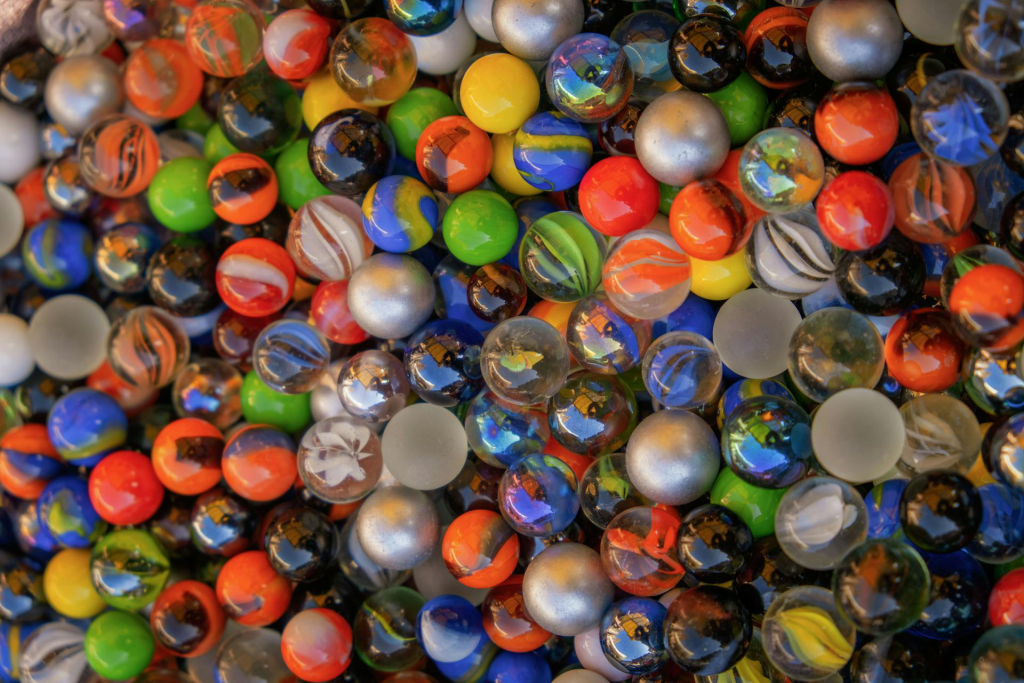
The Industrial Revolution marked a fundamental turning point in the production of everyday goods, transforming crafts that had once relied on manual skill into mechanized industries capable of mass output. Among these changes was the evolution of toy marble manufacturing in Europe. Though small and simple in form, toy marbles reflect broader industrial, social, and economic shifts that occurred from the late 18th through the 19th centuries. The Industrial Revolution reshaped how toy marbles were made, who made them, and how widely they were distributed, laying the foundation for the modern toy industry.
Toy Marble Production Before Industrialization
Before the Industrial Revolution, toy marbles were produced using traditional, labor-intensive methods. Early marbles were commonly made from clay, stone, or handmade glass. Clay marbles were molded by hand or rolled on flat surfaces and then fired in simple kilns. Stone marbles were shaped through grinding and polishing, a slow and physically demanding process.
Handmade glass marbles, which later became highly prized collectibles, were produced by skilled glassworkers. Molten glass was gathered on rods, shaped with scissors, and finished by hand, often leaving pontil marks. Production volumes were limited, and quality varied depending on the skill of the craftsman. Marbles were sold locally or regionally and were inexpensive but not universally available. For many children, marbles were treasured possessions rather than disposable toys.
Early Industrial Influences on Marble Making
As the Industrial Revolution gained momentum in the late 18th and early 19th centuries, improvements in glassmaking technology began to influence toy marble production. Advances in furnace design allowed for higher and more consistent temperatures, improving glass quality and reducing defects. Larger glassworks emerged, particularly in regions of Germany and Bohemia, where glassmaking traditions were already well established.
These developments did not immediately eliminate hand production, but they increased efficiency and output. Workshops expanded, employing more workers and producing marbles in greater quantities. Clay marble production also benefited from improved kiln technology, enabling faster firing and more consistent results.
Mechanization and Increased Output
The most significant impact of the Industrial Revolution on toy marble manufacturing was the gradual introduction of mechanization. Simple machines and tools were developed to assist with shaping and finishing marbles, reducing reliance on purely manual labor. Rolling devices helped form clay marbles more uniformly, while cutting and polishing tools improved consistency in stone and glass marbles.
Though fully automated marble machines would not appear until the early 20th century, 19th-century mechanization marked a clear shift toward standardized production. Marbles became more uniform in size and shape, making them better suited for organized games and competitive play. This standardization also helped expand markets, as retailers could sell marbles in bulk with predictable quality.
Expansion of Transportation and Trade
Industrialization dramatically improved transportation networks across Europe. Canals, railways, and improved roads allowed toy marbles to be shipped farther and more cheaply than ever before. Regions specializing in marble production, particularly in Germany, gained access to international markets.
By the mid-19th century, European toy marbles were being exported widely to Britain, France, and the United States. This expansion transformed marbles from local handmade items into global trade goods. Increased competition between producers encouraged innovation, lower prices, and greater variety in color and design.
Labor Changes and Social Impact
The Industrial Revolution also reshaped the labor structure of toy marble manufacturing. Traditional master-apprentice systems began to decline as larger workshops and factories emerged. While skilled glassworkers were still essential, many stages of production were simplified, allowing unskilled or semi-skilled workers, including women and children, to participate.
Child labor was particularly common in 19th-century glass and clay industries. Children were often employed in sorting, polishing, and packaging marbles. While this increased household incomes in industrial regions, it also raised ethical concerns that later fueled labor reforms. The marble industry thus reflected broader social tensions created by rapid industrialization.
Changes in Design and Aesthetics
Industrial production influenced not only how marbles were made but also how they looked. Increased control over glass composition and coloring allowed for more vibrant and varied designs. Swirls, ribbons, and layered colors became more common, adding visual appeal that boosted sales.
However, mechanization also reduced individuality. Handmade marbles varied subtly in shape and pattern, while industrial methods produced more uniform results. This shift foreshadowed later collector preferences, where pre-industrial handmade marbles would become highly valued for their uniqueness and craftsmanship.
Affordability and Mass Play
One of the most important consequences of industrialization was affordability. As production costs fell and output increased, marbles became widely accessible to children from all social classes. What had once been a modest luxury or treasured object became a common toy available in general stores and markets.
This accessibility helped cement marbles as one of the most popular children’s games of the 19th century. Standardized marbles encouraged shared rules and organized play, contributing to the spread of marble games across Europe and beyond. Marbles became a social connector, reflecting the democratization of leisure during the Industrial Revolution.
Environmental and Material Considerations
Industrial-scale production also brought environmental consequences. Increased demand for raw materials such as clay, sand, and fuel placed pressure on local resources. Glass furnaces consumed large quantities of coal, contributing to pollution in industrial regions. These issues were largely ignored at the time but form part of the long-term legacy of industrial toy manufacturing.
Long-Term Legacy and Transition to Modern Production
By the late 19th century, European toy marble manufacturing had been fundamentally transformed. Production was faster, more standardized, and more commercially oriented than ever before. These changes laid the groundwork for the next major shift in marble history: the rise of fully machine-made marbles in the early 20th century, particularly outside Europe.
The Industrial Revolution created the conditions that allowed toy marbles to transition from handcrafted playthings to mass-produced consumer goods. It also established Europe, especially Germany, as a dominant force in global marble markets until the disruptions of World War I.
Conclusion
The Industrial Revolution reshaped European toy marble manufacturing in profound ways. Mechanization, improved transportation, and industrial labor structures transformed marbles from locally crafted objects into widely distributed toys enjoyed by millions of children. While these changes increased accessibility and variety, they also reduced artisanal individuality and introduced social and environmental challenges. Today, the contrast between handmade and industrial-era marbles offers valuable insight into how industrialization affected even the smallest and simplest objects of everyday life.