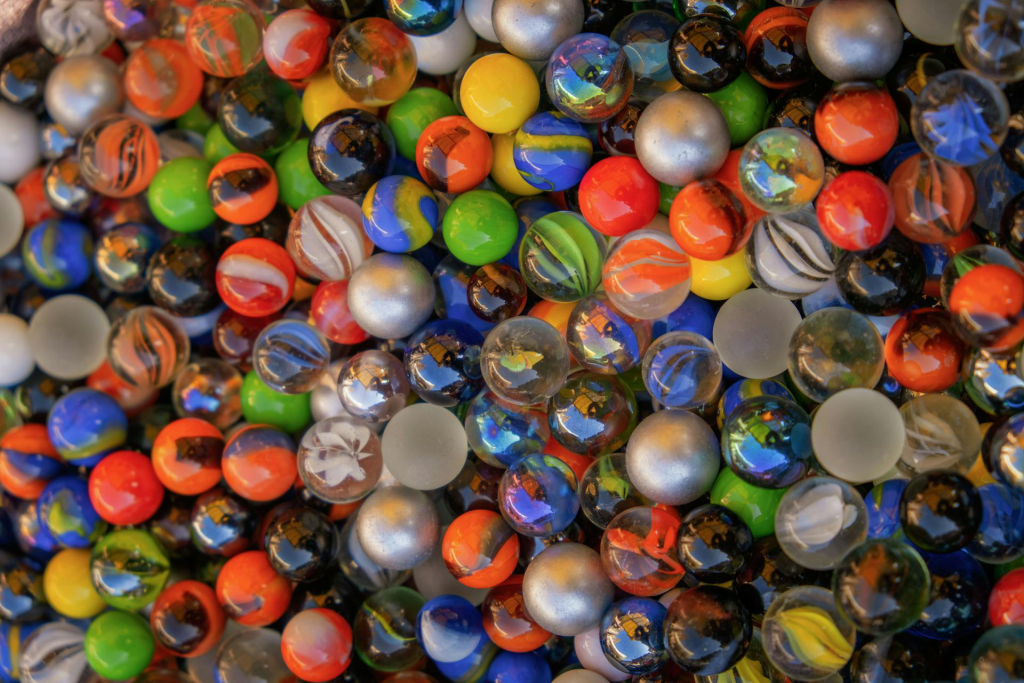

The two World Wars of the 20th century reshaped global manufacturing on an unprecedented scale, and the toy marble industry was deeply affected by these disruptions. Once a thriving sector producing glass, clay, and stone marbles for children’s games across Europe and the United States, toy marble manufacturing faced severe interruptions, material shortages, and long-term structural change as a result of global conflict. From factory shutdowns to postwar technological shifts, the World Wars marked a decisive turning point in the history of toy marbles.
Toy Marble Production Before World War I
Before World War I, toy marble production was already a well-established industry. Germany, particularly regions such as Thuringia, dominated the global market. German handmade glass marbles, including swirls, latticinos, and onionskins, were exported worldwide. Production relied heavily on skilled labor, with craftsmen using scissors and pontils to shape molten glass into individual marbles.
In addition to glass, clay and stone marbles were produced in large quantities, often using semi-mechanized processes. Marbles were inexpensive, durable, and immensely popular, making them a staple of childhood play across Europe and North America. By the early 1900s, toy marbles had become a truly international commodity.
World War I: Collapse of a Global Industry
The outbreak of World War I in 1914 caused an immediate and devastating disruption to toy marble production. German factories, which supplied the majority of the world’s handmade glass marbles, were either shut down or converted to support the war effort. Skilled glassworkers were conscripted into military service, leaving workshops without the labor needed to continue production.
International trade collapsed almost overnight. Export routes were cut off, and many countries imposed bans on imports from enemy nations. As a result, German marbles disappeared from markets in Britain, France, and the United States. Toy production, viewed as nonessential, was deprioritized in favor of military goods, fuel, and industrial materials.
This sudden vacuum in supply marked the beginning of the end for traditional handmade glass marble dominance.
Rise of Machine-Made Marbles During Wartime
While World War I devastated European production, it indirectly encouraged innovation elsewhere. In the United States, manufacturers began developing machine-made marble technology to replace lost imports. Companies such as Akro Agate, Christensen Agate, and later Peltier Glass invested in automated processes that could produce large quantities of uniform marbles quickly and cheaply.
Machine-made marbles differed significantly from handmade ones. They lacked pontil marks and displayed consistent patterns created by controlled glass streams rather than hand manipulation. Wartime necessity accelerated the adoption of these methods, permanently altering the toy marble industry.
The Interwar Period: Recovery and Transformation
The years between World War I and World War II saw partial recovery but lasting change. German marble production never fully regained its prewar dominance. Economic instability, inflation, and reduced export power limited the revival of handmade marble workshops.
Meanwhile, machine-made marbles gained popularity due to their affordability and availability. Bright colors, bold swirls, and mass-produced designs appealed to a new generation of children. Clay marbles gradually declined in popularity, while glass marbles became the dominant form.
For collectors today, this interwar period represents a critical transition phase, where handmade and machine-made marbles briefly coexisted before industrial production took over.
World War II: Near Total Disruption
World War II brought even more severe consequences for toy marble production. Glass factories across Europe were destroyed by bombing or repurposed for wartime manufacturing. Fuel shortages, rationing, and labor displacement made toy production nearly impossible.
In occupied regions, glassmaking resources were tightly controlled by governments, leaving no room for recreational goods. Even in the United States, production of nonessential consumer items was restricted. Many marble companies scaled back operations or temporarily shut down as raw materials were diverted to military use.
Children during the war years often played with older marbles, homemade substitutes, or whatever materials were available, highlighting the scarcity caused by prolonged conflict.
Postwar Boom and Industrial Consolidation
Following World War II, toy marble production rebounded rapidly, particularly in the United States. Pent-up consumer demand, population growth, and renewed economic confidence fueled a postwar toy boom. Machine-made marbles dominated the market, with companies producing millions of units annually.
Technological improvements led to faster production speeds, more complex color patterns, and greater consistency. However, this industrial efficiency came at the cost of variety. Many smaller manufacturers disappeared, and the industry consolidated around a handful of major producers.
Handmade marbles, once the pinnacle of craftsmanship, effectively vanished from commercial production, surviving only as antiques and collectibles.
Cultural Shifts and Changing Play Patterns
The World Wars also indirectly influenced how children played. Postwar decades saw increased competition from new toys, including plastic figures, board games, and later electronic entertainment. Marbles gradually declined in everyday use, becoming less central to childhood play than they had been before the wars.
Despite this decline, marbles retained cultural significance. They became symbols of simpler times and were increasingly collected rather than played with. Veterans and older generations often passed down marbles as keepsakes, further contributing to their preservation.
Long-Term Legacy for Collectors and Historians
Today, the impact of the World Wars is clearly visible in the toy marble collecting world. Pre–World War I handmade German marbles are highly prized due to their craftsmanship and historical scarcity. Machine-made marbles from early American companies are also sought after, representing the industry’s adaptive response to wartime disruption.
The wars permanently shifted toy marble production from artisanal to industrial, reshaped global supply chains, and altered consumer expectations. What began as a child’s game piece became a historical artifact shaped by global conflict and industrial change.
Conclusion
The World Wars brought profound interruption and transformation to toy marble production. From the collapse of German handmade glass industries to the rise of machine-made marbles in the United States, global conflict reshaped how marbles were made, distributed, and valued. While wartime shortages nearly ended the industry at times, postwar innovation ensured its survival in a new form. Today, toy marbles stand as small but powerful reminders of how even the simplest objects are shaped by history.