The ability to identify makers’ marks and manufacturing signatures separates casual marble enthusiasts from serious collectors and researchers. Unlike many antiques that bear stamped names or applied labels, marbles rarely carry obvious maker identification. Instead, they reveal their origins through subtle physical characteristics left by manufacturing processes—pontil marks from handmade production, seam patterns from machine manufacture, and other diagnostic features that function as fingerprints for those trained to recognize them. Mastering these identification techniques unlocks the stories embedded in every marble’s surface.
Pontil Marks: The Handmade Signature
The pontil mark represents the most definitive indicator of handmade marble production, serving as the gathering point where molten glass attached to the glassworker’s iron rod during manufacture. Understanding pontil characteristics, variations, and what they reveal about production methods forms the foundation of handmade marble identification.
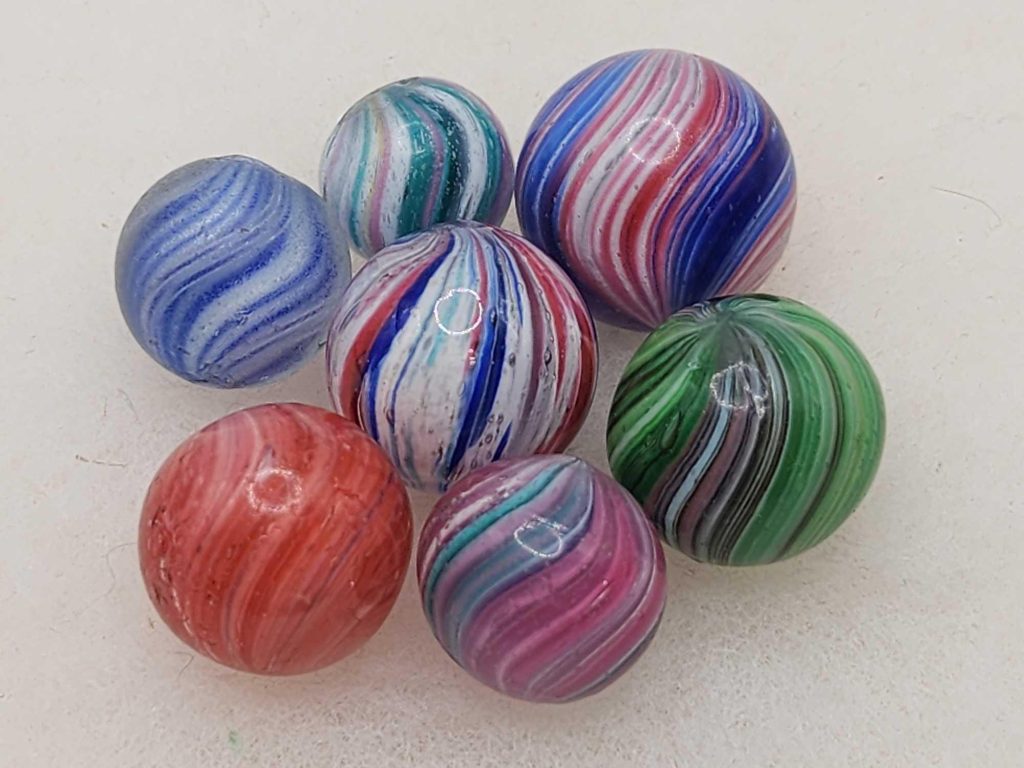
Classic pontil marks appear as rough, slightly raised areas where the marble was severed from the pontil rod after shaping. German glassworkers typically created marbles by gathering molten glass on a pontil, applying decorative elements, shaping the mass into a sphere, and finally cutting the finished marble free. This cutting process left a distinctive mark that most craftsmen minimized through cold-rolling—rotating the still-warm marble on a flat surface to smooth the rough cut area.
Well-executed pontils show as small, relatively smooth circular areas, often with subtle concentric rings visible under magnification. These rings result from the twisting motion used to separate the marble from the rod, creating spiral patterns in the glass as it pulled away. The best German craftsmen produced pontils so refined they’re nearly invisible without close examination, though they remain detectable through careful surface inspection under strong lighting.
Crude pontils display more prominent roughness, sometimes appearing as actual raised bumps or irregular surfaces. These rougher examples might indicate less-skilled craftsmen, marbles produced quickly without final smoothing, or pieces from earlier production periods when finishing techniques were less refined. Crude pontils don’t necessarily indicate lower quality in other respects—some exceptional German swirls display prominent pontils alongside masterful pattern work.
Dual pontil configurations occasionally appear on handmade marbles, with gathering marks at opposite poles of the sphere. This configuration typically indicates the marble was held at both ends during some portion of manufacture, possibly for applying decoration or for specialized shaping techniques. The relative prominence of each pontil varies, usually with one clearly more developed than the other.
Pontil color and clarity provide additional identification clues. The glass around pontil marks often shows slight color concentration or cloudiness where glass chemistry changed during reheating and cutting. Some pontils display tiny air bubbles trapped during the separation process, creating characteristic patterns that authenticate handmade origins.
Machine-Made Seams: Reading Production Methods
Machine-made marbles reveal their origins through seam patterns created where forming mechanisms met during production. Different machine types produced distinctive seam configurations, allowing experienced collectors to identify not just machine manufacture generally but often specific manufacturers or machine designs.
Single-stream machine seams appear on marbles produced by machines that formed glass from a single stream, including early M.F. Christensen and Akro Agate equipment. These seams encircle the marble’s equator where upper and lower rollers or cups met, creating a line that may be barely visible or quite prominent depending on machine adjustment and glass temperature. Well-adjusted machines produced nearly seamless marbles, while poorly adjusted equipment left raised ridges requiring inspection to detect.
The seam’s relationship to pattern helps identify manufacturers. Akro Agate corkscrews typically show seams running perpendicular to the spiral direction, while Peltier rainbows may display seams at various angles depending on how glass entered the forming mechanism. These pattern-seam relationships become diagnostic when combined with color and design characteristics.
Cut-off marks appear on some machine-made marbles as small rough spots where individual marbles were separated from the glass stream. These marks differ from seams but serve similar identification purposes, indicating specific machine types and manufacturing processes. Christensen Agate marbles sometimes display characteristic cut-off marks that help distinguish them from similar Akro production.
Dual seam patterns occasionally appear on marbles produced by machines with complex forming mechanisms. Some later machine types created intersecting seams or multiple seam lines, producing patterns that identify specific manufacturers or production periods when examined alongside other characteristics.
Color Distribution and Flow Patterns
Beyond pontils and seams, the way colors distribute throughout marbles reveals manufacturing signatures that aid identification. These patterns result from how glass was gathered, manipulated, and formed, creating manufacturer-specific characteristics.
Cane-cut patterns in machine-made marbles show how colored glass canes were cut and fed into forming machines. The angle at which canes entered, the rotation of forming rollers, and the temperature of glass all influenced final pattern appearance. Akro Agate’s corkscrew patterns show distinctive spiral characteristics that differ from Peltier’s ribbon patterns, even when superficially similar color combinations appear.
End distribution in handmade marbles—how patterns appear at the pontil areas versus the marble’s equator—provides clues about construction techniques. Divided core swirls show characteristic patterns where colored glass cores twist through clear outer layers, with specific arrangements indicating German versus American handmade production or identifying particular glassworking traditions.
Color layering reveals construction sequences in both handmade and machine-made marbles. Understanding whether white appears over or under colored glass, how transparent and opaque glasses combine, and the sequence of color application helps identify manufacturers who consistently employed specific layering approaches.
Surface Texture and Finish
Manufacturing processes left distinctive surface characteristics that assist identification beyond obvious pontils and seams. These subtle texture differences require hands-on experience to recognize but provide valuable authentication tools.
Cold-rolled surfaces on handmade marbles show slightly different texture than machine-polished surfaces, exhibiting organic irregularity from hand manipulation. The surface may display minute variations in smoothness, with some areas slightly more polished than others depending on how the craftsman rolled the marble during finishing.
Fire polish from machine production creates characteristically smooth surfaces with particular light-reflecting properties. Machine-made marbles often show more uniform surface polish than handmade examples, though both can achieve high degrees of smoothness through different means.
Tool marks occasionally appear on handmade marbles, particularly around pontil areas, showing where implements touched glass during manufacture. These marks appear as tiny scratches, indentations, or surface irregularities that authenticate handmade origins when examined under magnification.
Size Consistency and Tolerances
Manufacturing methods influenced size consistency in ways that help identify origins. These dimensional characteristics become apparent when examining multiple marbles from the same source.
Handmade size variation appears even within single production batches, as individual craftsmen couldn’t achieve mechanical precision. A group of German handmade marbles might vary by 1/16 inch or more despite attempts at consistent sizing, reflecting human limitations in judging dimensions while working molten glass.
Machine-made uniformity produces remarkably consistent diameters within production runs, with variations measured in thousandths of inches rather than the larger tolerances handwork accepted. This precision helps distinguish machine from handmade production when examining groups of similar marbles.
Manufacturer-specific sizing provides identification clues, as different companies favored particular diameter ranges. Knowing that Christensen Agate rarely produced marbles over 3/4 inch or that certain Akro types typically measure 5/8 inch helps authenticate examples and identify questionable pieces.
Internal Characteristics
Features inside marbles, visible through transparent or translucent glass, offer additional manufacturing signatures that resist later alteration or fakery.
Bubble patterns reflect manufacturing conditions and processes. Handmade marbles often show elongated bubbles aligned with glass gathering and manipulation directions, while machine-made marbles may display different bubble characteristics resulting from mechanical forming. The size, shape, distribution, and orientation of internal bubbles all provide identification information.
Annealing stress patterns visible under polarized light reveal thermal history and manufacturing processes. Different cooling rates and techniques created distinctive stress patterns that help authenticate age and identify manufacturers who employed specific annealing protocols.
Inclusion distribution of aventurine particles, mica flakes, or other additives follows patterns determined by manufacturing methods. The way these materials dispersed through glass during forming creates signatures specific to particular makers or production techniques.
Practical Application and Expertise Development
Learning to read manufacturing signatures requires systematic study and extensive hands-on examination of authenticated examples. Collectors should:
Build reference collections of verified examples from known makers, creating personal standards for comparison when evaluating unknown marbles. Even small collections of authenticated pieces provide invaluable references.
Use magnification systematically, examining every marble under at least 10x magnification to reveal details invisible to naked eyes. Loupe examination should become standard practice rather than reserved for questionable pieces.
Document observations through detailed photography and written descriptions, building personal databases of manufacturing characteristics. Over time, these records reveal patterns and relationships that enhance identification skills.
Study production history and techniques, understanding not just what manufacturing marks look like but why they appear. Knowledge of historical glassworking methods and machine designs provides context that elevates identification from pattern recognition to genuine understanding.
Handle marbles extensively, developing tactile familiarity with different weights, surface textures, and physical characteristics. The combination of visual and tactile information creates stronger identification capabilities than either sense alone.
Mastering makers’ marks and manufacturing signatures transforms marble collecting from passive acquisition into active detective work. Each pontil mark, seam line, and surface characteristic tells part of a marble’s creation story, revealing the hands and machines that shaped it. This knowledge deepens appreciation while providing practical tools for building authentic, well-documented collections that preserve these miniature masterpieces for future generations.