
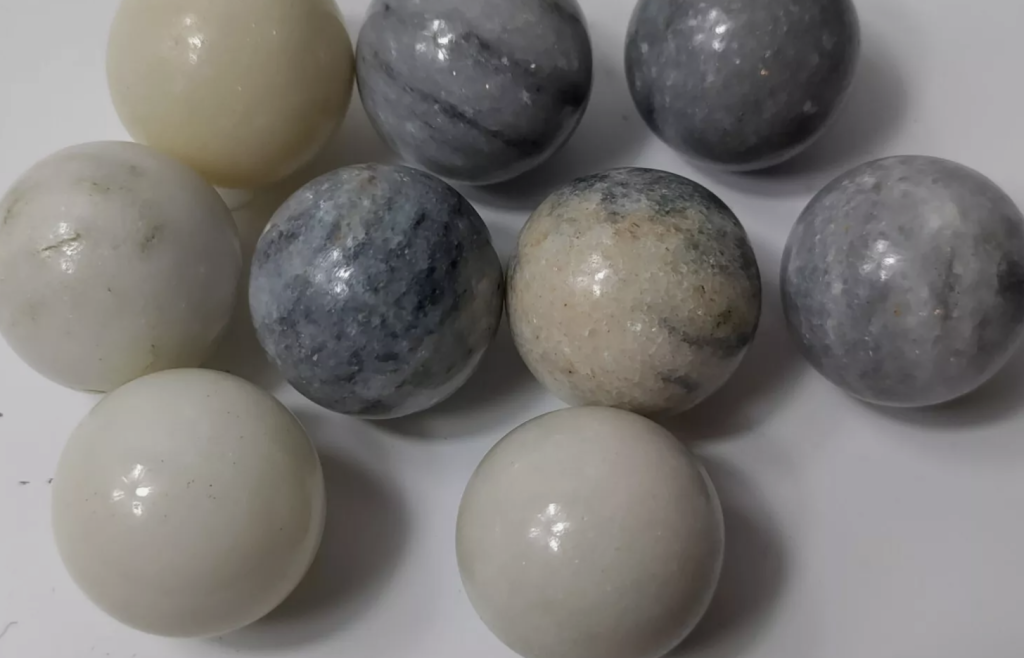
Before the age of swirling glass and machine perfection, the marble world was ruled by stone — and nowhere was this art form more refined than in Germany’s Thuringia region. From the mid-18th to late-19th centuries, German artisans crafted some of the most exquisite polished stone marbles ever made, combining geological beauty with precision craftsmanship.
Today, these early German marbles are highly sought after by collectors not only for their beauty but for their historical importance. Each stone sphere tells a story of a bygone era when marbles were hand-cut, hand-polished, and admired as miniature works of art.
The Birthplace of the Stone Marble
The small villages around Lauscha and Idar-Oberstein in Germany were renowned centers of stone cutting and gem polishing long before glass marble production began. By the 1700s, German lapidaries were already fashioning agate, jasper, onyx, and marble (the stone, not the toy) into spheres for decoration and play.
As Germany’s trade expanded across Europe and to America, these polished stone marbles became luxury exports. Wealthy families collected them as curiosities, while children in well-to-do households sometimes played with smaller examples. Each sphere was laboriously shaped from raw stone using foot-powered lathes and polished to a glass-like shine — a testament to the precision of early craftsmanship.
What Are German Polished Stone Marbles?
Unlike glass marbles, which rely on molten artistry, stone marbles are carved directly from natural rock. The Germans sourced beautiful materials from local quarries and imported exotic stones through trade routes. Popular varieties include:
- Agate: translucent, banded layers in browns, greys, reds, and creams.
- Jasper: opaque, rich reds and yellows, sometimes spotted or streaked.
- Onyx: dark with white bands, creating striking contrasts.
- Limestone and Marble (calcite): softer stones polished into creamy or veined finishes.
- Chalcedony: semi-transparent with subtle inner cloudiness.
Each material gave the marble a distinct identity — and a weight and feel unmatched by glass.
The Making Process
Creating one stone marble could take hours. Craftsmen first cut cubes of raw stone using wire saws, then ground them into rough spheres using rotating stone plates and grit. The marbles were polished with fine abrasives, sometimes finishing with tin oxide for an extra sheen.
The result was a perfectly smooth, dense marble with natural banding and subtle luster. Because no two pieces of stone were alike, each marble was inherently unique — a one-of-a-kind fusion of geology and artistry.
Identifying Authentic Early German Stone Marbles
Recognizing genuine 18th- or 19th-century German polished stone marbles requires a trained eye. Here are the most reliable indicators:
1. Size and Shape
Most early German stone marbles range from ½ inch to 1¼ inches (12–30 mm), though larger display pieces exist. Slight imperfections in roundness are common — these were handmade, not machine-ground to modern tolerances.
2. Surface Finish
Authentic pieces have a soft, glassy polish that’s smooth but not overly glossy. Over centuries, many develop a fine patina or micro-scratches from handling — evidence of genuine age.
3. Weight and Temperature
Stone marbles are heavier and colder to the touch than glass. Agate and jasper examples especially feel dense and cool when held.
4. Banding and Natural Variation
One hallmark of German workmanship is the careful selection of stone with beautiful natural banding or veining. In agate examples, the bands often spiral or curve gracefully — far more organic than modern synthetic stone.
5. Tool Marks
Occasional faint lines or flattened points (where the marble was mounted during polishing) may be visible under magnification. These are signs of authentic hand production.
Telling German Stone Apart from Later or Imitation Pieces
The early 1900s saw reproductions from Italy, India, and modern lapidary shops. To distinguish true early German examples:
| Feature | Early German | Modern or Reproduction |
|---|---|---|
| Stone Quality | Fine, uniform, often translucent | Coarser or dyed stones |
| Polish | Deep natural sheen, not mirror-bright | High gloss from modern buffing |
| Shape | Slightly imperfect spheres | Perfectly round |
| Wear | Minor age marks, softened edges | None or artificial distressing |
| Provenance | Often from antique toy or curio collections | Sold as “new decorative spheres” |
Modern lapidary marbles tend to be too perfect — flawless polish, intense colour, and exact symmetry. Genuine antiques carry the quiet irregularities of handwork.
Common Stone Types and Their Signatures
| Stone Type | Typical Appearance | Collector Notes |
|---|---|---|
| Agate | Banded layers, translucent edges | Most prized; German origin often identifiable by subtle grey or brown tones. |
| Jasper | Solid red, yellow, or brown | Slight mottling or “bloodstone” flecks add value. |
| Onyx | Black base with white bands | Contrast is natural, not painted; early examples scarce. |
| Marble (Calcite) | Creamy or veined; soft shine | Softer, so older examples may show wear. |
| Chalcedony | Milky, cloudy translucence | Often confused with glass; look for grain and weight differences. |
Why They’re So Collectible
Early German stone marbles represent the first European marble industry, predating machine-made glass by nearly a century. Their appeal lies in both their tactile beauty and historical significance:
- They connect the worlds of gemstone cutting and toy making.
- Each piece is unique — nature’s artistry guided by human skill.
- They’re durable, timeless, and display beautifully under natural light.
Collectors often describe holding one as “touching history” — a feeling of craftsmanship that can’t be replicated in mass production.
Caring for Polished Stone Marbles
Because stone is naturally porous and varied in hardness, care is important:
- Avoid harsh cleaning agents. Use only a soft cloth and mild soapy water.
- Keep them dry. Prolonged moisture can dull the polish or damage softer stones.
- Display thoughtfully. Avoid direct sunlight for long periods, which can fade certain minerals.
- Store separately. Harder stones (like agate) can scratch softer ones if stored together.
If your marble develops a hazy surface over time, a gentle buff with a microfiber cloth can restore its sheen.
Where to Find Them Today
Authentic early German stone marbles turn up in several places:
- Antique toy auctions and online platforms occasionally list them (often mislabelled as “agate balls”).
- Old European estate sales sometimes include them mixed with glass marbles or mineral specimens.
- Gem shows may carry them among old lapidary items — though caution is needed to avoid modern reproductions.
Look for examples that come from pre-1900 collections or have visible signs of wear consistent with age.
The Collector’s Perspective
While not as vividly coloured as glass marbles, early German polished stone marbles have an elegance all their own. Each one feels like a relic of precision and patience — a balance between natural geology and human touch.
Collectors value them not only for rarity but also as foundational pieces — the stones that paved the way for the marble industry we know today. Owning one is like owning the origin story of the hobby itself.
Final Thoughts
In the world of marbles, few items embody heritage as purely as the German polished stone marble. Born from the earth, refined by hand, and cherished for centuries, these spheres bridge the gap between geology, art, and play.
Learning to identify them isn’t just a technical skill — it’s an act of rediscovery. Each authentic piece offers a window into Europe’s earliest craftsmanship, where artisans transformed raw stone into timeless beauty.
So next time you handle an old marble that feels unusually heavy, cool, and perfectly calm in your palm — look closer. You might just be holding a polished treasure from the workshops of 19th-century Germany.