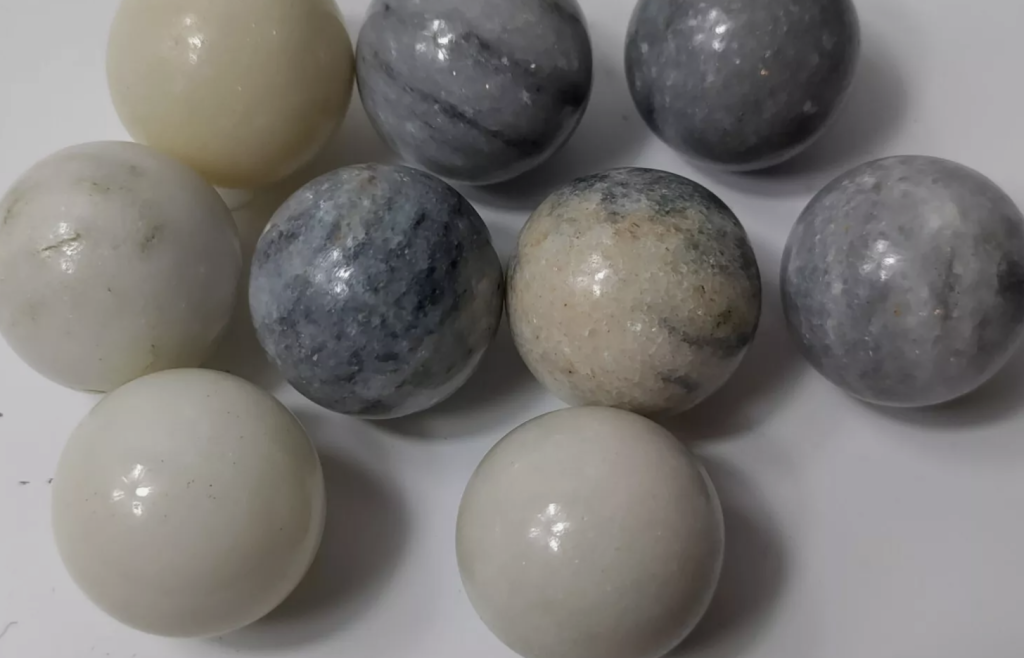

When marble collectors talk about “the beginning,” they’re often referring to one particular place and time: Lauscha, Germany, in the mid-19th century. It was there, in the glassblowing workshops of Thuringia, that the first true handmade glass marbles were created — and it all began with an ingenious tool known as the Grenier scissors.
These early marbles are the ancestors of every glass marble made thereafter. Each one carries the marks of human craftsmanship — tiny imperfections, unique colours, and evidence of the cutting technique that changed toy-making forever. For collectors, identifying these first-generation German handmade marbles is both a challenge and a thrill, akin to finding the missing link between glass art and play.
The Birth of Handmade Glass Marbles
Before the 1840s, marbles in Europe were primarily made of clay, stone, or polished agate. Glass marbles existed only as by-products — decorative or accidental blobs from lampwork studios.
That changed with the invention of Grenier scissors, a glass-cutting tool that allowed hot glass rods to be neatly snipped into small, consistent spheres. The tool is said to have been introduced by a Lauscha glassblower named Elias Greiner Vetters Sohn, whose family pioneered both marble and doll-eye production in the Thuringia region.
Using the Grenier scissors, artisans could cut molten glass tubes or rods into small balls, which were then rolled on an iron plate (the “marble table”) to round and smooth them. The technique produced far more consistent marbles than earlier hand-pulled blobs — and in doing so, it launched Germany into global dominance as the centre of marble-making.
Understanding the Grenier Scissors Technique
To appreciate what makes these early marbles distinctive, it helps to understand how they were made.
- Molten glass was gathered on a rod and shaped into a long cylinder or cane.
- Grenier scissors, resembling large shears with cup-shaped ends, were used to pinch and cut small portions from the hot glass.
- Each freshly cut piece was rolled on a metal or graphite plate, rounding it as it cooled.
- The resulting marble had a distinctive cut mark or pontil at one or both ends — a telltale sign of handmade production.
Unlike later machine-made marbles, no two were identical. The slight asymmetry, bubbles, and tool marks left behind by the scissors became their unmistakable signature.
Visual Clues: How to Identify Early Grenier-Scissor Marbles
For collectors, spotting one of these first-generation handmade marbles is all about subtle details. Here’s what to look for:
1. Pontil Marks
Every handmade marble has them.
Grenier-scissor marbles typically show two opposite pontils, where the glass was cut and rolled. These marks can appear as tiny rough spots, flattened circles, or slightly raised points. Over time, wear often softens their edges.
Machine-made marbles, by contrast, are seamless — the absence of pontils is a clear giveaway that a marble is later.
2. Shape and Symmetry
Early German handmade marbles are rarely perfect spheres. Because they were hand-rolled, expect minor irregularities in roundness. Viewed closely, they may appear slightly egg-shaped or uneven when rotated under light.
These imperfections, however, are part of their charm — visible proof of human touch.
3. Colour and Glass Quality
The earliest marbles were made from leftover glass used for doll eyes and ornaments. As such, their colours were often muted: whites, ambers, pale blues, greens, or transparent glass with subtle ribbons.
Look for:
- Opaque core with translucent outer layer
- Single or double ribbon swirls
- Subtle internal bubbles
- Delicate filigree or “latticinio” cores in more advanced examples
Later production (post-1870s) introduced brighter colours and more complex internal designs.
4. Surface Texture
Handmade marbles tend to have a slightly uneven surface under magnification, showing micro ripples or tool marks. Machine-made ones are uniformly smooth.
You might also see faint streaks where the hot glass was drawn — another indicator of early production.
Types of Early Handmade German Marbles
Within this category, collectors recognize several subtypes from the Grenier-scissor era:
- Single Ribbon Swirls: A coloured ribbon spiralling within clear glass — among the earliest recognizable patterns.
- Opaque White Marbles: Used in doll-eye manufacturing, sometimes mistaken for ceramic.
- Latticinio Core Marbles: Featuring a delicate white or coloured twisted core; likely made by more experienced artisans in later decades.
- Solid Core Swirls: Dense colour core encased in clear glass; a transition design between early and mid-period German production.
Each reflects the evolution of skill and experimentation during Germany’s handmade marble boom (roughly 1840–1910).
Distinguishing Early Handmade from Later Handmade
Because handmade marbles continued to be produced in Germany well into the 20th century, telling apart the earliest examples requires attention to detail.
| Feature | Early Grenier Type (1840–1870) | Later Handmade (1880–1910) |
|---|---|---|
| Glass Clarity | Very strong distinct colours with bubbles or streaks | Usually clearer, more refined glass |
| Colours | Muted, earthier tones | Brighter reds, yellows, blues |
| Pontils | Ground smooth is what is usually found. | Prominent, rough, opposite ends |
| Shape | Irregular, hand-rounded | More symmetrical |
| Patterns | Less complex but when viewed from above you can sometimes see into them. | Complex multicolour swirls and patterns. |
Early marbles have a humble, handmade feel — almost primitive compared to later decorative pieces.
How to Verify Authenticity
As interest in antique marbles grows, reproductions have entered the market. Here’s how to ensure you’re looking at a genuine 19th-century Grenier-scissor piece:
- Look for age wear: True antiques show small surface scratches, faded lustre, and smoothed pontils.
- Use magnification: Under a loupe, genuine pontil scars show age-darkened edges; modern reproductions appear clean and sharp.
- Check material: Authentic marbles are soda-lime glass, not borosilicate or modern coloured art glass.
- Assess pattern simplicity: Early examples are restrained — complex rainbow swirls generally point to later production.
- Provenance: Seek marbles from European collections or estate lots rather than modern glass studios.
Collector Tips: Where to Find Early German Handmades
- Old toy lots from the UK and Europe occasionally include them, mixed with later machine-made examples.
- Estate auctions sometimes sell them under generic terms like “antique glass balls.”
- Marble collector fairs and forums are excellent sources for verified examples.
- Look for wear and story: Marbles found in wooden chests or sewn pouches are more likely genuine than pristine, isolated specimens.
Patience and practice are key — genuine Grenier-scissor marbles are uncommon, but unmistakable once you’ve held one.
Why They Matter
These early handmade marbles are more than just toys; they’re artefacts of ingenuity. They mark the moment when glass artistry met childhood play, and the German workshops of Thuringia became the cradle of a global industry.
Each marble represents hours of human skill, the heat of the furnace, and the first experimentations that would lead to every glass marble made since. They’re the ancestors — the Adam and Eve of marble collecting.
Caring for Early Handmade Marbles
- Clean only with mild soap and lukewarm water — avoid ultrasonic cleaners.
- Display in padded trays to prevent rolling and impact.
- Keep away from direct sunlight, as early glass can fade slightly over time.
- Never polish or buff the surface — the aged patina is part of the marble’s story.
Final Thoughts
To hold one of the first German handmade marbles is to hold history itself. The faint pontil scars, muted colours, and irregular form are not flaws — they’re fingerprints of a vanished craft.
Thanks to the invention of the Grenier scissors, a simple but revolutionary tool, these artisans transformed molten glass into enduring beauty. Today, identifying one of their creations is both a study in technique and a tribute to the roots of the hobby we love.
Somewhere in a jar or drawer, one of these early marbles may still rest — heavy with time, faintly imperfect, and utterly priceless to those who know what they’re looking at