
Master Marble Company represents an important but sometimes overlooked American marble manufacturer operating primarily from the 1930s through 1970s. While less consistently documented than giants like Akro Agate or Christensen Agate, Master Marble produced distinctive types including Sunbursts, Clambroths, and various transitional pieces that hold legitimate collecting interest. This comprehensive guide explores Master Marble identification, major types, values, and collecting strategies.
What Is Master Marble Company History?
Master Marble Company began operations around 1930 in Clarksburg, West Virginia, joining the cluster of marble manufacturers in that region. The company’s early history is less comprehensively documented than some contemporaries, creating some uncertainty about exact dates and production details.
The company operated through multiple decades with varying production emphases across different periods. Early Master Marble focused on traditional patterned machine-made marbles competing with established manufacturers. Later production shifted toward simpler types and eventually cat’s eyes as the marble market evolved.
Ownership and management changes occurred during Master Marble’s operational life, potentially contributing to documentation gaps and production variations. These transitions created some inconsistency in product lines and quality across different eras.
The company’s location in Clarksburg placed them in America’s marble manufacturing heartland alongside Akro Agate and other major producers. This geographic concentration created both competitive pressures and shared labor pools skilled in marble manufacturing.
Master Marble’s closure timing remains somewhat unclear, with sources suggesting operations ceased in the 1970s. Unlike dramatic closures following specific events, Master Marble appears to have gradually wound down as marble manufacturing became economically unviable.
The relative documentation gaps for Master Marble create both challenges and opportunities for collectors. Identification can be trickier than better-documented manufacturers, but this also means the collecting community continues discovering and documenting Master Marble variations.
What Are Master Marble’s Most Recognizable Types?
Several distinctive Master Marble patterns create collector interest and allow identification.
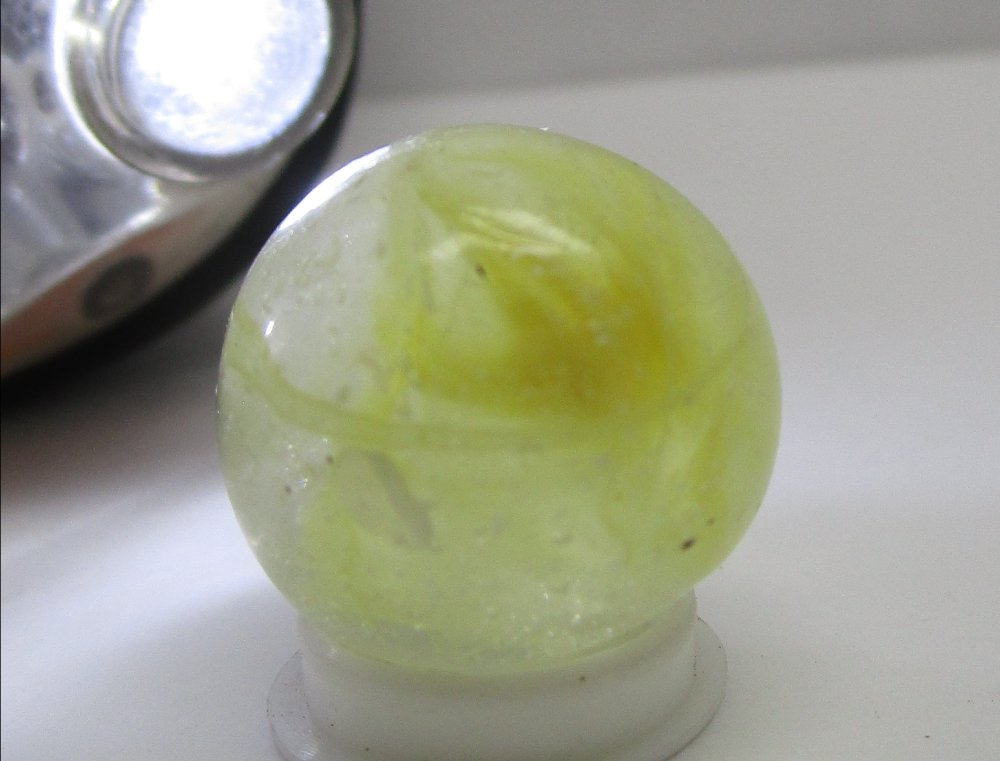
Sunburst marbles feature bright colors radiating from a central point creating dramatic sun-like patterns. These distinctive pieces show transparent or translucent colored glass in bold designs unmistakable once you’ve seen examples. The radiating pattern creates visual impact that makes Sunbursts popular with collectors.
Common Sunburst colors include yellows, oranges, and reds creating warm, fiery appearances. Blue and green Sunbursts exist but appear less frequently. Rare color combinations command premiums over standard variations.
Standard Sunbursts in common colors sell for $8-25 typically, while unusual colors or larger sizes bring $25-75. Exceptional examples occasionally exceed $100 when combining rare colors, large size, and superior condition.
Clambroth marbles feature white or cream-colored opaque glass sometimes showing slight translucency creating appearances supposedly resembling clam broth, hence the name. While the name’s origin is debated, the term describes these distinctive white or cream marbles.
Clambroths come in various whites from pure bright white to cream or slightly grayish whites. Some show faint color tints or aventurine sparkles adding interest. The best Clambroths have clean, bright colors with good translucency.
Common Clambroths sell for $3-12, while those with unusual characteristics like aventurine or interesting tints bring $12-40. Large Clambroths approaching one inch can reach $50-100.
Transitional marbles showing characteristics of changing production techniques or color experiments appear in Master Marble output. These pieces might combine pattern elements of different standard types or show unusual color combinations suggesting experimentation or production changes.
How Can I Identify Master Marble Pieces?
Identifying Master Marble requires understanding their construction characteristics and pattern recognition.
All Master Marble products are machine-made showing paired cutoff marks on opposite sides rather than pontil marks. The cutoff marks typically appear as small raised points similar to other American machine-made marbles.
Glass quality in Master Marble pieces varies somewhat across production periods. Early production generally shows good quality with clear transparent areas and solid opacity in opaque sections. Later production sometimes shows less consistent quality.
Pattern recognition becomes primary identification method for Master Marble. Once you’ve seen authenticated Sunbursts or Clambroths, recognizing similar pieces becomes easier. The distinctive radiating Sunburst pattern particularly aids identification.
Size ranges help narrow possibilities. Most Master Marble production falls in standard sizes around 0.625 inches, similar to other American manufacturers. Larger examples exist but are less common.
Compare suspected Master Marble pieces to authenticated examples in reference books or trusted collections. Side-by-side visual comparison helps confirm or disprove tentative identifications when characteristics match known Master Marble production.
What Challenges Exist in Master Marble Collecting?
Master Marble collecting presents specific challenges worth understanding.
Documentation gaps mean less definitive identification information exists compared to Akro Agate or Christensen Agate. Some pieces attributed to Master Marble might have uncertain provenance, with attributions based on stylistic similarities rather than documented proof.
The variety across production periods creates inconsistency in Master Marble characteristics. Early pieces might differ substantially from later production, making blanket identification rules difficult.
Distinguishing Master Marble from similar types by other manufacturers can be challenging. Some Master Marble pieces closely resemble competitors’ products, requiring careful examination and comparison for confident attribution.
Market recognition varies, with some collectors specifically pursuing Master Marble while others include them incidentally in broader collections. This uneven recognition affects both availability and pricing.
Reference material limitations mean fewer comprehensive Master Marble guides exist compared to major manufacturers. Collectors often rely on community knowledge and accumulated experience rather than definitive published references.
What Are Current Master Marble Values?
Master Marble pricing reflects their mid-tier status in machine-made marble collecting.
Common Master Marble types including standard Sunbursts and Clambroths sell for $3-25, representing affordable collectibles without premium pricing. These pieces work well for building variety without significant budget requirements.
Better examples with unusual colors, larger sizes, or superior condition reach $25-100. These mid-range pieces provide collecting challenge without the expense of premium manufacturers’ rare types.
Exceptional Master Marble pieces combining rare characteristics occasionally exceed $100-200, though such prices are uncommon. The upper value limits for Master Marble remain below Akro Agate or Christensen Agate premium pieces.
The market for Master Marble shows stability without dramatic appreciation. Pieces purchased for $15 twenty years ago might sell for $20-30 today—modest growth but not significant investment appreciation.
Collecting value comes more from completion satisfaction and variety than investment potential. Master Marble suits collectors seeking affordable mid-range pieces filling out comprehensive American manufacturer collections.
Where Can I Find Master Marble Pieces?
Master Marble marbles appear regularly through various collecting channels.
Online marketplaces including eBay list Master Marble pieces continuously, from individual marbles to mixed lots. Pricing varies based on seller knowledge, with informed sellers pricing appropriately and general sellers sometimes under or overpricing.
Marble shows feature dealers with Master Marble inventory, though typically as portions of broader offerings rather than Master Marble specialization. Shows allow in-person examination valuable for confirming identifications.
Antique malls and estate sales occasionally yield Master Marble discoveries. General antique dealers might not recognize Master Marble pieces specifically, pricing them simply as “old marbles” potentially below collector market values.
Specialized marble dealers maintain Master Marble selections alongside other manufacturers. While inventory might be smaller than Akro Agate or Christensen selections, quality dealers stock representative Master Marble examples.
Trading with other collectors provides Master Marble acquisition opportunities. Many collectors have duplicates or pieces not fitting their focus available for trading with fellow enthusiasts.
How Should I Start a Master Marble Collection?
Building Master Marble collections rewards focused, patient approaches.
Begin with recognized types like Sunbursts and Clambroths to learn Master Marble characteristics. Purchasing several examples of each major type provides foundation knowledge supporting identification of variations and unusual pieces.
Study reference materials showing authenticated Master Marble examples. While less comprehensive than guides for major manufacturers, available resources combined with online collector discussions provide adequate learning support.
Connect with collectors focusing on Master Marble or broader American machine-made collecting. These relationships provide identification help and trading opportunities specific to Master Marble interests.
Develop color variety within recognized types before pursuing rare variations. Comprehensive Sunburst color coverage provides achievable goals while building pattern recognition skills.
Budget appropriately recognizing Master Marble won’t require Lutz-level pricing. Collections of 20-30 quality pieces can be assembled for $200-500, making Master Marble accessible for modest budgets.
Consider Master Marble as part of broader American manufacturer collections rather than sole focus. Many collectors include Master Marble alongside Akro Agate, Peltier, and other makers creating comprehensive overviews of American production.
What Makes Master Marble Worth Collecting?
Despite documentation challenges and mid-tier pricing, Master Marble offers legitimate collecting appeal.
The distinctive Sunburst pattern creates visual interest unmatched by most machine-made types. These dramatic pieces provide eye-catching displays showcasing American marble creativity.
Relative affordability makes Master Marble accessible to collectors at various budget levels. Building representative collections doesn’t require premium prices, allowing completion satisfaction without extensive investment.
The ongoing documentation and discovery process means collectors can contribute to community knowledge. Finding and sharing unusual Master Marble variations helps develop collective understanding of this manufacturer.
Historical significance as part of American marble manufacturing heritage gives Master Marble legitimate cultural value. These pieces represent authentic American industrial production from mid-20th century.
Nostalgia connects some collectors to childhood memories of Master Marble pieces. Personal history with specific types creates emotional collecting motivations beyond pure investment considerations.
How Does Master Marble Compare to Contemporaries?
Understanding Master Marble’s market position relative to other manufacturers provides context.
Compared to Akro Agate, Master Marble generally shows less market recognition and somewhat lower values. Akro Agate’s extensive documentation and larger collector base creates more robust markets. However, this also means Master Marble might offer better value opportunities for similar quality.
Versus Christensen Agate, Master Marble operates in lower value tiers. Christensen’s brief production period and innovative patterns command premium prices that Master Marble pieces rarely approach. The gap reflects both scarcity and market maturity differences.
Relative to Peltier Glass, Master Marble shows comparable market positions with similar value ranges and collector recognition levels. Both manufacturers produce collectible pieces without commanding premium pricing of top-tier makers.
The comparisons suggest Master Marble occupies a solid mid-tier position in American machine-made marble collecting. Not premium manufacturers but legitimate collectibles with devoted followings and fair market valuations.
What Future Does Master Marble Collecting Have?
Master Marble’s collecting prospects depend on broader American machine-made marble market trends.
Ongoing documentation efforts should improve identification confidence and market understanding. As collectors share knowledge and examples, the Master Marble literature base will expand supporting collecting growth.
Nostalgia markets may support stable demand as collectors who played with Master Marble pieces in childhood maintain interest. This generational connection provides baseline market support.
Investment appreciation prospects remain modest. Master Marble pieces should maintain values and possibly show gradual appreciation but dramatic value growth seems unlikely given production quantities and current market positioning.
New collector entry could increase or decrease Master Marble interest depending on generational preferences. Whether younger collectors develop affinities for mid-century machine-made marbles remains uncertain.
Master Marble Company represents an important chapter in American marble manufacturing history, producing distinctive types that continue attracting collector interest decades after production ceased. While not commanding premium prices or enjoying comprehensive documentation, Master Marble pieces offer affordable, attractive collecting opportunities for enthusiasts appreciating American industrial heritage.

Shopping Basket