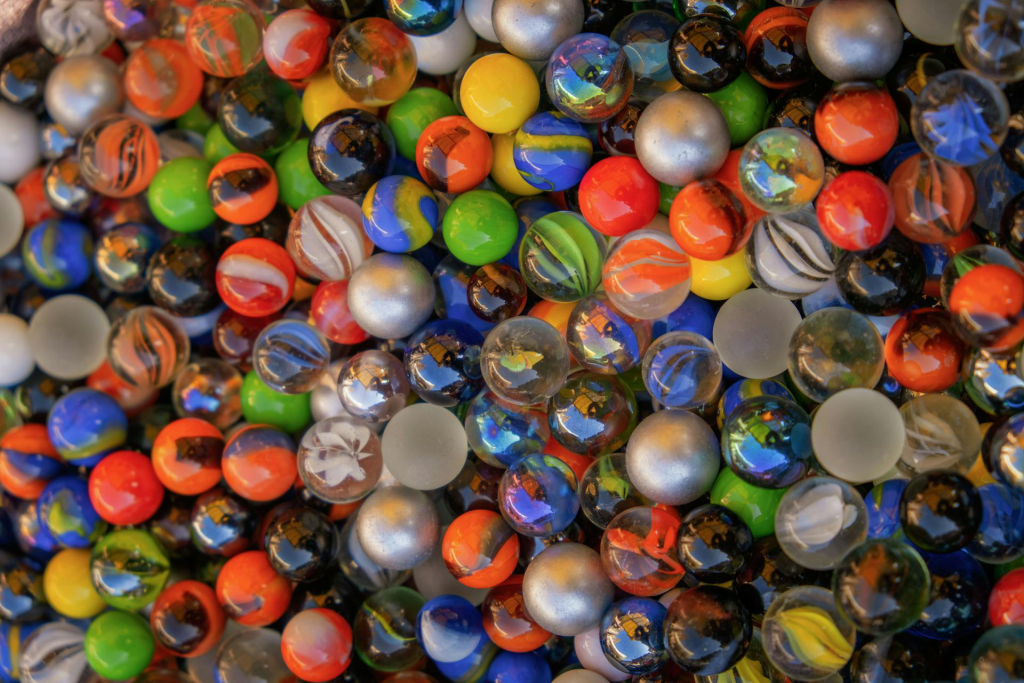
Vintage marbles weren’t simply collectibles—they were toys designed for active play through dozens of traditional games with specific rules, strategies, and social dynamics. Understanding how marbles were historically used adds context to collecting and connects today’s enthusiasts to generations of children who valued marbles as gaming equipment rather than display pieces. This comprehensive guide explores marble game history, classic games and their rules, tournament play, and how gaming heritage influences modern collecting.
When Did Marble Games Become Popular?
Marble gaming traditions extend back centuries, with children playing marble games in various forms since at least the Roman era. However, the golden age of marble play in America occurred from roughly 1870 through 1950, spanning the periods of peak German handmade and American machine-made production.
The late 1800s saw marble playing reach cultural prominence as German handmade imports flooded American markets. Quality marbles became affordable enough that most children could own collections, while expensive enough that winning and losing marbles through games carried real stakes. This combination created the social dynamics that made marble games central to American childhood.
School yards, vacant lots, and neighborhood streets served as marble gaming venues. Children drew circles in dirt, established tournament rules, and competed seriously for marble collections. The activity provided entertainment before television, video games, or organized youth sports dominated children’s time.
Marble playing declined after World War II as American culture changed. Television offered indoor entertainment, families moved to suburbs with paved yards less suitable for dirt circle games, and organized sports increasingly structured children’s play. By the 1960s, marble gaming had largely transitioned from active play to nostalgic collecting.
Some communities maintained marble playing traditions longer than others. Certain regions, particularly in the Midwest and Mid-Atlantic, sustained marble game cultures into the 1970s and occasionally beyond. These local traditions preserved gaming knowledge that might otherwise have been lost.
Today marble games survive primarily through organized vintage game events at marble shows, historical reenactments, and occasional school programs teaching traditional games. While no longer widespread childhood activities, the games remain playable and enjoyable for those interested in historical recreation.
What Was the Most Common Marble Game?
Ringer dominated American marble gaming, eventually becoming the standardized tournament game with official rules published by marble manufacturers and game organizations.
Ringer uses a ten-foot diameter circle drawn on smooth dirt or similar playing surface. Thirteen target marbles are arranged in a cross pattern at the circle’s center, with one marble at the exact center and three marbles extending in each cardinal direction.
Players take turns shooting from outside the circle, attempting to knock target marbles out while keeping their shooter marble inside the circle. Successfully knocking marbles out while keeping the shooter in-bounds allows continued shooting. Knocking marbles out while the shooter also exits, or failing to knock any marbles out, ends that turn.
The game continues until all thirteen target marbles are knocked out. The player who knocked out the most marbles wins. In “playing for keeps” variations, winners kept the marbles they knocked out, creating real stakes that made games exciting and sometimes contentious.
Ringer requires skill combining aim, power control, and strategic marble placement. Expert players developed techniques for specific shots, learned circle reading to predict marble behavior, and practiced extensively to dominate neighborhood competitions.
Official Ringer championships occurred in many communities during the 1920s-1940s, with local winners sometimes advancing to regional or even national competitions. Marble manufacturers including Akro Agate sponsored tournaments, providing trophies and publicity that promoted both the game and their products.
The standardization of Ringer rules allowed competition across communities and regions. While dozens of local marble game variations existed, Ringer’s official status made it the closest thing to a universal American marble game.
What Other Classic Marble Games Were Popular?
Beyond Ringer, numerous traditional games provided variety in marble play.
Marbles in the hole, or simply “Holes,” involved digging small depressions in dirt at various distances from a starting line. Players shot marbles attempting to land them in successive holes, with successful shots allowing continued play. The first player to complete the course of holes won. This game required precision shooting and distance control.
Lag involved drawing a line and shooting marbles from a distance attempting to stop as close to the line as possible without crossing it. The player whose marble stopped closest won. Lag often determined shooting order in other games, giving it importance beyond standalone play.
Bombers or Drops involved holding a shooter marble above target marbles and dropping it to strike them. Successfully hitting targets won those marbles. This game required less skill than shooting games but provided accessible play for younger children.
Bounce Eye required bouncing shooter marbles off vertical surfaces to strike targets. Walls, trees, or purpose-built boards served as bouncing surfaces. Successfully bouncing to hit targets claimed those marbles.
Picking Plums involved placing marbles in small depressions then attempting to flick them out using a finger-and-thumb technique. This required delicate touch rather than powerful shooting.
Spanning allowed claiming marbles if you could place your shooter within one hand-span of a target marble after shooting. This encouraged strategic positioning rather than forceful knocking.
Many games existed in multiple regional variations with different names, rules, or playing surfaces. The diversity of marble games meant children could play for years without exhausting game variety.
How Did Playing for Keeps Work?
The “playing for keeps” tradition, where winners kept marbles knocked out or won, created real stakes that intensified marble gaming culture.
Children built marble collections partly through purchasing but also through gaming skill. Successful players accumulated substantial collections by winning from less skilled opponents. This created social dynamics around marble ownership where skill and collection size correlated directly.
The stakes made marble games more than casual entertainment. Losing prized marbles created genuine disappointment while winning rare pieces from opponents brought real satisfaction. This emotional investment drove practice, skill development, and serious competition.
Parents and teachers sometimes prohibited playing for keeps, viewing the gambling-like aspects as inappropriate. Children then played secretly or in locations away from adult supervision. This prohibition created rebellious excitement around marble gaming in some communities.
Not all marble playing involved keeps. “Playing for fair” meant returning all marbles after games, removing stakes while maintaining competitive spirit. This allowed play without collection attrition for children with limited marble resources or those forbidden from keeps.
The keeps tradition influences modern collecting by explaining condition variations. Heavily played marbles show wear from years of gaming, while pristine examples may have been kept in collections rather than risked in play. Understanding this history helps collectors appreciate why condition variation exists.
Some modern marble tournaments at shows include keepsake games where participants compete for vintage marbles using traditional rules. These events recreate historical gaming while providing collecting opportunities through skill rather than pure purchasing.
What Made Certain Marbles Better for Playing?
Not all marbles were equally suited for game use, creating practical distinctions beyond aesthetic preferences.
Shooters required specific characteristics for effective play. Larger size (typically 0.75 to 1 inch) provided mass for knocking targets effectively while remaining maneuverable. Weight mattered more than beauty—a plain but heavy marble outperformed lighter prettier examples in shooting games.
Durability influenced marble selection for play. Machine-made American marbles were more uniform and perhaps slightly more chip-resistant than some handmade German pieces. Children might use common machine-made marbles for active play while keeping delicate handmade pieces as collection display.
Roundness affected shooting accuracy. Perfectly spherical marbles rolled true while irregular shapes veered unpredictably. Players sought round marbles for shooters while accepting irregular examples as targets or collection pieces.
Surface texture influenced marble behavior. Smooth-surfaced marbles rolled farther and more predictably than those with rough pontils or manufacturing irregularities. Players learned their marbles’ characteristics and chose appropriate pieces for specific games or shots.
Visibility helped players track marbles during fast games. Bright colors or distinctive patterns made marbles easier to follow during play and identify after shots. This practical advantage sometimes outweighed pure aesthetic beauty when selecting play marbles.
The dichotomy between playing marbles and collection marbles created two-tier value systems. Children might use twenty cent machine-made pieces for daily play while preserving premium German handmade marbles as prized possessions risked only in important games or kept entirely off-limits for play.
How Did Tournament Play Work?
Organized marble tournaments formalized games that were often casual in everyday play.
Local tournaments occurred in many communities during marble playing’s peak decades. Schools, community organizations, or marble manufacturers organized competitions with standardized rules and prizes. Winners might receive new marble sets, trophies, or advancement to regional competitions.
The National Marbles Tournament began in 1922 and continued for decades, bringing champion players from across America to compete. Wildwood, New Jersey hosted the national championship for many years, with the event drawing media attention and spectator interest.
Tournament rules standardized game specifics including circle dimensions, marble arrangements, shooting techniques, and scoring. Official rulebooks published by marble manufacturers ensured consistency across competitions.
Players developed specialized techniques for tournament success. Shooting styles, aiming methods, and strategic approaches emerged through practice and competition. Serious players practiced extensively, treating marble playing as a skill sport requiring dedication.
Age and gender divisions allowed appropriate competition levels. Separate brackets for different age groups and traditionally separate boys’ and girls’ tournaments ensured fair competition. Gender segregation reflected period social norms, though coeducational marble play occurred in casual contexts.
Tournament champions gained local fame and respect. Winning neighborhood, school, or regional competitions brought social status among peers. National champions achieved minor celebrity within marble gaming communities.
The tournament tradition continues in limited form today. Some marble collecting organizations host vintage game tournaments at shows, combining historical recreation with competitive play. These events preserve gaming heritage while providing entertainment for collectors and spectators.
What Marble Gaming Equipment Was Used?
Beyond marbles themselves, various tools and accessories supported game play.
Shooting techniques varied, with different finger positions and hand placements creating various shot styles. The “knuckle down” technique required keeping at least one knuckle touching the ground during shots, preventing players from lifting their hands for unfair advantage.
Some players used marble bags or pouches to carry collections to games. These ranged from simple cloth bags to more elaborate leather pouches with drawstring closures. The bags protected marbles while providing portable storage for gaming sessions.
Measuring devices helped enforce game rules. String or rope cut to specific lengths allowed measuring circle diameters or distances. Hand-span measurements determined spanning game outcomes.
Purpose-built marble boards existed for certain games, providing raised lips or designated shooting areas. While most games used improvised dirt circles or sidewalk squares, commercial marble boards offered structured play surfaces for indoor gaming.
“Mibs” or “mibsters” referred to players in some regions, with the terminology reflecting marble gaming’s developed culture. Specialized vocabulary around techniques, marble types, and gaming situations emerged in communities with strong marble playing traditions.
Rule books and instruction sheets accompanied some marble sets, particularly those marketed as complete game packages. These included illustrated rule explanations for various games and sometimes tournament information.
How Does Gaming History Affect Modern Collecting?
Understanding historical marble use influences collecting perspectives and strategies.
Condition variation makes sense when you recognize marbles as play objects. Mint examples were collection pieces or came from unopened packages. Worn marbles show honest use in the purposes they were designed for. Both condition levels have legitimacy within their historical contexts.
Shooter marbles command premiums partly due to historical importance. Large marbles weren’t just bigger—they were functional equipment for serious play. Understanding this functional significance adds appreciation beyond pure size scarcity.
Common machine-made marbles gain context from gaming heritage. While they may not be rare or valuable, they’re authentic pieces of American childhood culture used in ways that more precious handmade marbles often weren’t. This historical connection has value beyond monetary worth.
Documentation of period play adds interest to collections. Photographs showing children playing marbles, tournament records, or contemporary accounts of marble gaming provide cultural context that enriches collecting.
Some collectors specifically seek heavily played marbles showing honest wear from use. These pieces represent authentic childhood artifacts rather than pristine display pieces. The wear tells stories of actual play in ways mint examples cannot.
Replica or reproduction vintage games allow collectors to experience marble use as originally intended. Setting up Ringer circles, learning shooting techniques, and playing traditional games with vintage marbles connects collectors to historical experience beyond passive ownership.
What Happened to Marble Gaming Culture?
Several factors combined to diminish marble playing from central childhood activity to niche hobby.
Television provided indoor entertainment competing for children’s attention and time. As television ownership spread in the 1950s-1960s, children increasingly spent time watching programming rather than playing outdoor games including marbles.
Suburbanization changed childhood environments. New suburban homes featured paved driveways and manicured lawns less suitable for digging marble circles than the dirt lots and streets of earlier generations. Playing surfaces shifted in ways that made traditional marble games less practical.
Organized youth sports increasingly structured children’s free time. Baseball leagues, soccer programs, and other organized activities scheduled childhood play in ways that reduced time for informal games like marbles.
Toy industry evolution created competing products. New toy categories including action figures, electronic games, and later video games captured children’s interest with more intensive marketing and product development than traditional games received.
Cultural transmission interruption occurred as fewer adults taught marble games to children. When a generation doesn’t play marbles actively, they don’t naturally teach games to their children, breaking cultural continuity.
The transition from toy to collectible accelerated in the 1960s-1980s as adults began collecting childhood marbles with nostalgia. This reframed marbles as artifacts rather than play objects, further separating them from active use.
Vintage marble gaming traditions survive through preservation efforts, historical reenactments, and collectors maintaining cultural knowledge. While no longer mainstream childhood activities, the games remain accessible to anyone interested in experiencing historical play firsthand or understanding the context behind collectible marbles.
Understanding marble games enriches collecting by connecting physical objects to social practices, childhood experiences, and cultural traditions. The marbles we collect weren’t merely decorative—they were equipment for competitive play, social currencies in childhood economies, and central elements of American childhood culture during their peak decades.
What Exactly Are Sulphide Marbles?
Sulphide marbles are handmade glass marbles containing figures molded from white or cream-colored clay or ceramic material, suspended within transparent or translucent glass. The figures appear three-dimensional and seem to float in the marble’s interior, creating distinctive appearances unlike any other marble type.
German glassmakers primarily produced sulphides from approximately 1850 to 1910, with peak production occurring during the 1870-1900 period. The manufacturing process required considerable skill, as glassmakers had to embed fired clay figures in molten glass without cracking the figures or creating excessive bubbles. This technical challenge contributed to sulphide scarcity relative to other handmade marble types.
The term “sulphide” derives from the appearance of the white figures, which resemble silver sulphide in color. Despite the name, the figures contain no actual sulphur—they’re ceramic materials that fire to white or cream colors. The terminology emerged from early collectors and has remained standard despite being somewhat misleading about actual composition.
All genuine vintage sulphides are handmade, showing characteristic pontil marks from being cut from the glassmaker’s punty rod. This handmade construction, combined with the complexity of embedding figures, makes sulphides inherently more expensive to produce than standard swirl marbles or other common types.
The figures within sulphides were created separately from the marbles themselves. Glassmakers either made their own figure molds or purchased figures from ceramic suppliers. This meant figure quality and detail varied significantly between manufacturers and production periods. Some sulphides show crude, barely-detailed figures while others display remarkable sculptural quality.
What Figure Types Are Most Common?
Understanding figure subjects helps identify sulphides and assess their relative scarcity and value.
Animal figures dominate sulphide production, with dogs, sheep, lions, and bears appearing most frequently. These subjects were popular across manufacturers and production periods, creating substantial surviving quantities. Common animal sulphides in standard sizes typically sell for $75-250 depending on size, clarity, and condition.
Dogs appear in numerous poses and breeds, from sitting spaniels to standing hounds. The variety within dog sulphides creates collecting opportunities for those specializing in canine figures. Simple dog sulphides bring $75-150, while unusual poses or particularly detailed examples reach $200-400.
Sheep rank among the most frequently encountered sulphide subjects. These often show standing or reclining sheep with reasonable anatomical detail. Standard sheep sulphides sell for $80-200, with exceptional clarity or size commanding premiums.
Lions appear regularly in sulphide production, typically shown in standing or seated poses with recognizable manes. Lion sulphides generally bring $100-250 for standard examples, with larger or particularly well-detailed specimens reaching $300-600.
Bears show up frequently enough to be considered common but less so than dogs or sheep. Bear sulphides typically sell for $100-300 depending on pose quality, size, and clarity.
Other common animals include horses, rabbits, roosters, and various birds. These generally fall into similar value ranges as other common animals, with $75-250 representing typical prices for standard-size examples in good condition.
What Figure Types Are Rare and Valuable?
Certain sulphide subjects appear infrequently, commanding substantial premiums when found.
Human figures represent relatively scarce sulphide subjects. These might depict generic people, historical figures, or specific characters. Human figure sulphides typically bring $200-800 for standard sizes, with particularly interesting subjects or excellent detail reaching $1,000-3,000.
Political or historical figures including recognizable individuals create particularly valuable sulphides. A sulphide depicting a known historical person with documented attribution could bring several thousand dollars to collectors seeking such specific pieces.
Numeric sulphides containing numbers from zero through nine exist but are genuinely scarce. Collectors seeking complete number sets create demand exceeding supply. Individual number sulphides sell for $200-600 typically, with complete sets bringing $3,000-7,000 or more.
Religious figures including angels, crosses, or other religious imagery appear occasionally. These specialized subjects attract both marble collectors and religious artifact enthusiasts. Values typically range from $250-1,000 depending on specific subject and quality.
Unusual animals beyond the common types command premiums. Sulphides showing elephants, camels, exotic birds, or other uncommon creatures bring $200-800, sometimes more for particularly rare subjects in excellent condition.
Multiple figures in single sulphides are quite scarce. A marble containing two animals or a person with an animal represents unusual production requiring special molds. These complex sulphides can bring $400-1,500 depending on figures shown and overall quality.
How Does Size Affect Sulphide Values?
Size creates dramatic value differences in sulphide marbles, perhaps more so than most other marble types.
Standard size sulphides measuring 0.75 to 1.25 inches represent the most commonly encountered dimensions. When price guides reference sulphide values without specifying size, they typically mean this standard range. A common dog or sheep sulphide in this size might sell for $100-200.
Small sulphides under 0.75 inches bring modest premiums over standard sizes—perhaps 125-150% of standard values. The smaller size doesn’t create dramatic scarcity, though the diminutive figures have charm that appeals to some collectors.
Large sulphides from 1.25 to 1.75 inches command substantial premiums, typically 250-400% of standard size values. A standard animal subject worth $150 in normal size might bring $400-600 at 1.5 inches. The larger size provides better figure visibility and greater display impact.
Massive sulphides over 1.75 inches are genuinely rare and valuable regardless of subject. Even common animal subjects in genuine two-inch or larger sulphides bring $800-2,000. Rare subjects in massive sizes can exceed $3,000-5,000.
The combination of large size and rare subject creates exponential value multiplication. A rare human figure worth $400 in standard size might bring $1,500-3,000 in large size. The most valuable sulphides combine large dimensions with genuinely scarce subjects.
What About Glass Clarity and Quality?
The glass surrounding sulphide figures dramatically affects both appearance and value.
Crystal-clear glass represents the ideal, allowing perfect figure visibility without distortion or obstruction. Clear glass sulphides show figures as if suspended in perfectly transparent material, creating dramatic effect. These premium examples command full market values and sometimes exceed typical ranges when clarity is exceptional.
Bubbles within the glass are common in sulphide production, resulting from the manufacturing process of embedding figures in molten glass. Small bubbles that don’t significantly obstruct figure visibility are acceptable and don’t substantially affect values. However, large bubbles or bubble clusters that obscure figures reduce values 30-50% or more.
Cloudiness or haziness in the surrounding glass significantly impacts values even when no surface damage exists. Cloudy glass obscures figures and reduces aesthetic appeal dramatically. Sulphides with significant internal cloudiness might bring only 40-60% of clear example values.
The interface between figure and glass sometimes shows separation or gaps where the materials didn’t bond perfectly during manufacturing. Minor separation is relatively common and acceptable. Extensive gaps that create visual disruption reduce values moderately.
Some sulphides show slight coloring or tinting in the glass rather than perfect clarity. Light tinting doesn’t severely impact values if figures remain clearly visible. Heavy coloring that obscures figures reduces values similarly to cloudiness.
Glass cracks around figures represent serious condition issues. Even hairline cracks in the glass surrounding figures reduce values 60-70% or more, as they indicate structural compromise and detract severely from appearance.
How Can I Identify Sulphide Subjects?
Figure identification ranges from obvious to challenging depending on detail quality and subject matter.
Well-detailed figures with clear anatomical features allow straightforward identification. A sulphide showing a dog with distinct breed characteristics, a lion with prominent mane, or a sheep with textured wool presents few identification challenges.
Crude or simplified figures require more careful examination. Some sulphides show barely-detailed forms where distinguishing between similar animals becomes difficult. A standing quadruped might be a dog, sheep, or other animal depending on subtle clues like tail position, ear shape, or body proportions.
Compare uncertain sulphides to authenticated examples in reference books or online databases. Seeing confirmed identifications of similar figures helps narrow possibilities when details are ambiguous.
Size relationships provide identification clues. If a figure fills most of the marble, the subject is probably an animal rather than a standing human. If the figure is relatively small within the marble, consider whether it might be a person or small animal.
Context from other marbles in a collection sometimes helps. If you have multiple sulphides from the same source, they might share manufacturing characteristics or subject patterns that inform identification of ambiguous pieces.
When uncertain, describe figures neutrally rather than guessing specific subjects. “Standing quadruped animal” is more honest than confidently but incorrectly identifying an ambiguous figure as a specific breed of dog.
What Condition Issues Affect Sulphides?
Sulphide condition assessment includes standard marble issues plus factors specific to figured pieces.
Surface condition follows standard marble grading with chips, cracks, and surface wear reducing values proportionally. Mint sulphides with no damage command full values, while chipped or cracked examples see dramatic reductions. A $400 sulphide in mint condition might bring only $150 in collectible condition with moderate surface damage.
Figure condition matters independently from glass condition. Even when surrounding glass is perfect, damaged figures reduce values. Figures with broken parts, missing elements, or significant deterioration affect desirability and pricing.
The junction between figure and glass sometimes develops problems over time. Separation, discoloration, or degradation at this interface reduces values even when both glass and figure are otherwise sound.
Internal cloudiness specific to sulphides sometimes develops from moisture infiltration through tiny surface cracks invisible to casual examination. This progressive degradation cannot be reversed and significantly impacts values.
Check pontil marks carefully, as sulphide pontils sometimes show more damage than other marble types. The stress of embedding figures could have caused weaknesses at pontil areas that manifested as chips over time.
Examine figures under magnification to detect subtle damage not visible to naked eyes. Small chips on figure extremities, surface wear on details, or other minor issues affect values when discovered.
Where Can I Find Sulphide Marbles?
Sulphides require more focused searching than common marble types due to their relative scarcity.
Specialized marble dealers maintain sulphide selections with authenticated examples and appropriate pricing. These sources offer convenience and expertise but at premium prices reflecting dealer knowledge and guarantees. Expect to pay full market value or modest premiums for dealer sulphides.
Major marble auctions regularly feature sulphide lots with professional photography and descriptions. Auction houses provide authentication and condition reporting that helps distant buyers bid confidently. Competition at major auctions establishes true market values through competitive bidding.
eBay lists sulphides regularly though authenticity concerns require careful examination. Reproduction sulphides exist, and some modern decorative marbles superficially resemble vintage sulphides. Buy expensive eBay sulphides only from sellers with strong reputations and detailed, honest descriptions.
Estate sales occasionally yield sulphide discoveries, particularly in regions with German immigrant populations or established collecting traditions. Estate companies often cannot distinguish valuable sulphides from common marbles, creating acquisition opportunities.
Marble shows provide opportunities to examine sulphides in person before purchasing. The ability to inspect glass clarity, figure detail, and condition directly makes shows excellent venues for significant sulphide purchases.
Antique shops in marble collecting regions sometimes have sulphides from estate acquisitions. General antique dealers might underprice pieces they don’t fully appreciate, though increasingly they research marble values online before pricing.
How Should I Start a Sulphide Collection?
Building sulphide collections requires strategic approaches balancing budget constraints with collecting goals.
Begin with common animal subjects in standard sizes to learn sulphide characteristics affordably. Purchase dog, sheep, and lion examples for $300-600 total, providing diverse exposure to figure types and quality levels.
Focus on clarity when starting, even if it means accepting common subjects. Learning to recognize excellent glass quality helps evaluate future purchases. Better to own clear common subjects than cloudy rare ones at comparable prices.
Study reference materials showing various sulphide subjects, sizes, and quality levels. Understanding the range of possibilities helps identify good values and authentic pieces when shopping.
Develop relationships with dealers who specialize in sulphides or maintain quality selections. These connections provide access to pieces before they reach general markets and offer expert guidance.
Consider specializing in specific subjects once you’ve built foundational knowledge. Some collectors focus on all dog varieties, others pursue complete animal kingdoms, and still others seek unusual subjects like humans or numbers.
Patience benefits sulphide collecting more than most areas. Quality pieces appear less frequently than common marble types, so waiting for right examples at fair prices produces better collections than impulsive purchases.
What About Sulphide Reproductions?
Modern sulphide reproductions exist, requiring authentication awareness for expensive purchases.
Contemporary sulphides are produced primarily as decorative items rather than deliberate fakes, though some sellers misrepresent them as antiques. Modern sulphides typically show construction differences from authentic vintage pieces including too-perfect glass clarity, overly detailed figures, and modern manufacturing characteristics.
The figures in modern sulphides often display detail levels beyond what period manufacturing achieved. Vintage figures show hand-molded characteristics with subtle irregularities. Modern figures might appear too crisp or precise.
Glass quality differences help identify reproductions. Modern glass looks too fresh and lacks the subtle characteristics of century-old glass. The difference is subtle but recognizable with experience.
Some modern sulphides are actually cast resin or plastic rather than glass. These feel different in weight and temperature response when handled. Glass feels cooler initially and heavier than plastic alternatives.
Purchase expensive sulphides only from reputable sources offering authenticity guarantees. The combination of sulphide scarcity and reproduction presence makes expert authentication valuable for significant acquisitions.
Compare suspected reproductions to verified authentic examples in reference materials. Construction details, figure styles, and glass characteristics should match known vintage production standards.
What Makes Sulphides Special to Collectors?
Several factors combine to create sulphide appeal beyond typical marble collecting.
The sculptural element adds dimension absent from pattern-only marbles. The three-dimensional figures create miniature art objects that cross boundaries between marbles and decorative arts. This dual nature attracts collectors from multiple specialties.
Historical significance connects sulphides to 19th-century material culture and manufacturing. The figures reflect period artistic sensibilities, popular subjects, and technical capabilities. They’re genuine historical artifacts beyond simply being old toys.
Display appeal exceeds most marble types due to figure visibility. A sulphide in a display case draws attention as viewers try to see the embedded figure clearly. This visibility makes sulphides excellent display pieces even for non-collectors.
Collecting completeness challenges drive engagement. Pursuing all common animal types, seeking rare subjects, or building comprehensive size representations provides clear goals that maintain collecting interest over years or decades.
The mystery and craftsmanship of embedding figures in glass fascinates collectors who appreciate technical achievement. Understanding how glassmakers accomplished this task adds appreciation for the objects beyond their visual appeal.
Sulphide marbles represent unique intersections of glassmaking, sculpture, and childhood play, creating collectibles that reward study, appreciate in value, and provide lasting satisfaction to those who pursue them seriously.
What Were the Key Historical Differences?
Understanding each company’s history provides context for their marble production and collecting significance.
Akro Agate Company operated from approximately 1910 to 1951 in Clarksburg, West Virginia. The company began marble production relatively early in the machine-made era and sustained operations for over four decades. This long production period created enormous marble quantities and extensive type variety. Akro Agate’s longevity meant they produced marbles spanning multiple decades of American childhood, creating nostalgia connections for collectors born across different generations.
The company evolved production techniques and patterns throughout its operational life. Early Akro Agate marbles differ somewhat from later production, creating collecting opportunities to trace manufacturing evolution. The company’s closure in 1951 meant they stopped producing before late-century marble market changes, preserving their vintage character.
Peltier Glass Company entered marble production in the 1920s and continued manufacturing into the 1980s. This extended operation meant Peltier produced marbles across more decades than most competitors, spanning from classic machine-made era through later commodity production periods. The company’s survival beyond mid-century gives Peltier products greater time range diversity.
Peltier’s location in Ottawa, Illinois positioned them strategically for Midwest market access. Their long operational life created opportunity to refine manufacturing processes and respond to changing market demands across multiple decades.
How Do Their Most Famous Patterns Compare?
Each company developed signature patterns that define their collecting appeal and market presence.
Akro Agate’s corkscrews represent perhaps the most iconic American machine-made pattern. These marbles feature colored spiral ribbons running through clear or colored glass, creating twisted effects that gave them their name. Corkscrews appear in dozens of color combinations ranging from common red, blue, and yellow varieties worth $3-12 to rare purple, orange, or unusual combinations bringing $20-80 or more.
Corkscrew quality varies within Akro Agate production. Some show bold, prominent spirals creating strong visual impact. Others display subtle, less dramatic spirals. The best corkscrews with vibrant colors and prominent patterns command premium prices while weaker examples sell for modest amounts.
Peltier’s National Line Rainbos represent their signature contribution to marble design. These marbles feature multiple colors arranged in distinctive panel or patch patterns, often showing geometric color placement rather than the spiral arrangements of corkscrews. Rainbos appear in numerous color combinations and subtypes including specific named variations that collectors pursue.
Common Rainbo patterns sell for $3-15, while rare color combinations or particularly attractive examples reach $20-80. The geometric precision of Rainbo patterns creates different aesthetic appeal than flowing Akro Agate spirals. Some collectors prefer the bold graphic quality of Rainbos while others favor the organic movement of corkscrews.
Akro Agate’s Popeyes—solid opaque marbles in single colors—provide simpler alternatives to patterned types. These utilitarian pieces served functional purposes while offering bright colors. Common Popeyes sell for $2-8, with rare colors like lavender or unusual oranges bringing $10-25.
Peltier’s Superman marbles feature specific pattern configurations that collectors recognize and pursue. These bring $15-50 typically, representing mid-range collectible examples within Peltier production.
What About Their Special Premium Types?
Both companies produced types commanding substantial premiums above standard production.
Akro Agate’s oxbloods represent their most valuable and controversial type. These marbles feature white glass with red in specific patterns creating effects collectors recognize as oxblood. The exact definition of oxblood versus other red and white combinations generates debate, but accepted oxbloods bring $50-300 or more depending on specific patterns and quality.
The oxblood controversy creates authentication challenges. Not all red and white Akro Agate marbles qualify as oxbloods, and distinguishing genuine oxbloods from similar patterns requires experience. This authentication complexity adds both challenge and interest for Akro Agate specialists.
Peltier produced fewer ultra-premium types than Akro Agate, though certain rare Rainbo variations and experimental types command strong prices. Unusual color combinations or pattern configurations can bring $100-300, though these rarities appear less consistently than Akro Agate oxbloods.
Akro Agate sparklers or Moonies—opaque marbles containing aventurine creating glittering effects—represent another premium category. Common sparklers sell for $5-20, while rare colors or heavy aventurine content reach $25-75.
How Do Quality and Construction Compare?
Examining manufacturing quality reveals differences in production standards and approaches.
Akro Agate marbles generally show excellent glass quality with good transparency in clear sections and solid opacity in opaque areas. The color saturation tends toward vibrant, rich tones that create strong visual appeal. Construction quality remains consistent across most Akro Agate production periods.
Cutoff marks on Akro Agate marbles typically appear as small raised points with minimal roughness. The company achieved good finish quality in their manufacturing processes, producing marbles that feel well-made when handled.
Peltier marbles similarly demonstrate quality construction, though some collectors perceive subtle differences in glass characteristics compared to Akro Agate. Peltier transparent colors sometimes appear slightly different in tone or clarity, though these differences are subtle and subjective.
The longer Peltier production period means their marbles show more variation across decades. Early Peltier pieces from the 1920s-1930s differ somewhat from later production in the 1960s-1980s. This evolution creates interest for collectors tracking manufacturing changes over time.
Both companies experienced occasional production variations, experimental runs, or transitional pieces showing characteristics of multiple types. These oddities attract specialist collector interest and sometimes command premiums for their unusual nature.
What Size Ranges Did Each Company Produce?
Size distributions differ somewhat between these manufacturers, affecting collecting strategies.
Akro Agate primarily produced standard sizes clustering around 0.625 inches (5/8 inch), representing typical shooter dimensions. Most Akro Agate marbles collectors encounter fall within 0.5625 to 0.6875 inches. Larger examples approaching 0.75 to 0.875 inches exist but are substantially less common.
The concentration in standard sizes means Akro Agate collecting focuses more on type and color variety than size range diversity. Building comprehensive Akro Agate collections happens primarily through acquiring pattern and color variations rather than pursuing size representations.
Peltier similarly concentrated on standard sizes, though their long production period created more size variation than most manufacturers. Peltier marbles span similar ranges to Akro Agate, with most pieces falling in standard dimensions and occasional larger examples appearing.
Neither company regularly produced very large marbles over one inch or very small peewees under 0.5 inches in significant quantities. Size collecting with either manufacturer focuses on finding the relatively scarce three-quarter inch to one inch examples that command premiums over standard sizes.
How Do Their Color Palettes Differ?
Color characteristics create one of the most obvious differences between these manufacturers.
Akro Agate colors tend toward vibrant, saturated tones with strong visual impact. Their reds are particularly rich, blues are deep and clear, and yellows are bright. This color intensity creates the bold appearance that makes Akro Agate marbles visually distinctive.
Certain Akro Agate color shades are quite recognizable to experienced collectors. The specific tones of their purple, their characteristic oranges, and their particular greens become identifiable with practice. This color recognition helps authenticate pieces and distinguish Akro Agate from other manufacturers.
Peltier colors show somewhat different characteristics, with their palette including tones that differ from Akro Agate equivalents. Peltier reds, yellows, and blues have subtly different appearances, though casual observers might not notice distinctions without side-by-side comparison.
Color combinations differ significantly between manufacturers. Akro Agate corkscrews pair colors differently than Peltier Rainbos. The specific color juxtapositions become recognizable signatures helping identify manufacturer even when other characteristics might be ambiguous.
Both companies used similar base colors—red, blue, yellow, green, white—but the specific shades, saturation levels, and combination approaches create distinctive appearances that collectors learn to recognize.
What Are Their Relative Values and Investment Potential?
Comparing market values and appreciation potential helps collectors making acquisition decisions.
Common Akro Agate marbles—standard corkscrews, Popeyes, and patches—maintain steady values in the $2-15 range with minimal appreciation over time. These pieces exist in large quantities with supply exceeding demand for entry-level material. They serve wonderful purposes for beginning collectors or nostalgic purchasers but don’t represent investment vehicles.
Better Akro Agate examples including rare colors, oxbloods, and premium patterns show stronger value stability and modest appreciation. These $30-300 pieces have sustained collector demand and limited supply supporting gradual value growth.
Common Peltier marbles similarly trade in modest ranges of $2-15 with stable values. Like common Akro Agate pieces, these serve collecting and nostalgia purposes without significant investment appreciation.
Premium Peltier pieces in rare colors or exceptional patterns maintain decent values, though generally the Peltier premium market is less developed than Akro Agate’s. This might represent opportunity for Peltier specialists to acquire quality pieces before wider recognition develops.
Akro Agate generally shows stronger overall market recognition and established collecting community compared to Peltier. This market maturity creates more liquidity and predictable values but also means prices more efficiently reflect quality and rarity.
Which Company Should Beginning Collectors Focus On?
Choosing manufacturer focus depends on collecting goals, budget, and personal preferences.
Akro Agate suits collectors seeking variety, established market values, and extensive collecting literature. The company’s long recognition in collecting circles means abundant reference materials, active trading, and clear market valuations exist. Beginning collectors benefit from this infrastructure supporting their learning and collecting.
The variety within Akro Agate production provides years of collecting opportunities. Pursuing comprehensive corkscrew color coverage, assembling Popeye rainbows, or seeking oxbloods creates clear collecting goals with achievable pathways.
Peltier appeals to collectors interested in geometric patterns, extended production history, and potentially undervalued collecting areas. The company’s output is substantial but receives somewhat less focused attention than Akro Agate, possibly creating acquisition opportunities.
Collecting both manufacturers simultaneously provides maximum variety and market exposure. Many collectors maintain mixed collections showing major American manufacturers rather than restricting to single companies. This approach offers flexibility while building comprehensive American machine-made marble knowledge.
Consider personal aesthetic preferences. If flowing spiral patterns appeal more than geometric panels, favor Akro Agate. If you prefer graphic color arrangements, Peltier might suit better. Visual appeal and personal connection drive long-term collecting satisfaction more than purely intellectual or investment considerations.
How Can I Distinguish Between Them?
Developing reliable identification skills requires studying authenticated examples and understanding key differences.
Pattern types provide the clearest identification starting point. Corkscrews strongly suggest Akro Agate, while National Line Rainbos indicate Peltier. Learning characteristic patterns for each manufacturer builds identification confidence.
Color tones help distinguish manufacturers when pattern types overlap or are ambiguous. The specific red shade, blue tone, or yellow color can indicate manufacturer to experienced collectors familiar with each company’s palette.
Construction characteristics including cutoff mark appearance, glass quality nuances, and overall feel provide additional identification clues. These subtle differences become recognizable through handling many authenticated examples from each manufacturer.
Size and weight sometimes differ slightly between manufacturers, though these differences are subtle enough that they work better for confirming tentative identifications rather than making primary attributions.
Consult reference books showing authenticated examples when uncertain about attributions. Side-by-side photograph comparison helps confirm manufacturer identity before making purchases or collection listings.
Join collector forums and ask for identification help on ambiguous pieces. Experienced collectors familiar with both manufacturers can often identify pieces immediately that might puzzle beginners. This community resource accelerates learning while preventing attribution errors.
What Are Common Collecting Strategies?
Various approaches work well for building Akro Agate or Peltier collections systematically.
Comprehensive type collecting pursues examples of all major patterns from chosen manufacturers. Akro Agate type collections include representatives of corkscrews, Popeyes, patches, sparklers, and oxbloods. Peltier type collections show various Rainbo subtypes, Superman marbles, and other pattern categories.
Color collecting within manufacturers seeks all color variations of preferred types. Corkscrew color collectors pursue every recognized color combination. This approach creates clear collecting goals with varying difficulty levels from common colors to rare variations.
Condition-focused collecting emphasizes acquiring the finest examples available regardless of type variety. Some collectors prefer owning ten mint condition pieces over fifty good condition examples. This quality-over-quantity approach works particularly well with limited budgets or display space.
Size specialty collecting pursues larger examples of standard types. Building collections of three-quarter inch Akro Agate or Peltier pieces creates distinctive holdings showcasing size variation within single manufacturers.
Peltier Glass Company and Akro Agate Company both contributed enormously to American marble manufacturing heritage, producing millions of marbles that defined mid-century American childhood play. Whether you collect one, both, or simply appreciate their differences, understanding these manufacturers enriches marble collecting knowledge and appreciation.
What Is the Most Expensive Marble Ever Sold?
While comprehensive public records of all marble transactions don’t exist, documented sales through major auction houses and dealer reports provide insight into record pricing.
One of the highest documented prices involves a large sulphide marble that sold for approximately fifteen thousand dollars at a major auction. This exceptional piece featured a rare subject figure embedded in crystal-clear glass approaching two inches in diameter. The combination of large size, rare subject, perfect clarity, and mint condition created the extraordinary value.
Large Lutz marbles in exceptional condition and rare colors have sold in the ten thousand to fifteen thousand dollar range at specialty marble auctions. These pieces typically measure one and three-quarter inches or larger, feature unusual color combinations like Indian Lutz variations, and show mint or near mint condition. The goldstone content, size, and pristine preservation justify these premium prices to advanced collectors seeking trophy pieces.
Extraordinary end-of-day marbles with spectacular color combinations and large sizes have brought eight thousand to twelve thousand dollars. These pieces show multiple vibrant colors in complex stretched and folded patterns, measure over one and one-half inches, and maintain exceptional condition. The visual impact combined with genuine rarity drives premium pricing.
Certain rare Christensen Agate Guinea marbles in unusual colors and exceptional condition have sold for five thousand to eight thousand dollars. While most Guineas bring hundreds to low thousands, the absolute finest examples with rare colors and perfect condition command these premium prices among serious Christensen collectors.
Record sales often occur at major auction events including Morphy Auctions, Block’s Marble Auctions, and similar specialty sales where serious collectors compete directly. The combination of authentication, professional photography, and concentrated collector attendance creates ideal conditions for record pricing.
What Makes a Marble Worth Thousands of Dollars?
Multiple factors combine to create exceptional marble values, with the most expensive pieces showing excellence across all dimensions.
Rarity represents the foundation of high values. The marbles bringing thousands are genuinely scarce pieces, often with only dozens or perhaps a few hundred examples existing worldwide. Large handmade German marbles over two inches are exceptionally rare. Certain color combinations in any type might have survival populations in the low hundreds. This genuine scarcity creates the foundation for premium pricing.
Size dramatically affects values at the upper end. A Lutz marble worth five hundred dollars in standard size might bring two thousand in one inch size, five thousand at one and one-half inches, and ten thousand approaching two inches. The exponential size premiums reflect both increasing rarity and display impact.
Condition becomes absolutely critical for expensive marbles. Trophy-level pieces must be mint or very close to mint. A marble worth ten thousand in mint condition might be worth only three thousand with moderate damage. At premium price levels, collectors demand perfection or very close to it.
Visual impact separates great pieces from merely good ones. The most expensive marbles are stunningly beautiful with exceptional color saturation, pattern clarity, and overall eye appeal. Technical rarity alone doesn’t create maximum values without the aesthetic impact that makes collectors desire pieces emotionally as well as intellectually.
Documented provenance can add thousands to values at the high end. Marbles from famous collections, featured in reference books, or with auction history from prestigious sales carry premium values. The documentation becomes part of what buyers acquire, adding legitimacy and story to ownership.
Type matters significantly, with certain categories commanding higher maximum prices than others. Lutz marbles, exceptional sulphides, spectacular end-of-days, and premium Christensen Agate pieces reach the highest prices. Common machine-made types, regardless of size or condition, rarely exceed a few hundred dollars.
What Notable Marble Sales Have Made Headlines?
Several memorable sales provide context for understanding the high-end marble market.
A collection of over two hundred premium marbles sold at Morphy Auctions for a combined total exceeding one hundred thousand dollars, with individual pieces bringing two thousand to eight thousand each. This demonstrated market depth for quality pieces and showed that serious collectors will pay substantial prices for properly authenticated exceptional examples.
The estate collection of a prominent collector that came to auction included multiple pieces exceeding three thousand dollars, with several Lutz marbles bringing five thousand to nine thousand. The provenance from a well-known collection added value while the quality of pieces justified the premium pricing independent of source.
A charity auction featured a donation of rare marbles that collectively sold for over fifty thousand dollars, with a spectacular two-inch swirl bringing twelve thousand. The charity context created competitive bidding while the quality of donated pieces demonstrated serious collector engagement.
Private sales through high-end dealers occasionally see pieces change hands for five figures, though these transactions typically remain confidential. Dealers report selling exceptional Lutz marbles, rare sulphides, and other premium pieces for ten thousand dollars or more to private collectors seeking specific items to complete or enhance collections.
Record-breaking sales typically generate discussion within collecting communities through forums, social media, and collector newsletters. While exact prices might not always be publicly disclosed, the marble types and approximate ranges become known, establishing market benchmarks for future transactions.
What Factors Can Push Prices Even Higher?
Certain circumstances or characteristics create bidding frenzies that drive prices beyond typical market levels.
Competitive bidding between two or more determined collectors pushes prices beyond pre-sale estimates. When multiple serious collectors decide they must own a particular piece, rational pricing can yield to emotional determination. Auction fever creates prices that seem irrational in retrospect but reflect genuine desire and competitive dynamics.
Fresh-to-market pieces from important collections generate excitement that increases values. A spectacular marble appearing for the first time in decades creates opportunity that collectors recognize as rare. The unknown next-appearance timeline motivates aggressive bidding.
Museum-quality examples representing the absolute finest known specimens command premiums reflecting their status. When a marble is objectively among the best three or five examples of its type known to exist, that recognition drives prices substantially above even other rare examples.
Historical significance or connection to marble manufacturing history adds premiums. A marble documented as coming directly from a manufacturer, owned by company founders, or featured in early advertising materials carries historical value beyond the object itself.
Perfect storm combinations where a rare type appears in exceptional size, perfect condition, and rare colors simultaneously create exponential value multiplication. A large Lutz in standard colors might bring three thousand, while the same size in rare color combinations could bring eight to ten thousand or more.
Media attention or publicity around specific sales can inflate prices temporarily. When mainstream media covers marble collecting or specific sales, temporary increased interest might drive prices higher than sustainable long-term values. These publicity-driven premiums often moderate after attention fades.
What About Marbles That Didn’t Sell at High Estimates?
Not every expensive marble finds buyers, providing important market reality checks.
Reserve prices set too optimistically prevent sales when bidding falls short of seller expectations. Marbles estimated at ten thousand that attract only five thousand in actual bidding don’t sell if reserves exceed bid levels. This demonstrates market price discovery and prevents unrealistic pricing from completing transactions.
Condition issues not fully disclosed or apparent in catalog descriptions suppress bidding below expectations. When hands-on examination reveals problems not evident in photos or descriptions, bidders adjust their maximum prices downward. This emphasizes importance of honest, thorough condition disclosure.
Market timing affects high-end sales significantly. Economic uncertainties, collecting trend shifts, or seasonal factors influence premium marble demand. Pieces failing to sell at one auction might succeed at future sales when market conditions improve.
Authentication questions or reproduction concerns depress bidding regardless of claimed rarity or catalog descriptions. If bidders harbor doubts about authenticity, they either don’t bid or bid only fractions of what they’d pay for verified authentic pieces. This demonstrates how critical confident authentication is for premium pricing.
Competition quantity matters as much as competition presence. A rare marble needs multiple serious bidders to reach maximum prices. Auctions with only one interested buyer see prices settle at that buyer’s comfort level rather than competitive maximums. The difference between one determined bidder and three can be thousands of dollars.
How Can Regular Collectors Benefit from Understanding High-End Sales?
Studying premium marble sales provides valuable insights even for collectors operating at modest price levels.
Proportional pricing helps evaluate pieces in your range. If a one-inch Lutz brings three thousand, a half-inch example might bring five to seven hundred—understanding relationships between size and price guides your buying and selling decisions.
The characteristics driving premium values apply downward through price ranges. Condition, rarity, visual appeal, and authenticity matter at twenty dollars as much as two thousand. Applying lessons from high-end sales improves collecting at all levels.
Market trends visible in premium sales eventually affect lower price segments. If large handmade marbles show strong appreciation at auctions, standard-size handmade pieces likely follow similar trajectories at smaller scales.
Authentication standards and best practices developed for expensive pieces protect buyers throughout price ranges. The careful examination, documentation, and verification processes used for ten-thousand-dollar marbles apply equally to hundred-dollar purchases.
Understanding what serious collectors value helps identify underpriced pieces at estate sales or antique shops. If you recognize characteristics that drive premium pricing, you can spot valuable marbles that general dealers might underprice.
What Marbles Might Break Records in the Future?
Certain types and characteristics position marbles as potential future record-setters as the market evolves.
Enormous boulder-size handmade marbles over two and one-half inches in any type could exceed current records if exceptional examples appear. The absolute rarity of these sizes combined with display impact creates potential for extraordinary pricing. Perhaps only dozens of genuine handmade marbles this size exist worldwide.
Perfectly mint large Lutz marbles in colors rarely seen could bring fifteen to twenty-five thousand or more from determined collectors. If a two-inch Indian Lutz in mint condition with spectacular goldstone appeared at auction, competitive bidding might establish new benchmarks.
Exceptional sulphides with extremely rare subjects—political figures, unusual animals, documented historical connections—could bring unprecedented prices if authenticated examples surface. The combination of sulphide scarcity, rare subjects, and historical interest creates potential for record values.
Documented marbles owned by marble manufacturing company founders or principals with verified provenance could command premiums reflecting historical significance. Material culture collectors might compete with marble specialists for such pieces, driving prices beyond typical marble market levels.
Complete documented sets of rare types or manufacturers could bring collective prices exceeding individual component values. A complete set of Christensen Agate Guinea color variations, if such a set could be assembled and documented, might bring fifty thousand or more to a museum or serious private collector.
As the collector base ages and wealth concentrates among serious collectors, competition for the absolute finest examples should intensify. Record prices from the past may become average prices for comparable pieces in future decades as premium marble supply diminishes while serious collector wealth grows.
What Can We Learn from Failed Predictions?
Looking at marbles that were expected to bring high prices but didn’t provides valuable market insights.
Condition matters more than wishful thinking. Damaged rare marbles that sellers believed would bring thousands based on type often struggle to reach hundreds. The market ruthlessly discounts damaged pieces regardless of underlying rarity.
Trendy types experience value volatility. Marbles popular during specific periods sometimes see declining interest as collector preferences evolve. What seemed destined for record prices during height of popularity might disappoint years later as enthusiasm moderates.
Reproductions and uncertain authenticity destroy value regardless of appearance. Pieces suspected of being modern productions, even if quite attractive, bring minimal prices as collectors avoid authentication risks.
Market size limitations affect very expensive pieces. There aren’t infinite buyers willing to spend five figures on marbles. When expecting record prices, consider whether sufficient serious buyers exist to create competitive bidding necessary for maximum values.
Timing and presentation matter enormously. The same marble might bring vastly different prices at different auctions, with different marketing, or presented at different times. Disappointed sellers sometimes achieve much better results by waiting for better selling opportunities.
How Should This Information Affect Your Collecting?
Understanding record prices and premium marble values should inform collecting strategies without creating unrealistic expectations.
Focus on quality appropriate to your budget. The same characteristics creating ten-thousand-dollar values—condition, rarity, visual appeal—apply at every price level. Buy the best pieces you can afford rather than accumulating damaged or common pieces.
Recognize that exceptional marbles commanding premium prices represent tiny fractions of the market. Most collecting occurs at modest price levels where marbles bring tens to hundreds rather than thousands. Don’t let record prices create false expectations about typical values.
Appreciate great marbles when you see them, whether you can afford them or not. Examining museum-quality pieces at shows or auctions educates about what excellence looks like, improving your ability to evaluate pieces in your range.
Consider how characteristics driving premium values might apply to your accessible collecting areas. Larger sizes, better conditions, and rarer colors create premiums proportionally throughout all price ranges.
Understanding record prices for vintage marbles reveals market dynamics, collector psychology, and the characteristics that create exceptional value. Whether you’re spending twenty dollars or twenty thousand, these lessons help build better collections and make more informed decisions throughout your collecting journey.
Why Do Vintage Marbles Make Excellent Gifts?
Marbles combine multiple gift qualities that separately characterize successful presents. They offer tangible, physical presence in our increasingly digital world, providing something recipients can hold, display, and appreciate daily. Unlike consumable gifts or experiences that fade, marbles remain as lasting reminders of special occasions and relationships.
The historical significance connects recipients to American and European manufacturing heritage. A handmade German marble from the 1890s or an American machine-made piece from the 1930s carries genuine history spanning a century or more. This connection to the past adds meaning beyond the object itself.
Aesthetic appeal makes marbles naturally gift-worthy. The colors, patterns, and glassmaking artistry create beautiful objects worthy of display. Recipients unfamiliar with marble collecting often express surprise at how attractive quality marbles appear when examined closely.
Versatile price points accommodate any budget from twenty dollars to thousands. You can give a meaningful marble gift whether you’re spending modestly or generously. This flexibility makes marbles suitable for various relationships and occasions without financial awkwardness.
Collections can grow over time through successive gifts. Give someone their first marble this year, add complementary pieces for future occasions, and help them build a collection gradually. This creates ongoing gift-giving opportunities with clear themes and purposes.
The unexpected nature of marble gifts creates memorable moments. Most people don’t anticipate receiving vintage marbles, making the surprise element particularly strong. This novelty factor enhances the gift-giving experience for both giver and recipient.
What Marbles Should I Give to Beginning Collectors?
First-time marble recipients need pieces that introduce collecting appealingly while maintaining reasonable costs and clear identification.
Mixed lots of common machine-made marbles provide excellent starter gifts in the twenty to fifty dollar range. Purchase assortments including various types—Akro Agate corkscrews, Peltier patches, cat’s eyes, and other recognizable types. This variety introduces marble diversity without focusing narrowly on expensive rarities. The recipient gets immediate collecting material allowing hands-on exploration.
Single handmade German marbles make impressive introductory gifts showing craftsmanship differences between hand and machine production. Choose attractive swirl marbles in clear patterns and vibrant colors, typically available for thirty to seventy-five dollars. These pieces demonstrate why collectors value handmade examples while remaining affordable.
Small display cases or storage solutions paired with marbles create complete gift packages. Include a dozen marbles with an attractive display box allowing immediate appreciation and organization. This combined gift provides both collectibles and presentation method.
Beginner reference books paired with starter marbles educate while entertaining. “Marbles: Identification and Price Guide” or similar comprehensive references combined with representative marble examples create gifts that keep giving as recipients learn identification and valuation skills.
Marble show admission or vendor table vouchers work well for recipients near collecting communities. Give tickets to upcoming local or regional marble shows, perhaps accompanied by several marbles introducing what they’ll see. This experiential component adds dimension to physical gifts.
What Marbles Suit Established Collectors?
Experienced collectors appreciate gifts complementing their existing collections or representing types they don’t own yet.
Research the recipient’s collection focus before purchasing. If they collect Akro Agate, find quality Akro pieces in colors or types they lack. If they focus on handmade swirls, source examples complementing their holdings. This targeted approach shows thoughtfulness and provides genuine collection value.
Upgrade pieces offer excellent gift opportunities. If you know the collector owns a good condition example of a particular type, give them a near mint or mint version. This allows upgrading while providing marbles they already appreciate enough to own.
Large size examples of types they collect in standard sizes create impressive gifts. If someone collects three-quarter inch swirls, gift them a one-inch or larger example. The size difference provides novelty while staying within their collecting interests.
Rare colors in familiar types work wonderfully for advanced collectors. Someone with extensive blue and green corkscrews will appreciate a rare purple or orange example. These pieces fill gaps even in comprehensive collections.
Documentation of existing collection pieces adds value when physical additions aren’t appropriate. Provide professional authentication, detailed photography, or research on pieces they already own. This enhances collection value without requiring storage space for additional marbles.
Consider non-marble gifts supporting their collecting. Quality storage boxes, display cases, magnification tools, reference books, or marble show memberships all support collecting without adding to accumulations that might be reaching capacity limits.
What Occasions Suit Marble Gifts Best?
Various occasions provide appropriate contexts for marble gift-giving with different selection approaches.
Birthdays work excellently for marble gifts across all types and price ranges. The personal nature of birthdays justifies thoughtful selection matching recipient interests. Birth year marbles—pieces from the recipient’s birth year—create particularly meaningful birthday gifts for those born during marble manufacturing periods.
Holidays including Christmas, Hanukkah, or other religious celebrations accommodate marble gifts well. The gift-giving traditions surrounding these occasions make marble presents feel natural rather than unusual. Consider themed selections like red and green marbles for Christmas or blue and white for Hanukkah.
Graduations mark achievement milestones with gifts representing accomplishment and future potential. Quality marbles symbolize value, craftsmanship, and lasting significance appropriate for graduation recognition. Consider pieces the recipient can appreciate throughout their life as career and personal growth occur.
Retirement gifts acknowledge decades of work with meaningful tokens of appreciation. Premium marbles suit retirement contexts given typically generous budget allocations for these milestone events. A spectacular handmade marble or rare machine-made piece provides lasting retirement remembrance.
Anniversaries, particularly those involving collecting couples, work well for marble gifts. If both partners collect or one introduced the other to collecting, anniversary marbles acknowledge shared interests and history together.
Housewarming gifts that include attractive marbles in display cases add decorative elements to new homes while providing collectible value. Choose pieces with strong visual appeal that complement various decorating styles.
Thank you gifts for significant favors or assistance can be personalized through marble selection. The thought required to choose appropriate marbles demonstrates genuine appreciation beyond generic thank-you presents.
What Price Ranges Work for Different Relationships?
Budget appropriateness varies significantly based on relationship contexts and occasion significance.
Casual acquaintance gifts work well in the twenty to fifty dollar range. Purchase small mixed lots, single attractive machine-made marbles in nice condition, or starter sets with basic storage. These price points acknowledge relationships without suggesting inappropriate intimacy or obligation.
Good friend gifts typically range from fifty to two hundred dollars. Quality handmade swirls, nice Christensen Agate or Akro Agate examples, or small collections of themed pieces suit friendship contexts. The generosity shows appreciation while remaining comfortable for most budgets.
Close family gifts can range from one hundred to one thousand dollars or more depending on family gift-giving norms and financial circumstances. Premium handmade pieces, large size rarities, or comprehensive collections of desirable types suit close family contexts where more generous gifting is appropriate.
Romantic partner gifts span wide ranges depending on relationship stage and occasion. Dating relationships might involve fifty to two hundred dollar marble gifts, while engagement or wedding anniversary gifts could extend to several thousand dollars for spectacular pieces. Let relationship context and other gift-giving patterns guide budget decisions.
Business or professional relationships typically warrant fifty to two hundred dollar ranges. Exceed this and gifts might seem inappropriate or create uncomfortable obligation feelings. Choose pieces with aesthetic appeal and quality presentation suitable for professional contexts.
Collection gifts at any price point benefit from thoughtful selection over pure monetary value. A fifty-dollar marble chosen carefully to complement someone’s collection means more than a three-hundred-dollar piece purchased without consideration of their collecting interests.
How Should I Present Marble Gifts?
Presentation enhances marble gift impact, making thoughtful packaging worthwhile.
Individual protective boxes or pouches create immediate quality impressions. Place each marble in a small gift box lined with cotton or felt, showing care in presentation. These protective containers become useful storage after the gift-giving occasion.
Information cards explaining each marble add educational value and demonstrate thoughtfulness. Create small cards noting type, approximate age, manufacturer if known, and any special characteristics. Recipients appreciate understanding what they’ve received beyond simply “old marbles.”
Display-ready presentation works well for marbles with strong visual appeal. Arrange gift marbles in small shadow boxes, display stands, or cases allowing immediate appreciation without requiring recipients to create their own displays. This plug-and-play approach increases likelihood of pieces being displayed rather than stored away.
Gift baskets or themed collections create comprehensive presentations. Combine marbles with complementary items like reference books, magnifying glasses, or collecting supplies. These multi-element gifts provide complete collecting starter packages.
Storytelling through written notes personalizes marble gifts. Explain why you chose particular pieces, how they relate to the recipient’s interests, or what you learned while selecting them. These narratives add emotional connection beyond the physical objects.
For very special occasions, consider professional appraisal or authentication documentation. Including expert assessments with high-value marble gifts provides both practical information and demonstrates the seriousness of your gift selection process.
What Should I Avoid When Giving Marble Gifts?
Several common mistakes can undermine otherwise thoughtful marble gift-giving intentions.
Avoid damaged pieces regardless of type or rarity. Recipients might not appreciate that a chipped rare marble was originally valuable. The damage creates poor impressions even when the underlying marble would be desirable in better condition. Always give clean, undamaged pieces unless the recipient specifically collects damaged marbles as study pieces.
Don’t give marbles without some context or information. Recipients unfamiliar with marble collecting cannot appreciate gifts without understanding what they’ve received. Include basic information about age, type, and significance even for modest gifts.
Avoid extremely expensive marbles for non-collectors without discussion first. Someone unfamiliar with marble values might feel uncomfortable receiving a thousand-dollar gift they don’t fully appreciate. Very generous marble gifts work best when recipients understand what they’re receiving.
Don’t assume all old marbles are valuable. Some well-meaning gift-givers present childhood marbles or yard sale finds as precious antiques when they’re actually common pieces worth very little. Research values before gifting to avoid embarrassment.
Avoid marbles with uncertain authenticity or questionable attribution unless clearly disclosed. Don’t give potential reproductions as authentic antiques or optimistically identified pieces as verified rarities. Honest representation prevents future disappointment.
Don’t give duplicate pieces to established collectors without checking their holdings first. The thoughtfulness of marble gifts largely comes from selecting pieces that enhance collections. Duplicates suggest insufficient research or care in selection.
Where Should I Buy Marble Gifts?
Sourcing appropriate marble gifts requires knowing where to find quality pieces at fair prices.
Reputable online marble dealers provide authenticated pieces with detailed descriptions and return policies. These sources work well when you understand what you’re seeking but cannot shop in person. The professional presentation and guarantees justify modest premium pricing over auction sites.
eBay offers extensive selection at competitive prices for knowledgeable buyers. If you can identify and evaluate marbles confidently, eBay provides access to thousands of potential gift options. Exercise caution about authentication and condition, requesting additional photos before purchasing expensive gifts.
Marble shows provide hands-on selection with dealer expertise available. Attend shows before gift-giving occasions, examining inventory and asking dealers about pieces suitable for your recipient’s interests and your budget. Dealers appreciate gift-shoppers and often provide helpful guidance.
Antique shops occasionally offer marble discoveries, particularly in areas with active collecting communities or near former glass manufacturing centers. Shopping antique venues requires authentication knowledge but can yield interesting finds at reasonable prices.
Estate sales provide opportunities for acquiring multiple marbles economically. You might purchase small collection lots providing several marbles for gifting across different occasions while keeping some for yourself or trading.
Avoid random online sellers without marble specialization or established reputations. The risk of reproductions, misidentified pieces, or condition issues outweighs any price savings for gift purchases where recipient disappointment creates relationship costs.
How Can I Make Marble Gifts More Personal?
Personalization transforms marble gifts from generic presents into meaningful expressions of relationship and thoughtfulness.
Choose marbles matching recipient preferences or meaningful colors. If someone’s favorite color is purple, find purple marbles. If they love their alma mater’s colors, source marbles in school color combinations. These connections show attention to recipient characteristics beyond general collecting.
Select pieces from significant time periods or locations. Marbles manufactured during birth years, from home regions, or connected to family history create personal meaning beyond collecting value.
Create custom display solutions incorporating personal elements. Build or commission display cases with nameplate engravings, special wood finishes, or designs matching recipient décor preferences. The presentation becomes as personalized as the marbles themselves.
Include written histories or research about gift marbles. If you learned interesting facts about the manufacturer, time period, or type while selecting gifts, share this information. Your research effort adds personal investment beyond monetary spending.
Photograph marbles creatively and include prints with gifts. Professional or artistic marble photography creates display pieces celebrating the actual gift marbles while demonstrating extra effort and creativity.
Connect marble gifts to shared experiences or inside jokes when appropriate. If you and the recipient share meaningful memories involving marbles, collecting, or related topics, acknowledge these connections through gift selection or presentation.
Vintage marbles offer remarkable versatility as gifts combining beauty, history, value, and personalization opportunities. Whether introducing someone to collecting or adding to established holdings, thoughtfully selected marbles create meaningful gift-giving moments that recipients will treasure and remember long after typical presents are forgotten or consumed.
Can Vintage Marbles Be Good Investments?
Vintage marbles offer several investment characteristics that attract financially-motivated collectors. The market has demonstrated price appreciation over decades, particularly for premium handmade German pieces and rare American machine-made types. Historical data shows quality marbles purchased in the 1980s-1990s have increased substantially in value, sometimes three to five times or more.
Supply is fixed and diminishing, creating favorable long-term dynamics. No new antique German handmade marbles are being produced, while existing examples face ongoing attrition through damage, loss, and incorporation into permanent collections. This supply constraint supports price appreciation as demand persists or grows.
Transaction costs are relatively low compared to fine art, real estate, or other alternative investments. Buying marbles directly from collectors or at shows avoids dealer markup percentages that burden other collectibles. Selling through eBay costs only 13-15% in fees, while auction houses charge 15-25%—reasonable compared to art auction premiums of 25-30% or more.
Storage and insurance requirements are minimal relative to other tangible investments. A valuable marble collection fits in several small boxes requiring no climate control beyond typical household conditions. Insurance costs are modest compared to art, jewelry, or other high-value collectibles requiring specialized coverage.
Market liquidity varies significantly by marble type and value level. Common marbles under $50 sell readily but generate minimal investment returns. Premium pieces over $500 require patient marketing to serious collectors but can achieve strong prices when properly presented. The market isn’t as liquid as stocks or bonds but exceeds many other collectibles in transaction ease.
However, marbles face investment limitations worth considering. The market is relatively small compared to mainstream collectibles, limiting exit options for very expensive pieces. Authentication expertise requirements create barriers for casual investors lacking specialized knowledge. Price volatility affects certain market segments, with trends and preferences shifting over time.
What Has Historical Performance Been?
Examining past price trends provides context for understanding marble investment potential, though past performance never guarantees future results.
Premium handmade German marbles show strong long-term appreciation. Lutz marbles that sold for $100-300 in the 1980s now bring $500-2,000 or more for comparable examples. Exceptional sulphides purchased for $200-400 thirty years ago might sell for $1,000-3,000 today. These appreciation rates of 300-500% over three to four decades represent roughly 5-8% annual compound returns.
Quality machine-made marbles from desirable manufacturers show more modest but still positive appreciation. Christensen Agate Guineas worth $50-100 in the 1990s now bring $150-400. Rare Akro Agate types have appreciated similarly, though common machine-made pieces have seen minimal price growth.
The marble market experienced particularly strong growth from the 1970s through early 2000s as the hobby matured and organized. Growth has moderated since 2000 but remains positive for premium pieces. Common marbles have seen flat to declining real prices as supply exceeds demand for entry-level material.
Market corrections have occurred, particularly during economic recessions when discretionary spending decreases. The 2008-2009 financial crisis softened marble prices temporarily, though premium pieces recovered and continued appreciating. Similar softness appeared during 2020 pandemic disruptions, followed by recovery.
Comparing marble appreciation to other investments provides perspective. Stock market returns averaged roughly 10% annually over similar periods, exceeding marble appreciation for most types. However, marbles provided diversification from financial markets and tangible asset ownership some investors value. Real estate appreciation in many markets exceeded marble returns, though required substantially larger capital commitments.
What Marble Types Offer Best Investment Potential?
Investment-focused collectors should concentrate on segments with strongest appreciation prospects and market dynamics.
Large handmade German marbles over one inch diameter represent excellent investment candidates. Supply is extremely limited—perhaps only hundreds to low thousands of genuine two-inch handmade marbles exist worldwide. Growing wealth concentration creates buyers able to pay premium prices for trophy pieces. A spectacular two-inch Lutz purchased for $5,000 today might bring $10,000-15,000 in ten to fifteen years.
Mint to near mint condition pieces outperform damaged examples dramatically. A mint Lutz worth $2,000 might bring $2,400-2,800 after ten years at 3-4% annual appreciation. The same marble in good condition worth $1,000 might struggle to reach $1,200 over the same period. Condition preservation is crucial for investment returns.
Rare color combinations and unusual examples show strong appreciation potential. A standard blue Lutz might appreciate modestly, while a rare pink or multicolor Lutz could double or triple given intense competition among advanced collectors for such pieces.
Documented provenance adds value and appreciation potential. Marbles from famous collections, with auction history, or featured in reference books carry premium values that tend to grow over time. The story and documentation become part of the investment value.
Conversely, common machine-made marbles offer minimal investment potential despite collectibility. Standard Akro Agate corkscrews purchased for $8 today will likely sell for $8-12 in a decade—barely keeping pace with inflation. These marbles work wonderfully for enjoyment-focused collecting but not wealth building.
Damaged marbles of any type represent poor investments even when initially affordable. A chipped rare marble purchased for $200 might still be worth $200 in twenty years, as damaged pieces attract minimal collector competition regardless of type.
What Investment Strategies Work Best?
Successful marble investment requires strategic approaches balancing acquisition, holding, and eventual disposition.
Buy the best condition examples affordable within your budget rather than accumulating quantity. One mint $500 marble likely appreciates more than ten good condition $50 marbles. Quality over quantity proves true for investment collecting more than any other approach.
Focus on types with established collecting constituencies and long-term market presence. Lutz marbles, sulphides, Christensen Agate Guineas, and premium Akro Agate types have been collectible for decades with consistent demand. Trendy types without historical collecting depth carry higher risk.
Purchase with very long time horizons, ideally decades rather than years. Alternative investments requiring patience suit marble collecting, as attempting quick profits usually requires accepting below-market prices or involves transaction cost inefficiencies.
Buy opportunistically from motivated sellers rather than paying retail premiums. Estate sales, collection liquidations, and situations where sellers prioritize speed over maximum prices create acquisition opportunities. Patience waiting for opportunities beats continuous buying at full retail.
Maintain comprehensive documentation including acquisition dates, sources, prices paid, and condition assessments. This information proves valuable for insurance, estate planning, eventual sales, and tracking actual investment performance over time.
Consider tax implications of collecting-as-investment. In the United States, collectibles face 28% capital gains tax rates on profits versus 15-20% for stocks and bonds. Factor this into return calculations and consider consulting tax professionals for substantial collections.
Store investment marbles with maximum protection. Individually wrapped pieces in compartmentalized boxes, secure locations, and appropriate insurance coverage protect against loss or damage that would destroy investment value instantly.
What Risks Should Investment Collectors Understand?
Marble investment involves various risks that potential investors must acknowledge and manage.
Market size limitations create liquidity challenges for very expensive pieces. Finding buyers willing to pay $5,000-10,000 for individual marbles requires patience and appropriate marketing. Forced quick sales typically require accepting significant discounts.
Authentication risks threaten investment returns if purchased marbles prove to be reproductions or misidentified. Even experienced collectors occasionally purchase problem pieces. This risk emphasizes buying from reputable sources with guarantees for expensive acquisitions.
Market preference shifts can affect values for specific types or categories. What’s popular today might lose favor with future collector generations, impacting prices. Diversification across multiple desirable types helps mitigate this risk.
Condition degradation through damage, theft, or environmental factors destroys investment value. A single chip on a mint $2,000 marble might reduce value to $800-1,000. Proper storage and handling become critical for protecting investment returns.
Economic downturns affect discretionary spending on collectibles. Marble prices generally decline during recessions as collectors reduce purchasing and some sell holdings for financial needs. Long holding periods allow riding out economic cycles.
Generational transition presents uncertainty as older collectors age and younger people show different collecting patterns. The market’s ability to attract new collectors long-term affects future demand and prices. Current demographic trends show aging collector base with uncertain replacement.
Transaction costs and time investment represent hidden costs. The hours spent researching, buying, maintaining, and eventually selling collections have opportunity costs. Transaction fees of 15-25% significantly impact net returns when buying and selling through commercial channels.
How Should I Balance Enjoyment and Investment?
Most successful marble collectors blend appreciation with strategic acquisition, creating collections that provide satisfaction while maintaining value potential.
Primary motivation should be enjoyment and fascination with marbles themselves. Collections built purely for investment without genuine interest become burdens rather than pleasures. The years or decades of ownership should provide satisfaction beyond potential financial returns.
Make strategic choices within collecting passions. If you love Lutz marbles, focus on larger sizes and rarer colors that offer appreciation potential rather than common small examples. Enjoy your collecting focus while positioning for value growth.
Accept that not every acquisition will be an optimal investment. Purchasing marbles you find personally appealing even when investment potential is limited adds enjoyment value that financial calculations cannot capture. Balance strategic collecting with personal preferences.
Consider collections as wealth preservation rather than wealth generation. Marbles might maintain purchasing power over decades rather than dramatically multiplying wealth. This realistic expectation prevents disappointment while providing satisfaction from ownership.
Build relationships within the collecting community rather than approaching collecting purely transactionally. The friendships, knowledge sharing, and social aspects of collecting provide value beyond financial returns. These connections also facilitate better buying and selling opportunities over time.
Document and photograph collections for personal satisfaction as well as investment tracking. Creating visual records and detailed inventories enhances enjoyment while serving practical investment management purposes.
What About Marble Collecting Versus Other Investments?
Comparing marbles to alternative investments provides perspective on relative attractiveness and role in overall wealth strategies.
Versus stocks and bonds, marbles offer tangible asset ownership and portfolio diversification but generate no income and require active management. Stocks averaged roughly 10% annual returns historically versus 3-7% for quality marbles. However, marbles provide decorative value and collecting enjoyment that financial assets cannot offer.
Versus real estate, marbles require dramatically less capital and maintenance while offering superior portability. Real estate generated comparable returns in many markets but demands larger commitments and ongoing management. Marbles suit collectors with moderate capital seeking tangible investments.
Versus precious metals, marbles offer rarity and historical significance versus commodity pricing dynamics. Gold and silver provide universal liquidity and inflation hedging but no collecting enjoyment. Metals suit wealth preservation while marbles combine preservation with hobby satisfaction.
Versus other collectibles like coins, stamps, or art, marbles offer accessible entry points and lower transaction costs. Fine art appreciates more dramatically at the high end but requires substantial capital and expertise. Coins and stamps have larger collecting communities providing better liquidity but also more competition and efficiency.
The optimal approach integrates marbles into diversified portfolios rather than concentrating wealth exclusively in collectibles. Allocating 5-15% of investment capital to quality marbles balances potential appreciation and enjoyment benefits with maintaining core holdings in traditional investments.
How Should I Plan for Collection Succession?
Investment collectors should consider long-term disposition planning ensuring collections transfer appropriately or realize value when needed.
Create comprehensive inventories documenting every piece with photographs, acquisition information, and value estimates. This documentation helps heirs understand what they’ve inherited and facilitates eventual sales if desired.
Discuss collections with heirs or estate executors, explaining significance and values. Many heirs lack marble knowledge and might liquidate valuable collections for minimal prices without proper understanding. Education prevents this wealth destruction.
Consider gradual downsizing in later collecting years, selling pieces while you can manage the process and enjoy proceeds. This prevents forcing heirs to handle large collections during difficult bereavement periods.
Identify reputable dealers or auction houses who could handle estate sales if needed. Establishing these relationships in advance ensures heirs can access expert help rather than making uninformed disposal decisions.
Consider charitable donations of collections to museums or educational institutions. This provides tax benefits during life or estate planning while ensuring collections are preserved and appreciated rather than dispersed.
Update insurance coverage and documentation regularly ensuring current values are protected and documented. Outdated insurance appraisals and inventories create problems for heirs seeking to realize appropriate values.
Marble collecting can play meaningful roles in wealth strategies while providing decades of enjoyment and satisfaction. Approaching collecting with realistic expectations, strategic focus on quality, and proper documentation creates collections that maintain value while delivering the primary benefit any hobby should provide—personal fulfillment and happiness.
Why Are Christensen Agate Marbles So Collectible?
The brief operational period creates inherent scarcity that drives collector interest. While companies like Akro Agate operated for decades producing millions of marbles, Christensen Agate’s eight-year run produced relatively limited quantities. This scarcity means any Christensen Agate marble represents a piece from a finite, non-renewable supply.
The company’s innovation and quality set standards for the American marble industry. Christensen Agate developed distinctive pattern types including flames, slags, and the famous Guineas that other manufacturers couldn’t replicate successfully. Their technical achievements and creative output during such a short period demonstrate remarkable manufacturing expertise.
Color variety within Christensen Agate types provides collecting depth. The company experimented extensively with color combinations, creating numerous variations within pattern types. Some color combinations are relatively common while others are genuinely rare, allowing collectors to pursue comprehensiveness or focus on scarce examples.
The company’s connection to marble manufacturing pioneer Martin Frederick Christensen adds historical significance. M.F. Christensen developed early marble-making machines around 1903. His son Howard and associates founded Christensen Agate Company, continuing the family’s marble manufacturing legacy with improved technology and creative vision.
Market recognition ensures strong ongoing demand. Christensen Agate marbles have been collectible for decades, with established values and active trading. This market maturity provides confidence for collectors investing in quality pieces.
What Are Christensen Agate Slag Marbles?
Slags represent Christensen Agate’s most common and accessible type, featuring opaque base glass combined with transparent colored glass in swirled patterns. The combination creates distinctive two-tone effects that vary from marble to marble despite machine production.
The most common slag colors pair opaque white base glass with transparent colors including purple, blue, green, red, orange, and brown. Purple slags and blue slags are particularly prevalent, appearing frequently at shows and in online sales. These common color combinations typically sell for $8-25 depending on size and condition.
Green slags appear in several shades from light lime to deep emerald. Common green slags bring $10-30, while unusual green shades can reach $40-80. The variation in green tones creates collecting interest as enthusiasts seek different green expressions.
Red and orange slags are less common than purple or blue, commanding premiums of $20-50 for standard examples in good condition. Particularly vibrant red or orange coloring increases values further, with exceptional examples reaching $60-120.
Brown slags exist in smaller quantities than other colors, making them relatively scarce. Quality brown slags typically sell for $25-60, with particularly attractive examples or larger sizes bringing $75-150.
Unusual slag colors including yellow, pink, or multicolor combinations are genuinely rare. These scarce variations can bring $100-300 or more depending on specific colors and quality. Advanced Christensen Agate collectors actively seek these unusual slag types to complete comprehensive collections.
Size affects slag values significantly. While most slags measure standard sizes around 0.625 inches, larger examples approaching or exceeding 0.75 inches command 150-250% premiums. A common purple slag worth $12 in standard size might bring $18-30 in three-quarter inch size.
What Makes Christensen Agate Flame Marbles Special?
Flame marbles represent Christensen Agate’s most visually distinctive type, featuring transparent colored glass with lighter wisps or tongues that appear to flicker through the marble like flames. This pattern creates dynamic visual effects impossible to achieve with other manufacturing techniques.
The flame effect results from introducing lighter colored molten glass into the main glass stream during production, creating streaky patterns that resemble flames or smoke. The specific technique Christensen Agate used remains somewhat mysterious, as other manufacturers couldn’t replicate the effect successfully.
Common flame colors include transparent purple, blue, green, and amber with lighter flame streaks. Standard examples in these colors sell for $15-60 depending on prominence of flame pattern and overall eye appeal. Flames with particularly dramatic pattern effects command premium prices within color ranges.
The flame pattern visibility varies significantly between marbles. Some flames show bold, prominent flame wisps creating strong visual impact. Others display subtle, barely visible flames requiring careful examination. Bold pattern flames bring substantially higher prices than subtle examples—a dramatic flame might sell for $50 while a weak pattern in the same color brings only $20.
Rare flame colors including red, unusual greens, or color combinations are highly sought after. Red flames can bring $100-300 for quality examples, while unusual multicolor flames occasionally exceed $400-800 for exceptional pieces.
Transparent colored flames without colored wisps exist as variations, showing single colors in clear glass. These simpler constructions bring lower values than true flames but remain collectible as Christensen Agate products.
What Are Guinea Marbles and Why Are They Valuable?
Guinea marbles represent Christensen Agate’s most valuable and controversial type. The exact definition of what constitutes a Guinea remains somewhat debated among collectors, though certain pattern characteristics generally qualify pieces for this prestigious designation.
Most collectors define Guineas as having specific swirled patterns with particular color combinations and constructions. Common Guinea types include those with white bases combined with other colors in distinctive swirled arrangements. The patterns show more complexity than simple slags while maintaining recognizable Guinea characteristics.
Standard Guinea types in common colors sell for $100-300 depending on pattern quality and condition. Better examples with particularly attractive patterns reach $300-600. The substantial values reflect both scarcity and strong collector demand.
Rare Guinea colors command extraordinary prices. Unusual color combinations, particularly those including rare colors like pink, red, or unique shades, can bring $600-2,000 or more. The most exceptional Guineas occasionally exceed $3,000-5,000 at major auctions when multiple serious collectors compete.
The Guinea designation controversy stems from varying definitions among collectors and dealers. Some use strict pattern criteria while others apply the term more broadly. When buying expensive marbles described as Guineas, verify that the seller’s definition matches collector consensus to avoid overpaying for marbles that might not be universally accepted as true Guineas.
Size particularly affects Guinea values given their already premium pricing. A Guinea worth $200 in standard size might bring $400-600 in large sizes approaching one inch. The combination of Guinea status plus size rarity creates exponential value increases.
What Other Christensen Agate Types Should I Know?
Beyond slags, flames, and Guineas, Christensen Agate produced several other collectible types.
Oxblood-type patterns in red and white show similarities to later Akro Agate oxbloods but with Christensen Agate construction characteristics. These pieces bring $40-150 typically, with exceptional examples reaching $200-400.
Swirl patterns without slag characteristics appear in various Christensen Agate production. These multicolor swirled types sell for $15-60 depending on colors and pattern appeal.
Transparent single-color marbles in clear glass represent simpler Christensen Agate production. Common transparent colors bring $5-15, while rare transparent shades can reach $25-80.
Experimental or transitional pieces showing unusual construction or pattern characteristics occasionally appear. These oddities attract advanced collectors willing to pay premiums for unique examples, sometimes bringing $100-500 depending on specific characteristics.
How Can I Identify Christensen Agate Marbles?
Identifying Christensen Agate requires understanding their construction characteristics and pattern recognition.
All Christensen Agate marbles are machine-made, showing two small cutoff marks on opposite sides where marbles were sheared from glass streams. These cutoff marks are characteristic of machine production and distinguish Christensen pieces from handmade marbles.
The glass quality in Christensen Agate marbles is generally excellent, with good clarity in transparent areas and solid opacity in opaque sections. The overall construction demonstrates quality manufacturing typical of their production standards.
Pattern recognition comes from familiarity with Christensen types. Slags with their opaque base and transparent swirled colors have distinctive appearances. Flames with their characteristic wispy patterns are recognizable once you’ve seen several examples. Guineas require more experience to identify confidently given definitional ambiguities.
Size ranges help identification, as Christensen Agate primarily produced standard sizes around 0.625 inches with some larger examples. Very small marbles under 0.5 inches or very large ones over one inch are less typical of Christensen production.
Compare suspected Christensen marbles to authenticated examples in reference books or verified collections. Side-by-side comparison helps confirm identification when characteristics match known Christensen patterns.
What Christensen Agate Colors Are Rare?
Understanding color rarity helps evaluate potential purchases and identify valuable finds.
In slags, brown is less common than purple or blue, creating modest premiums. Yellow slags are genuinely rare, bringing substantial premiums over common colors. Pink slags rarely appear, commanding high prices when found. True red slags (not orange-red) are scarce and valuable.
For flames, red flames are much rarer than blue, green, or purple. Yellow flames rarely appear in authentic Christensen production. Multicolor flames combining two or more flame colors are unusual and desirable.
Guinea color rarity varies with specific combinations. While some Guinea types appear with moderate frequency, those featuring pink, true red, or unusual color mixes are genuinely scarce. Advanced collectors pursue these rare Guinea variations actively, supporting strong prices.
Transparent colors show rarity variations as well. While common transparent blues and greens appear regularly, certain shades of amber, unusual greens, or rare transparent colors command premiums.
How Does Condition Affect Christensen Agate Values?
Condition impacts Christensen Agate marbles similarly to other vintage pieces, with mint examples commanding full values and damaged pieces bringing discounted prices.
Mint condition Christensen marbles (grades 9.0-10.0) sell for full market values. Given the company’s eight-decade-plus age, truly mint examples are increasingly scarce. Christensen marbles in genuine mint condition represent premium collecting opportunities.
Near mint examples (grades 8.0-8.9) bring approximately 70-85% of mint values. A flame worth $40 in mint condition might sell for $28-34 in near mint. This represents solid value for pieces showing minimal wear.
Good condition (grades 7.0-7.9) Christensen marbles sell for roughly 40-60% of mint prices. Many collectors building Christensen collections focus on good condition examples to acquire variety affordably while maintaining reasonable eye appeal.
Lower grades see dramatic value reductions. Even rare Christensen types bring minimal prices when heavily damaged, as condition severely compromises the visual appeal that makes these marbles desirable.
Certain Christensen types develop condition issues more frequently than others. Some slag colors show higher rates of surface haziness or internal clouding, affecting values even when surface condition is excellent. Examine internal clarity carefully when evaluating Christensen purchases.
Where Should I Buy Christensen Agate Marbles?
Multiple venues offer Christensen Agate marbles at various availability and pricing levels.
eBay lists numerous Christensen pieces constantly, from common slags under $20 to rare Guineas exceeding $1,000. The platform provides selection and competitive pricing but requires careful examination of photos and seller descriptions.
Marble shows feature dealers specializing in Christensen Agate alongside those with mixed inventory. Shows allow in-person examination before purchasing, particularly valuable for expensive Guineas or rare flames where authentication matters significantly.
Specialized marble dealers maintain Christensen inventories with expert authentication and grading. While prices may exceed auction sites, guarantees and expertise provide value for significant purchases.
Antique shops occasionally offer Christensen marbles from estates or collections. General dealers might underprice pieces they don’t recognize as valuable, creating discovery opportunities for knowledgeable collectors.
How Should I Start a Christensen Agate Collection?
Building a Christensen collection rewards strategic approaches balancing education and acquisition.
Begin with common slags in various colors to learn Christensen characteristics at affordable prices. Purchase purple, blue, green, and red slags for $30-100 total, providing diverse exposure to Christensen construction and colors.
Add several flame marbles to experience this distinctive pattern type. Start with common flame colors in good condition for $20-60 each, building familiarity before pursuing rare flame types.
Study reference materials showing Christensen types with detailed photographs and descriptions. Understanding what distinguishes slags from flames from Guineas prevents identification errors and overpaying.
Connect with Christensen Agate specialists through forums and shows. These focused collectors share identification knowledge and market insights valuable for avoiding mistakes.
Progress to better examples and rare colors after building foundational knowledge. Once you can confidently identify Christensen types and assess values, pursue premium pieces including large sizes, rare colors, and eventually Guineas if your budget permits.
What Should I Know About Christensen Agate Reproductions?
Modern reproductions of Christensen Agate marbles exist but are generally less problematic than reproductions of handmade types.
Most alleged Christensen reproductions are actually modern decorative marbles that resemble slags or flames but weren’t specifically created to deceive. These modern pieces usually show construction differences from authentic Christensen production, making identification straightforward for experienced collectors.
Glass quality differences help distinguish reproductions. Modern glass appears too fresh and perfect compared to authentic eight-decade-old Christensen pieces. The subtle patina and characteristics of genuine age are difficult to fake convincingly.
When buying expensive Guineas or rare flames, purchase from reputable dealers offering authenticity guarantees. The combination of high values and identification complexity makes expert authentication valuable for significant purchases.
Compare suspected pieces to verified authentic examples in reference materials or trusted collections. Pattern characteristics, glass quality, and construction details should match known Christensen production standards.
How Is the Christensen Agate Market Performing?
Christensen Agate marbles maintain strong market positions with stable to increasing values for quality pieces.
Common slags remain affordable and readily available, serving new collectors building initial Christensen exposure. These pieces show stable values providing consistent entry points without dramatic price fluctuations.
Better slags in rare colors and quality flames show modest appreciation over time. As collectors recognize these pieces’ quality and relative scarcity, demand supports gradual value increases.
Guinea marbles, particularly rare color examples, show strong appreciation reflecting fixed supply and growing advanced collector demand. Serious Christensen collectors compete for the finest Guineas, driving prices higher at major auctions.
The overall market benefits from Christensen Agate’s established collecting reputation. Decades of collector interest have created deep market knowledge and consistent demand that should continue supporting values long-term.
Christensen Agate’s brief but brilliant production period created a legacy of innovative, beautiful marbles that continue captivating collectors nearly a century later. Whether you focus on affordable slags or pursue rare Guineas, Christensen Agate offers rewarding collecting opportunities at every level.
Why Is Condition Grading So Important?
Condition determines marble values more dramatically than most beginning collectors realize. A rare Lutz marble in mint condition might sell for $2,000, while the identical marble heavily damaged could bring only $200-300. This tenfold value difference makes grading accuracy crucial for both buyers and sellers.
Standardized grading provides common language for marble transactions. When a seller describes a marble as “near mint, grade 8.5,” buyers know what to expect without seeing the piece in person. This shared vocabulary facilitates online sales, auction descriptions, and dealer communications.
Honest grading builds seller reputations and buyer confidence. Dealers and collectors known for conservative grading develop trust that drives repeat business. Conversely, optimistic graders who overstate condition quickly earn poor reputations that harm future selling prospects.
Learning to grade accurately protects you from overpaying for damaged pieces while helping you recognize genuine mint examples worth premium prices. This skill develops through practice and experience examining many marbles across condition ranges.
What Is the Standard Marble Grading Scale?
The marble collecting community uses a numerical scale from 10.0 (perfect) down to 1.0 (essentially destroyed), with most collectible marbles falling between 6.0 and 9.9.
Mint condition represents grades 9.0 to 10.0, indicating no damage visible to the naked eye. Mint marbles might show tiny manufacturing imperfections that occurred during production, but these don’t constitute play wear or damage. The glass surface appears original and unaltered, showing no chips, scratches, or dulling from use.
True 10.0 marbles are extremely rare—essentially perfect examples that appear as if they came directly from the factory yesterday despite being decades or centuries old. Most marbles described as mint fall into the 9.0-9.7 range, showing microscopic imperfections visible only under magnification.
Near mint condition spans grades 8.0 to 8.9, indicating very minor issues that barely affect appearance. A near mint marble might show one tiny fleabite chip barely visible to the naked eye, or minimal surface wear that doesn’t significantly dull the glass. Eye appeal remains exceptional, with most observers considering the marble essentially perfect.
The 8.5-8.9 range represents particularly fine near mint examples very close to mint. The 8.0-8.4 range shows slightly more obvious minor issues while still maintaining excellent overall appearance.
Good condition covers grades 7.0 to 7.9, indicating minor damage visible without magnification but not severely affecting appearance or pattern visibility. Good condition marbles might show several small chips, one slightly larger chip, or light surface wear creating subtle dulling. Colors and patterns remain clear and attractive despite condition issues.
Many collectors build representative collections in good condition, as these pieces provide variety at manageable costs while still displaying well. A collection of good condition marbles looks attractive in displays and serves educational purposes effectively.
Collectible condition includes grades 6.0 to 6.9, representing moderate damage that reduces eye appeal but doesn’t destroy the marble’s collectibility. These pieces might show multiple chips, one more significant chip, moderate surface wear, or other issues. Patterns remain identifiable and the marble retains some aesthetic appeal despite obvious damage.
Collectible grade marbles work well for type identification, completing manufacturer collections when better examples aren’t available, or as placeholders until upgraded pieces can be acquired. Many collectors keep collectible condition examples of rare types rather than going without pieces they may never find in superior condition.
Poor condition encompasses grades below 6.0, indicating heavy damage, significant chips, cracks, or severe wear that substantially compromises appearance. Poor condition marbles generally interest collectors only if the type is extremely rare or for study purposes when no better examples are available.
How Do I Assess Chips and Missing Glass?
Chips represent the most common type of marble damage and vary dramatically in severity and value impact.
Fleabites are tiny chips barely visible without magnification, typically smaller than a pinhead. A single fleabite on an otherwise perfect marble might reduce grading from 9.5 to 8.5-8.9. Multiple fleabites create cumulative impact, potentially dropping grades to 8.0-8.4 with several small chips.
Examine fleabites carefully under good lighting and magnification. Some tiny chips are so minor they barely affect appearance or value. Others, while small, are positioned prominently or have rough edges that catch light and draw attention.
Small chips measuring 1-2 millimeters are clearly visible without magnification but don’t dominate visual appearance. One small chip typically drops grading to 7.5-8.0 range depending on location and marble type. Multiple small chips might bring grades to 7.0-7.5.
Location matters significantly for chip impact. Chips on pontil marks or cutoff lines are less visible and less damaging to value than chips on smooth surfaces. A chip hiding in a rough pontil might have minimal impact, while an identical chip on the opposite pole would be more prominent.
Medium chips (2-4 millimeters) clearly affect appearance, dropping grades to 6.5-7.5 range typically. These chips are immediately visible and reduce eye appeal substantially. Medium chips with sharp edges or multiple occurrences further reduce grading.
Large chips (over 4 millimeters) or moon-shaped subsurface chips severely damage values. These condition issues typically result in grades below 6.5, though rare marble types might retain collecting interest despite large chips.
Assess whether chips have sharp edges or are smoothed. Old chips sometimes wear smooth through decades of handling or storage friction, appearing less offensive than fresh sharp-edged chips. Some collectors consider smoothed chips less detrimental than sharp chips of similar size.
Consider chip depth as well as diameter. Deep chips removing substantial glass reduce values more than shallow surface chips of similar width. Subsurface moon chips that haven’t broken through to the surface are particularly problematic as they create internal damage visible as white spots or areas.
How Do I Evaluate Surface Wear and Dulling?
Surface condition affects both grading and eye appeal, requiring careful assessment under appropriate lighting.
Examine marble surfaces under bright light from multiple angles. Mint surfaces appear glossy with original factory polish intact. Near mint surfaces might show very subtle wear visible only when seeking it specifically. Good condition surfaces show clear wear creating slight dulling but not severe roughness.
Run your finger gently over marble surfaces, feeling for texture changes. Mint marbles feel smooth and glassy. Worn marbles develop subtle roughness from microscopic surface damage accumulated through play or storage friction.
Surface wear appears most prominently on marble high points and around cutoff marks or pontil areas where handling concentrates. Check these areas carefully as wear indicators of overall condition.
Distinguish between manufacturing surface characteristics and play wear. Some machine-made marbles show slight surface irregularities from production that aren’t damage. Handmade marbles sometimes have minor surface variations from hand forming. These manufacturing characteristics don’t constitute wear.
Heavy surface wear creating obvious dulling and roughness severely impacts grades and values. Marbles with extreme wear typically fall into collectible or poor categories regardless of other condition factors.
What About Cracks and Subsurface Damage?
Cracks represent serious condition issues dramatically reducing marble values regardless of other characteristics.
Surface cracks appear as fine lines running across or around marble exteriors. Even small cracks reduce grades to 6.0-6.5 range typically, as cracks indicate structural compromise and potential for propagation.
Internal cracks appear as lines visible within the glass rather than on surfaces. These are less immediately obvious but still constitute serious damage affecting both grading and value.
Subsurface moon chips appear as white spots or crescents under the surface where glass has stress-fractured without breaking through. These are particularly troublesome as they’re permanent and highly visible despite being technically internal.
Examine marbles under bright light and magnification to detect cracks that might not be immediately obvious. Some hairline cracks are difficult to see but seriously affect values once discovered.
Any marble with cracks should be graded 6.5 or below regardless of other condition factors. Cracks are non-negotiable serious damage that overwhelms other condition considerations in value determination.
How Do I Grade Internal Condition Issues?
Some condition problems occur inside marbles rather than on surfaces, requiring different assessment approaches.
Haziness or sickness is internal clouding or degradation affecting glass clarity. This condition results from unstable glass chemistry breaking down over time. Haziness particularly affects some white-based machine-made marbles but can occur in any type.
Examine marbles under bright light against white backgrounds to detect haziness. Compare internal clarity to similar marble types in known good condition. Haziness creates milky or cloudy appearance rather than crystal clarity.
Haziness cannot be corrected and dramatically reduces values even when no surface damage exists. A rare marble with significant haziness might be worth only 30-40% of clear example values. Slight haziness might reduce values 20-30%, while severe clouding can reduce values 60-70% or more.
Staining appears as discoloration inside the glass, typically brownish, yellowish, or grayish tones not original to the marble. Staining usually results from moisture infiltration through tiny surface cracks over time.
Most staining is permanent and affects values similarly to haziness. Stained marbles typically grade no higher than 7.0-7.5 even if surface condition is excellent.
What Tools Help with Condition Assessment?
Several tools improve grading accuracy and confidence.
Jeweler’s loupes or magnifying glasses with 10x magnification reveal condition details invisible to naked eyes. Examine pontil marks, suspected chip areas, and surface conditions under magnification for accurate assessment.
Bright LED flashlights help examine internal clarity, detect hairline cracks, and assess color saturation. Shine light through transparent marbles to reveal internal structures and any condition issues.
White or black backgrounds help assess condition depending on marble colors. Light marbles show best against dark backgrounds, while dark marbles display better against light backgrounds. Having both options available improves assessment accuracy.
Digital calipers measure chips precisely when creating detailed condition descriptions. Rather than estimating “small chip,” you can state “1.5mm chip on side” for precise communication.
Reference marbles in known conditions provide comparison standards. Keep examples of different grade levels to compare against marbles being assessed. This side-by-side comparison calibrates your grading against known standards.
How Should I Grade Special Considerations?
Certain situations require modified grading approaches or special considerations.
Manufacturing imperfections that occurred during original production don’t constitute damage or wear. Small bubbles inside glass, slight color irregularities, or minor shape variations are acceptable in mint marbles if they occurred during manufacturing.
Distinguish between original characteristics and later damage by examining whether issues match production patterns or appear as external damage. A small surface bump that clearly occurred during marble formation differs from a chip that removed previously smooth surface.
Rare marble types sometimes maintain collectibility despite condition issues that would relegate common types to insignificance. A unique experimental marble with moderate damage might still interest collectors, while a common type in similar condition would have minimal value.
Grade rare pieces honestly but recognize that condition impact on values is somewhat less severe for genuinely rare marbles than for common types. A rare Christensen Agate Guinea in good condition might retain 60% of mint value, while a common corkscrew in good condition brings only 40-50% of mint pricing.
Historical significance sometimes affects grading consideration. A marble with documented provenance from an important collection or event might maintain interest despite condition issues. The history adds value independent of physical condition.
How Do I Develop Grading Confidence?
Grading accuracy improves through practice and systematic learning approaches.
Examine many marbles across condition ranges, consciously assessing each piece. Visit marble shows and examine dealer inventory, noting how they grade various condition levels. This exposure calibrates your grading against market standards.
Compare your grading to dealer descriptions and completed auction listings. When you assess a marble as near mint, see whether dealers grade similar pieces the same way. This comparison reveals whether you’re grading conservatively, optimistically, or accurately.
Ask experienced collectors for grading help on difficult pieces. Post photographs in collecting forums requesting grade assessments. Community feedback helps you learn and prevents costly grading errors on expensive purchases.
Start conservatively, erring toward harsher grades rather than optimistic assessments. If uncertain whether a marble is 8.5 or 8.0, grade it 8.0. Conservative grading protects your reputation and prevents disputes.
Document your own collection grading in spreadsheets, then reassess pieces periodically. Your grading accuracy should improve over time as experience develops. Comparing current assessments to earlier grades reveals learning progress.
Study reference materials showing graded examples with detailed condition descriptions and photographs. These provide visual standards for different grade levels across various marble types.
What Are Common Grading Mistakes?
Avoiding common errors improves grading accuracy and prevents problematic transactions.
Optimistic grading overstates condition, claiming near mint for good condition or mint for near mint pieces. This error stems from wishful thinking, limited experience, or deliberate deception. Optimistic grading leads to returns, disputes, and damaged reputations.
Failure to disclose condition issues explicitly creates problems even when overall grades are accurate. State specific defects: “Near mint, grade 8.5, with one small fleabite on side shown in photo 3” is far better than simply “near mint.”
Ignoring internal condition while focusing only on surface issues misses important factors. Always assess internal clarity, staining, and other interior problems alongside surface condition.
Grading without proper lighting leads to missed defects. Examine marbles under bright light from multiple angles, rotating pieces to catch any issues. Dim lighting hides condition problems that good lighting reveals.
Comparing marbles only to damaged examples rather than true mint pieces skews grading optimistically. Calibrate against the best examples available, not average condition pieces.
Assuming old means mint overlooks the reality that age creates condition issues. Just because a marble is 100 years old doesn’t mean it’s mint—most antique marbles show some wear from decades of existence.
Accurate condition grading represents essential knowledge for marble collecting success. Whether buying, selling, or simply cataloging your collection, the ability to assess condition reliably protects investments and facilitates fair transactions throughout your collecting journey.
Should I Sell My Marble Collection?
Several legitimate reasons motivate marble sales, and understanding your specific situation helps inform selling strategies.
Collection downsizing allows focusing on preferred pieces while converting others to cash or trading material. Many collectors periodically cull their holdings, selling common pieces to fund purchases of rarer examples they value more highly. This upgrading process is natural as collecting interests mature and refine.
Financial needs sometimes require liquidating collections regardless of personal preferences. Medical expenses, home purchases, or other major expenditures might necessitate converting marble values to cash. Understanding this motivation helps set realistic expectations about timing and pricing.
Estate liquidation following an inheritance or death requires selling collections you didn’t personally assemble. Executors and heirs often lack marble knowledge, making proper valuation and sales venue selection particularly important. Professional assistance might be justified for substantial estate collections.
Loss of interest happens when hobbies no longer provide satisfaction. Rather than letting collections languish in storage, selling allows someone else to enjoy the marbles while you pursue interests that currently engage you. There’s no shame in changed priorities.
Preventive downsizing in anticipation of moves, life changes, or simply before collections become burdensome to heirs represents thoughtful planning. Selling while you can still handle the process prevents forcing family to deal with collections later.
Whatever your motivation, be honest with yourself about goals and timeline. Rushed sales under pressure typically yield lower returns than patient, strategic selling. If circumstances permit, take time to research values and choose appropriate venues rather than accepting quick offers from the first buyer available.
How Should I Value My Marbles Before Selling?
Accurate valuation prevents underselling valuable pieces while setting realistic expectations about common marbles.
Research completed sales on eBay for comparable marbles. Search for your specific marble types, noting final selling prices rather than asking prices. Completed auctions show actual market values better than active listings or price guides that may not reflect current demand.
Consult published price guides, understanding these represent general ranges rather than guaranteed values. “Marbles: Identification and Price Guide” and similar references provide baseline values, but actual selling prices vary based on condition, current demand, and sales venue.
Consider condition honestly and adjust valuations accordingly. Price guides typically reference near mint to mint condition examples. Your marbles in good condition might sell for 50-60% of guide prices, while poor condition pieces might bring only 20-30%.
Post photographs to marble collecting forums requesting valuation help. Experienced collectors often provide free informal appraisals based on photos, particularly for unusual or rare pieces. This community resource helps prevent costly mistakes.
Professional appraisal makes sense for substantial collections or individual marbles you believe are worth over $500. Appraisers charge $75-200 per hour typically but provide documentation useful for pricing, insurance, or estate purposes. The investment makes sense when potential values justify the cost.
Create a spreadsheet inventory listing each marble with type, size, condition, and estimated value based on your research. This organized approach prevents overlooking valuable pieces while documenting your collection systematically.
Be realistic about common marbles that may have limited value despite age. Machine-made marbles from the 1950s-1970s, standard swirls in common colors, or heavily damaged pieces might bring only $2-10 each. Not every old marble is valuable, and accepting this prevents frustration during selling.
What Are the Best Venues for Selling Marbles?
Different selling venues suit different marble types, collection sizes, and seller priorities.
eBay remains the largest marketplace for marble sales, reaching millions of potential buyers worldwide. The platform works particularly well for mid-range marbles worth $20-200 where auction format creates competitive bidding. You’ll retain 85-87% of sale prices after eBay and PayPal fees.
eBay selling requires good photographs, accurate descriptions, and responsive customer service. List marbles with detailed measurements, condition assessments, and clear images from multiple angles. Build seller reputation through honest transactions and fair grading.
Time listings to end during peak traffic periods—Sunday evenings work well for most collectibles. Seven-day auctions provide maximum exposure while maintaining bidding urgency. Consider starting bids low to attract initial interest, letting competitive bidding establish final prices.
Specialized marble auction houses including Block’s Marble Auctions and Morphy Auctions serve the high-end market. These venues suit rare marbles worth $200+ where professional photography, authentication, and targeted marketing to serious collectors justifies 15-25% seller commissions.
Auction houses handle marketing, photography, description writing, and transaction management. You simply consign marbles and receive payment after sales. The professional presentation often achieves higher prices than individual sellers can generate independently, offsetting commission costs.
Facebook Marketplace and marble collecting groups provide direct buyer access without significant fees. Post marbles in groups like “Marble Collectors Worldwide” or “Vintage Marble Sales,” engaging directly with interested buyers. This works well for collections and lots where individual pricing would be inefficient.
Facebook sales lack formal buyer protection, requiring trust between parties. Established community members generally deal honestly, but caution remains appropriate for expensive transactions with unknown buyers.
Local marble shows allow in-person sales where buyers examine pieces directly before purchasing. Rent dealer tables at regional shows for $50-150, bringing your sales inventory. This venue works well for accumulations of common to mid-range marbles that sell more easily at shows than online.
Show selling requires investing time in event attendance and dealer setup, but provides opportunities for immediate cash sales and networking within the collector community.
Selling directly to dealers provides immediate payment at wholesale prices. Dealers typically pay 40-60% of retail value, making this approach suitable when you need quick liquidation and want to avoid selling efforts. Contact dealers specializing in marbles, offering your pieces for cash purchases.
The convenience and speed of dealer sales trades lower returns for simplicity. This makes sense for common marbles with modest values where the effort of individual sales isn’t justified by potential returns.
How Should I Photograph Marbles for Sale?
Quality photographs dramatically affect selling success, particularly online where buyers cannot examine pieces physically.
Use natural indirect daylight whenever possible, as this shows colors most accurately. Position marbles near windows with diffused light, avoiding direct sun that creates harsh shadows or glare. Overcast days provide excellent lighting for marble photography.
Photograph marbles on neutral backgrounds that don’t compete visually with the marbles themselves. White, light gray, or black backgrounds work well. Felt or velvet surfaces prevent rolling while creating attractive backdrops.
Take multiple images from different angles showing pattern details, pontil marks or cutoff lines, and overall appearance. Include at least four photos per marble—top view, bottom view showing pontil/cutoff, side view showing pattern, and detail shot of any condition issues.
Include size references in at least one photograph. Place a ruler or coin next to the marble so buyers can assess dimensions accurately. A marble next to a quarter provides clear size context.
Photograph any damage clearly and honestly. Show chips, cracks, or surface wear in detailed close-ups so buyers know exactly what condition issues exist. Honest damage disclosure prevents returns and disputes.
Use macro settings or close-up modes on cameras to capture fine details. Smartphone cameras with portrait mode often work excellently for marble photography, creating focused images with subtle background blur.
Avoid excessive photo editing that misrepresents colors or condition. Minor adjustments to brightness or contrast are acceptable, but don’t alter images to hide damage or enhance colors beyond their actual appearance.
What Information Should Sales Descriptions Include?
Detailed, accurate descriptions help buyers evaluate marbles confidently while reducing questions and preventing disputes.
Identify marble type specifically using correct terminology. Rather than “old swirl marble,” write “handmade German latticinio core swirl, circa 1890-1910.” Specific identification demonstrates knowledge and helps buyers find your listings.
State exact measurements using decimal notation. “0.685 inches diameter” provides precision that “about 11/16 inch” cannot match. Buyers making size-based purchase decisions need accurate dimensions.
Grade condition honestly using standard terminology. “Near mint, grade 8.5—one tiny fleabite on surface, otherwise excellent with no significant wear” communicates precisely. Include condition information about pontil marks, surface polish, and internal clarity.
Describe colors and patterns in detail. “Opaque white core with four colored ribbons—blue, yellow, red, and green—suspended in clear glass” tells buyers exactly what they’re getting.
Disclose any issues prominently. “Small chip on side, approximately 2mm, shown in photo 3” ensures buyers see damage before bidding. Honest disclosure prevents returns and protects seller ratings.
Include provenance when known. “From the collection of [name], acquired at Morphy Auctions in 2018” or “Estate find, Ohio” provides context buyers appreciate. Documented provenance sometimes increases values.
Explain your return policy clearly. “14-day returns accepted if not as described, buyer pays return shipping” or “No returns, all sales final—please ask questions before bidding” sets expectations upfront.
How Should I Price Marbles for Sale?
Pricing strategy balances maximizing returns with achieving actual sales within acceptable timeframes.
For eBay auctions, consider starting bids 30-50% below estimated values to attract initial bidders. Competitive bidding often drives final prices to fair market values or beyond. Starting too high discourages initial bids, potentially causing auctions to end without sales.
Set “Buy It Now” prices 10-20% above typical market values if you’re willing to wait for the right buyer. Serious collectors will pay fair prices for properly described pieces they need. Be prepared to accept offers 10-15% below asking prices from reasonable buyers.
Price common marbles in lots rather than individually. “Lot of 20 vintage machine-made marbles, various types and colors—$40” sells more easily than attempting to price each $2-3 marble separately. Lot pricing saves time while attracting buyers seeking variety.
Reserve expensive marbles at wholesale values to prevent panic selling if bidding is slow. A marble worth $500 might have a $300 reserve, ensuring you won’t sell at giveaway prices while still allowing bidding to find market value. Many sellers avoid reserves as they discourage bidding, so weigh options carefully.
Monitor market conditions and adjust pricing for seasonal patterns. Marble sales typically peak during spring and fall show seasons when collectors are most active. Summer and winter sometimes see softer demand justifying modest price reductions.
Be willing to negotiate within reason. Collectors often expect some flexibility, particularly on multiple purchases. A 10-15% discount for buyers purchasing several marbles encourages larger sales while still providing fair returns.
What Are Common Selling Mistakes to Avoid?
Learning from others’ errors prevents costly mistakes during your own selling efforts.
Undervaluing rare pieces due to inadequate research costs sellers substantially. That “old marble” might be a $500 Lutz, not a $20 swirl. Research before pricing prevents leaving money on the table.
Overvaluing common marbles creates unrealistic expectations and unsold inventory. Your childhood marbles may have sentimental value but market value might be only $2-5 each. Accept market realities rather than insisting on prices buyers won’t pay.
Poor photographs sink sales of quality marbles. Blurry, poorly lit, or insufficient images make buyers skip your listings. Invest time in quality photography that shows marbles attractively and accurately.
Inadequate descriptions raise questions and reduce buyer confidence. Vague listings like “old marble, good condition” don’t provide information buyers need to bid confidently. Detailed descriptions reduce questions while demonstrating seller knowledge.
Dishonest condition grading leads to returns, disputes, and damaged seller reputations. Grade conservatively, erring toward harsher rather than optimistic assessments. Buyers appreciate sellers who understate rather than overstate condition.
Choosing wrong venues wastes time and reduces returns. Don’t list $500 marbles in yard sales or $5 common pieces at expensive auction houses. Match sales venues to marble values appropriately.
Impatient selling at below-market prices to speed liquidation sacrifices returns unnecessarily. Unless you face genuine time pressure, taking weeks or months to sell properly achieves much better outcomes than accepting quick lowball offers.
Ignoring buyer questions damages sales. Respond promptly and thoroughly to all inquiries, providing additional photos or information as requested. Good communication builds buyer confidence and facilitates sales.
Should I Sell Individual Marbles or Collections?
The individual-versus-lot decision depends on marble values, collection size, and time availability.
Sell valuable marbles individually to maximize returns. Marbles worth $50+ deserve individual listings with detailed descriptions and multiple photographs. The extra effort yields substantially better prices than including such pieces in mixed lots.
Group common marbles into attractive lots by type, manufacturer, or color theme. “Lot of 15 Akro Agate corkscrews, various colors” or “Mixed lot of 25 handmade swirls” creates value through variety while avoiding time-intensive individual sales of modest pieces.
Consider collection sales when liquidating hundreds of marbles quickly. Advertise complete collections to serious collectors or dealers willing to purchase entire accumulations. Collection sales provide convenience and speed at the cost of per-marble returns.
Create tiered lots separating premium, medium, and common pieces. Sell best marbles individually, group mid-range pieces into attractive themed lots, and bulk-sell common pieces. This strategy optimizes returns across different value levels.
How Long Does Marble Selling Typically Take?
Selling timelines vary dramatically based on venues, marble quality, and market conditions.
Individual eBay auctions run seven days typically, though sales continue as long as you relist unsold pieces. Selling a collection of 50 marbles might require 2-4 months of continuous listing, assuming roughly half sell initially and remainders need relisting.
Auction house consignment processes take 2-4 months from submission through receiving payment. Houses need time for cataloging, photography, marketing, conducting sales, and processing payments. Plan accordingly if you have timing needs.
Show sales happen during event days but require advance preparation and travel. Plan 1-2 months ahead for regional shows, including inventory preparation, pricing, and travel arrangements.
Facebook Marketplace and collecting groups can generate sales within days for desirably priced pieces. However, finding buyers for entire collections through direct sales might take weeks or months of periodic posting and buyer negotiations.
Dealer purchases happen quickly—contact dealers, negotiate prices, ship marbles, and receive payment within 1-2 weeks typically. The speed provides convenience compensating for wholesale rather than retail prices.
What Should I Do with Unsold Marbles?
Not every marble sells immediately, requiring strategies for handling inventory that doesn’t move.
Reduce prices on unsold items after 30-60 days of unsuccessful selling attempts. A 15-20% reduction often attracts buyers who passed at original prices. Continue reducing every 30-60 days until pieces sell.
Relist with improved photographs or descriptions if original listings had weaknesses. Better presentation sometimes generates sales that inadequate initial listings couldn’t achieve.
Create lots combining multiple unsold individual marbles. Buyers might not want each piece individually but will purchase attractive lots at reasonable prices.
Donate unsold common marbles to schools, youth groups, or charity shops. The tax deduction might exceed what you’d realize selling pieces worth only $2-5 each, while clearing inventory more easily than continued selling efforts.
Keep unsold rare pieces rather than accepting unreasonably low offers. If marbles don’t sell at fair prices, retain them and try again later when market conditions might be more favorable.
Selling vintage marbles successfully combines knowledge, patience, and appropriate venue selection. Whether you’re downsizing a lifetime collection or clearing an inheritance, strategic selling maximizes returns while ensuring your marbles find appreciative new homes.
What Defines a Swirl Marble?
Swirl marbles are characterized by colored glass ribbons, bands, or threads that spiral through the marble creating twisted, flowing patterns. These ribbons were created by the glassmaker applying colored glass to the gather on the punty rod, then manipulating and rotating the piece to create spiral effects before forming the final spherical shape.
All authentic vintage swirl marbles are handmade, showing pontil marks from being cut from the punty rod. The presence of a pontil mark confirms handmade construction and helps distinguish genuine antique swirls from modern decorative marbles attempting to mimic swirl patterns.
The term “swirl” encompasses numerous specific subtypes based on core construction, color arrangements, and pattern characteristics. Understanding these subtypes allows precise identification and appropriate valuation. What appears as simply a “swirl marble” to beginners might be specifically a “divided ribbon core swirl” or “latticinio core swirl” to experienced collectors.
German glassmakers produced swirl marbles from approximately 1850 through 1920, with peak production occurring during the 1870-1914 period. These marbles represent German handmade marble craftsmanship at its finest, combining technical skill with aesthetic sensibility to create genuinely beautiful objects.
What Are the Major Swirl Marble Types?
Swirl marbles divide into distinct categories based on core construction and overall design approach.
Solid core swirls feature a dense, opaque colored core in the marble’s center, surrounded by transparent or translucent outer glass. The core might be white, colored, or multicolored, with the outer glass often showing additional colored bands or ribbons. Solid cores create strong visual contrast between the opaque center and surrounding transparent areas.
Common solid core swirls in average condition sell for $30-80, while those with unusual colors or larger sizes reach $80-250. Exceptional examples with rare color combinations in superior condition can exceed $300-600.
Latticinio core swirls are among the most desirable swirl types, featuring cores made from white glass threads creating delicate lace-like patterns. The term “latticinio” comes from Italian glassmaking traditions where similar lace-glass techniques were developed. The white threads twist and interweave within the marble core, creating intricate internal structures visible through outer transparent glass.
Quality latticinio swirls in standard sizes typically sell for $75-200 in good condition, with superior examples reaching $200-500. Large latticinio swirls over one inch can command $500-1,500, and exceptional pieces occasionally exceed $2,000.
Ribbon core swirls contain cores made from multiple colored glass ribbons twisted together rather than solid color masses or white threads. The ribbons might be two, three, four, or more different colors, creating colorful, complex cores. Some ribbon cores are divided into sections, while others show continuous spiral patterns.
Standard ribbon core swirls sell for $40-120, with better examples reaching $120-350. Unusual color combinations, large sizes, or particularly complex ribbon arrangements push values higher, sometimes exceeding $500 for exceptional pieces.
Divided core swirls feature cores split into distinct sections or panels, often with different colors in each division. These cores create geometric internal patterns different from the flowing spirals of continuous core types. Divided cores might split into two, four, or more sections depending on construction complexity.
Values for divided core swirls range from $50-150 for common examples to $150-400 for better pieces, with rare colors or constructions occasionally reaching $500-1,000.
Joseph’s Coat swirls represent premium examples featuring cores with multiple vibrant colors creating rainbow-like effects. The name references the biblical Joseph’s coat of many colors. These spectacular marbles show three, four, five, or more distinct bright colors in their cores and outer bands.
Quality Joseph’s Coat swirls consistently bring premium prices, starting around $150-300 for standard sizes in good condition and reaching $400-1,200 for exceptional examples. Large Joseph’s Coat swirls over one inch can exceed $1,500-3,000.
Banded swirls are simpler constructions featuring colored bands or ribbons in clear glass without elaborate cores. These bands might be single or multiple colors, creating straightforward but attractive patterns. Banded swirls represent more common, affordable entry points to swirl collecting.
Common banded swirls sell for $20-60, while those with unusual colors or larger sizes reach $60-180. These marbles work well for new collectors building swirl variety without extensive investment.
How Can I Identify Different Swirl Types?
Accurate swirl identification requires examining core construction, color arrangements, and overall pattern characteristics.
Start by determining whether a core exists and its construction type. Hold the marble up to bright light, examining the internal structure. Solid cores appear as opaque color masses in the center. Latticinio cores show white threads creating lacy patterns. Ribbon cores display multiple colored ribbons twisted together. Some swirls lack distinct cores, showing only outer bands or ribbons.
Examine how many colors appear in the marble and their arrangement. Count distinct colors visible in both core and outer areas. Note whether colors appear in bands, ribbons, or more complex patterns. Color number and arrangement help narrow identification to specific swirl subtypes.
Look at outer glass characteristics. Is it clear and transparent, allowing full core visibility? Or is it translucent, partially obscuring internal details? Some swirls feature colored outer glass rather than clear, creating additional pattern complexity.
Check the pontil mark to confirm handmade construction. All authentic vintage swirls are handmade, showing single pontil marks rather than paired cutoff marks of machine production.
Assess size, as this affects both identification confidence and value. Measure diameter accurately with calipers or compare to known reference objects like coins.
Compare your marble to reference images in guide books or online databases. Swirl identification benefits greatly from visual comparison to authenticated examples showing specific subtypes.
What Colors Are Most Valuable in Swirl Marbles?
Color significantly affects swirl marble values, with certain combinations commanding substantial premiums over common colors.
Purple appears rarely in swirl marbles, making any swirl with purple content valuable. Purple ribbons, bands, or core elements add 200-400% premiums over similar swirls in common colors. A swirl worth $50 in standard colors might bring $150-200 with purple content.
Pink represents another rare and desirable color. Pink swirls of any type command premiums similar to purple examples. The delicate color appeals to collectors seeking unusual examples.
Orange appears less commonly than red or yellow, creating moderate premiums. Orange-containing swirls typically bring 150-250% of common color values.
Certain specific color combinations are particularly desirable. Joseph’s Coat swirls with blue, red, yellow, green, and purple all present in one marble create extraordinary eye appeal and command maximum values. The more colors present in vibrant saturation, the higher the value.
Black core swirls show distinctive appearance creating strong visual contrast with outer ribbons. While not necessarily rare, black cores appeal to collectors and bring modest premiums over standard colors.
Common colors including blue, red, yellow, green, and white appear frequently in swirl production. While perfectly collectible and attractive, marbles showing only these common colors bring standard market values without color premiums.
How Does Condition Affect Swirl Marble Values?
Condition dramatically influences swirl values across all subtypes, often determining whether a marble is worth fifty dollars or five hundred.
Mint condition swirls (grade 9.0-10.0) command full market value and sometimes premiums when condition is truly exceptional. A latticinio core swirl in absolute mint condition might bring the high end of its value range or beyond.
Near mint examples (grade 8.0-8.9) sell for approximately 70-85% of mint values. A swirl worth $200 in mint condition might bring $140-170 in near mint. For expensive swirls over $500, near mint examples still represent significant value.
Good condition swirls (grade 7.0-7.9) with minor chips or surface wear bring roughly 40-60% of mint values. Many collectors building comprehensive swirl collections focus on good condition examples as they provide variety at manageable costs. A $300 mint marble might sell for $120-180 in good condition.
Lower condition grades (collectible and poor) see dramatic value reductions. Even rare swirl types bring minimal prices when heavily damaged. Condition becomes increasingly critical as base marble value increases—damage to a $50 marble costs $30-40, while damage to a $1,000 marble costs $600-800 in value reduction.
Surface haziness or sickness particularly affects swirl values because these marbles rely on transparency for full pattern visibility. Clouded glass obscures internal cores and ribbons, dramatically reducing eye appeal and value even without chips or cracks.
What Size Variations Exist in Swirl Marbles?
Swirl marbles were produced in various sizes, with size dramatically affecting values.
Standard sizes (0.625-0.875 inches) represent the majority of swirl production. When price guides reference swirl values, they typically mean standard size examples unless otherwise specified.
Larger swirls (1.0-1.5 inches) command substantial premiums, typically 250-500% of standard size values for the same type. A solid core swirl worth $60 in standard size might bring $150-300 at one inch. Large swirls create more impressive displays and are genuinely scarcer than standard sizes.
Boulder-size swirls over 1.5 inches are extremely rare and valuable regardless of type. Even common swirl patterns in boulder sizes bring $500-2,000, while rare types can exceed $5,000. A two-inch latticinio core swirl represents a true treasure.
Small swirls under 0.5 inches appear occasionally but command smaller premiums than large examples. Small size premiums typically run 125-175% of standard values.
The size premium percentage increases with swirl rarity and quality. Common types show moderate size premiums while rare types exhibit exponential value increases with size.
How Should I Start a Swirl Collection?
Building a swirl collection offers numerous approaches depending on budget, interests, and goals.
Beginning collectors should acquire diverse examples representing major swirl types. Purchase several banded swirls, a few solid core examples, one or two ribbon cores, and perhaps a modest latticinio swirl. This variety teaches identification skills while building a foundation collection showing swirl diversity.
Budget $200-400 for initial swirl collection building, allowing acquisition of 5-10 quality examples across different types. This investment provides substantial variety without requiring premium rare pieces.
Focus initially on standard sizes in good to near mint condition. These pieces are most available and affordable while still showing swirl characteristics clearly. Graduate to larger sizes or rarer types after developing identification expertise and market knowledge.
Study reference materials showing swirl subtypes with detailed photographs. Understanding construction differences between solid core, latticinio core, and divided core swirls helps identify pieces accurately and avoid overpaying due to misidentification.
Intermediate collectors often specialize in specific swirl categories. Some focus on latticinio cores, pursuing examples in various colors and sizes. Others collect Joseph’s Coat swirls or seek rare color combinations across types.
Advanced collectors pursue large sizes, rare colors, and exceptional condition examples within chosen specialties. These collectors compete for trophy pieces at major auctions and shows, driving prices for the finest swirls to premium levels.
Where Should I Buy Swirl Marbles?
Multiple venues offer swirl marbles at various price points and selection levels.
Online marketplaces like eBay list hundreds of swirl marbles continuously. This provides selection and convenience but requires careful photo examination and seller evaluation. Request additional images showing pontil marks, internal core details, and any damage before purchasing expensive examples.
Marble shows offer the best opportunities to examine swirls in person before buying. Hold pieces up to light, inspect cores and patterns, check pontil marks, and assess condition directly. Most dealers at shows are knowledgeable about swirl types and can answer identification questions.
Specialized marble dealers maintain curated inventories with expert authentication and grading. Prices run higher than auction sites but include guarantees and expertise. For expensive swirls over $300, dealer authenticity guarantees provide valuable peace of mind.
Estate sales occasionally yield swirl discoveries, particularly in regions where German immigrants settled or where marble collecting was popular decades ago. Estate swirls might be underpriced by companies lacking marble expertise.
Antique shops and malls provide hunting opportunities for collectors who can identify and value swirls independently. General antique dealers often underprice swirls they don’t recognize as valuable handmade pieces.
What Should I Know About Swirl Reproductions?
Modern swirl reproductions exist, requiring authentication awareness when buying expensive examples.
Contemporary Asian manufacturers produce decorative marbles with swirl-like patterns. These modern pieces often show too-perfect construction, colors not achievable with period glass formulations, and machine-made characteristics (cutoff marks) despite attempting to mimic handmade patterns.
Some reproductions try faking pontil marks on machine-made constructions. Careful examination reveals these added pontils look artificial rather than showing natural characteristics of authentic hand production.
Glass quality differences help identify reproductions. Modern glass appears too fresh and perfect compared to antique glass showing subtle surface changes from decades of exposure.
Purchase expensive swirls only from reputable dealers offering authenticity guarantees, or develop authentication expertise through study and experience before buying high-value pieces independently.
How Should I Display Swirl Collections?
Swirl marbles deserve display methods showcasing their patterns and colors effectively.
Backlit display cases work exceptionally well for swirls, as illumination from behind highlights internal cores and ribbons. LED lighting provides cool, consistent illumination that won’t heat glass.
Individual compartments prevent marble-to-marble contact while allowing appreciation of each piece. Shadow boxes with compartmentalized interiors work well for wall-mounted displays.
Group swirls by type for educational displays showing construction differences, or arrange by color for aesthetic presentations. Both approaches create visually interesting arrangements while organizing collections logically.
Rotate displayed pieces periodically if you have more swirls than display space. This lets you enjoy your full collection over time while preventing display from becoming static.
Keep displays away from direct sunlight to prevent potential color fading over extended exposure. Indirect natural light or artificial lighting provides illumination without risks.
Swirl marbles represent German glassmaking artistry at its finest, combining technical skill with aesthetic beauty to create endlessly fascinating collectibles. Whether you focus on affordable banded swirls or pursue rare latticinio examples, swirl collecting offers rewards at every level of involvement and investment.
What Are the Basic Manufacturing Terms?
Manufacturing terminology distinguishes fundamental production methods and their characteristics.
Handmade marbles were individually crafted by glassmakers using hand tools and techniques, produced primarily in Germany from approximately 1850 to 1920. Each piece was formed by gathering molten glass on a punty rod, manipulating colors and patterns, then cutting the finished marble free. This process created unique pieces with characteristic pontil marks and subtle irregularities reflecting individual craftsmanship.
Machine-made marbles were produced using automated equipment that created marbles continuously from streams of molten glass. American manufacturers pioneered this technology around 1900, with production dominating from the 1920s through 1970s. Machine-made marbles show paired cutoff marks rather than pontil marks and exhibit greater uniformity than handmade examples.
The pontil mark is the small circular mark on handmade marbles where the piece was cut from the glassmaker’s punty rod. This mark appears as either a rough unfinished patch or a smooth polished area depending on whether the manufacturer ground it smooth after cutting. The pontil mark definitively identifies handmade construction.
Cutoff marks are the paired small marks on opposite sides of machine-made marbles where the marble was sheared from a continuous glass stream. These appear as tiny pinpricks, sometimes with small raised areas around them. The presence of two cutoff marks identifies machine-made construction.
The punty rod is the metal or glass rod glassmakers used to gather and manipulate molten glass when creating handmade marbles. The term “pontil” derives from punty, referring to the mark left when marbles were separated from this rod.
What Pattern Terms Should I Know?
Pattern terminology describes the visual designs and color arrangements in marbles.
Swirl marbles feature colored glass ribbons or bands that twist through the marble in spiral patterns. Swirls represent one of the most common and varied handmade marble types, with numerous subtypes based on core construction and color arrangements.
Core refers to the internal structure of swirl marbles, typically consisting of colored glass ribbons arranged in the marble’s center. Different core types create distinct appearances: latticinio cores feature white threads creating lace-like patterns, solid cores show dense color masses, divided cores split into sections, and ribbon cores display multiple colored ribbons twisted together.
End-of-day marbles feature stretched and folded multicolored glass creating complex patterns. Despite the name suggesting leftover glass, these were intentionally designed premium marbles. The term “onionskin” is sometimes used interchangeably for end-of-day marbles, though some collectors distinguish between these terms based on specific construction characteristics.
Latticinio refers to white glass threads creating delicate lace-like patterns, particularly in marble cores. The term comes from Italian glassmaking traditions where similar techniques created lacy effects in art glass. Latticinio core swirls rank among the most desirable handmade marble types.
Aventurine glass contains sparkling metallic particles, most commonly copper flecks creating goldstone effects. In marbles, aventurine appears primarily in Lutz types where copper-flecked glass creates distinctive glittering bands. The term derives from Italian glass manufacturing where aventurine techniques were developed.
What Are Important Color and Material Terms?
Understanding material and color terminology helps identify and describe specific marble characteristics.
Goldstone is copper-flecked aventurine glass that creates a sparkling appearance, most famously used in Lutz marbles. The copper particles catch light producing a glittering effect that makes goldstone marbles instantly recognizable. Authentic period goldstone has specific appearance characteristics distinguishing it from modern aventurine reproductions.
Oxblood refers to specific red and white Akro Agate marble patterns where red appears to float or swirl in white base glass. The exact definition of oxblood versus other red and white combinations is somewhat debated among collectors, but recognized oxbloods command significant premiums. The term derives from the resemblance to ox blood in appearance.
Slag marbles feature opaque base glass combined with transparent or translucent colored glass, creating distinctive two-color effects. Common slags combine opaque white with transparent colors like purple, green, or blue. Christensen Agate Company particularly is known for quality slag production in numerous color combinations.
Mica marbles contain flecks of mica mineral creating sparkly appearances different from goldstone aventurine. Mica appears as flat silvery flakes rather than the copper-colored sparkles of goldstone. While less valuable than Lutz marbles, attractive mica examples remain collectible.
Transparent glass allows light to pass through, making internal structures and colors clearly visible. Many swirl marbles feature colored ribbons suspended in transparent glass, creating depth and visual interest.
Opaque glass blocks light transmission, appearing solid rather than see-through. Many machine-made marbles like Akro Agate Popeyes are entirely opaque, while patches combine opaque colors.
Translucent glass partially transmits light, falling between transparent and opaque. Some marbles feature translucent base glass that allows some light transmission while maintaining color density.
What Size Classifications Exist?
Size terminology provides standard language for describing marble dimensions.
Peewee marbles measure under 0.5 inches in diameter, representing the smallest collectible sizes. These tiny marbles appear less commonly than standard sizes and present display and handling challenges due to their diminutive dimensions.
Standard size refers to marbles measuring 0.5 to 0.75 inches in diameter, with 0.625 inches (5/8 inch) being extremely common. The vast majority of vintage marbles fall within standard size ranges, representing typical production dimensions.
Shooter marbles measure 0.75 to 1 inch in diameter. These larger pieces were used as shooting marbles in games, requiring extra mass for effectively striking target marbles. Shooters are substantially less common than standard sizes, commanding premiums across marble types.
Boulder marbles exceed 1.5 inches in diameter, representing genuinely rare large examples. Boulder-size pieces command extraordinary premiums regardless of type, as size alone creates significant value. Some collectors define boulders as starting at 1.75 or 2 inches, so context matters when using this term.
What Condition Terms Are Important?
Condition grading terminology allows precise communication about marble state and damage.
Mint condition (grade 9.0-10.0) indicates no damage visible to the naked eye, though tiny manufacturing imperfections are acceptable. Mint marbles show no play wear, chips, or surface dulling. These represent the highest condition grade and command full market value.
Near mint condition (8.0-8.9) shows very minor wear or one tiny fleabite that doesn’t significantly affect appearance. Eye appeal remains exceptional despite minimal issues. Near mint marbles typically sell for 70-90% of mint values.
Fleabite refers to a tiny chip barely visible to the naked eye, typically smaller than a pinhead. Multiple fleabites or larger chips represent more serious condition issues affecting value more substantially.
Chips are small missing pieces of glass on marble surfaces. Size, location, and number of chips dramatically affect values. A single small chip might reduce value 30-50%, while multiple significant chips could reduce value 70-90% or more.
Surface wear is dulling or roughening of glass surfaces from play, handling, or storage friction. Wear appears as loss of original polish and glossiness. Extensive wear significantly impacts value even without chips or cracks.
Cracks are stress fractures in glass, appearing as lines running through or across marble surfaces. Cracks dramatically reduce value as they compromise structural integrity and indicate potential for further breakage. Even small cracks can reduce value 60-80% or more.
Haziness or sickness refers to internal clouding or degradation in glass, particularly affecting some white-based marbles. This condition results from glass chemical instability over time and cannot be corrected. Haziness significantly reduces value and eye appeal.
What Are Key Manufacturer Terms?
Understanding manufacturer terminology helps identify origins and production periods.
Akro Agate Company, operating from 1910-1951 in Clarksburg, West Virginia, produced numerous collectible marble types including corkscrews, patches, Popeyes, and oxbloods. Akro Agate represents one of the most important and widely collected American manufacturers.
Christensen Agate Company operated from 1925-1933, producing highly collectible slags, flames, and Guinea marbles despite their brief production period. The company’s short operational life makes surviving examples relatively scarce, enhancing collector demand.
M.F. Christensen & Son Company pioneered machine marble production in Akron, Ohio, around 1903-1917. While the company preceded longer-operating manufacturers, their innovations revolutionized marble manufacturing.
Peltier Glass Company produced marbles from the 1920s through 1980s, known particularly for National Line Rainbos with distinctive multicolor patterns. Peltier’s long production history created extensive output spanning several decades.
Master Marble Company operated primarily in the 1930s-1970s, producing various machine-made types. Their marbles are less consistently documented than some manufacturers, creating identification challenges for specific types.
What Specialized Pattern Terms Exist?
Specific pattern terminology describes distinctive designs within broader marble categories.
Corkscrews are Akro Agate marbles featuring spiral ribbons of color running through clear or colored glass. The ribbons create twisted, corkscrew-like appearances that give this popular type its name. Corkscrews appear in dozens of color combinations with common and rare variations.
Patches describe marbles featuring two or more opaque colors in blended or sectioned patterns. Akro Agate and other manufacturers produced numerous patch variations with different color combinations and arrangements.
Flames are Christensen Agate marbles showing flame-like wisps or tongues of transparent color in clear or colored glass. The color appears to flicker or wave through the marble resembling flames, creating distinctive effects.
Guineas are Christensen Agate marbles featuring specific pattern configurations, particularly valuable when found in unusual colors. The exact Guinea definition is debated among collectors, but these marbles consistently command premium prices.
Rainbos are Peltier Glass marbles, particularly National Line Rainbos with characteristic panel-like color arrangements. Different Rainbo subtypes include specific pattern configurations that Peltier produced during various production periods.
Sulphides are marbles containing embedded clay figures, typically white or cream-colored, suspended in clear glass. Common subjects include animals like dogs, sheep, bears, and lions, though human figures, numbers, and other subjects also exist.
Cat’s eyes are marbles featuring colored vanes or blades inside clear glass, introduced in the 1950s. The internal vanes create distinctive appearances different from earlier marble types. While common, certain cat’s eye colors and sizes are collectible.
What Auction and Sales Terms Should I Understand?
Market terminology helps collectors navigate buying, selling, and valuation.
Provenance refers to documented history of marble ownership and origins. Marbles with strong provenance—known collection history, purchase records from reputable dealers, or documentation of age and authenticity—command premiums over similar pieces without documentation.
Buyer’s premium is the additional percentage auction houses charge buyers beyond the hammer price. Premiums typically range from 15-25%, meaning a marble selling for $100 hammer price costs the buyer $115-125 total. Understanding premiums prevents surprise costs.
Reserve price is the minimum price a seller will accept at auction. If bidding doesn’t reach the reserve, the marble doesn’t sell. Reserves protect sellers from having valuable pieces sell for unreasonably low prices.
Authentication refers to expert verification that a marble is genuinely what it claims to be rather than a reproduction or misidentified piece. Professional authentication provides confidence for expensive purchases.
Grading is the process of assessing marble condition using standardized scales. Professional grading provides objective condition assessment that buyers and sellers can reference for pricing and negotiation.
What Collection Terms Are Useful?
Collection building terminology describes approaches and strategies collectors employ.
Type collection includes representative examples of different marble patterns, styles, or manufacturing categories. Type collectors seek diversity showing broad marble production rather than depth in specific narrow areas.
Manufacturer collection focuses on output from specific companies like Akro Agate or Christensen Agate. Manufacturer collectors pursue comprehensive representation of chosen company production or select their finest types.
Color collection concentrates on specific colors across all types and manufacturers. Color collectors might pursue all purple marbles, all orange examples, or complete rainbow representation.
Complete set or run includes all known variations within a specific category, such as all Akro Agate corkscrew color combinations or all Peltier Rainbo types. Completing sets challenges advanced collectors while providing clear goals.
Investment collection prioritizes marbles based on value appreciation potential rather than personal preference. Investment collectors focus on premium pieces with strong historical performance and future appreciation likelihood.
How Should I Use This Terminology?
Proper term usage improves communication with dealers, collectors, and when researching.
Use precise terminology when describing marbles you’re buying, selling, or identifying. Saying “latticinio core swirl with rough pontil” communicates much more than “old colorful marble,” enabling others to help accurately.
Learn related terms together rather than memorizing isolated definitions. Understanding that handmade marbles have pontil marks while machine-made marbles have cutoff marks creates connected knowledge more useful than knowing either term independently.
Reference glossaries when encountering unfamiliar terms in listings, descriptions, or conversations. Building vocabulary gradually through repeated exposure and reference checking develops fluency naturally.
Ask for clarification when dealers or collectors use terms you don’t understand. The marble community generally welcomes questions and enjoys explaining terminology to developing collectors.
Mastering marble terminology accelerates collecting success by enabling effective communication, accurate identification, and confident research across all aspects of this fascinating hobby.
How Are Marble Sizes Classified and Measured?
The marble collecting community uses specific terminology for size ranges that every collector should understand. These classifications provide common language for describing and discussing marbles across the hobby.
Peewee marbles measure under 0.5 inches in diameter, typically ranging from 0.25 to 0.5 inches. These small marbles were used for specific games requiring smaller pieces or simply represented manufacturing variations. Peewees appear less frequently than standard sizes, making them somewhat scarce despite their small size.
Standard size marbles range from 0.5 to 0.75 inches, with 0.625 inches (5/8 inch) being extremely common. The vast majority of vintage marbles fall within this range, representing typical production sizes for both handmade German and machine-made American manufacturers. When price guides reference marble values without specifying size, they typically mean standard size ranges.
Shooter marbles measure 0.75 to 1 inch in diameter. These larger marbles were used as shooting pieces in marble games, requiring enough mass to effectively strike target marbles. Shooters are substantially less common than standard sizes, commanding premiums across all marble types.
Large marbles range from 1 to 1.5 inches. These pieces are considerably scarcer than shooters, as manufacturers produced relatively few marbles in this size range. The scarcity creates strong demand among collectors seeking impressive display pieces.
Boulder marbles exceed 1.5 inches in diameter, with some examples reaching 2.5 inches or larger. These massive marbles are genuinely rare, particularly in handmade German production. Boulder-size marbles command extraordinary premiums regardless of type or pattern, as size alone creates value.
Accurate measurement requires proper technique. Use digital calipers for precision, measuring the marble’s diameter at its widest point. Marbles aren’t always perfectly spherical, so take multiple measurements and use the largest. For approximate measurements, compare marbles to coins—a US quarter measures 0.955 inches, a nickel measures 0.835 inches, and a penny measures 0.75 inches in diameter.
How Does Size Affect Handmade Marble Values?
Size creates dramatic value differences in handmade German marbles, often making size the most important pricing factor after type and condition.
A common handmade swirl marble in standard size (0.625-0.75 inches) might sell for $30-60 in good condition. The identical pattern in one-inch size could bring $75-150. At 1.5 inches, that same pattern might reach $200-400. A two-inch example could sell for $500-1,000 or more. The value increases exponentially rather than proportionally with size.
Lutz marbles demonstrate extreme size premiums. A small Lutz (under 0.75 inches) in common colors might sell for $200-400. Standard size (0.75-1 inch) brings $500-1,500. Large examples (1-1.5 inches) reach $1,500-4,000. Boulder-size Lutz marbles over 1.5 inches can sell for $5,000-15,000, with exceptional examples occasionally exceeding $20,000.
Sulphide marbles show similar size sensitivity. A small sulphide with common animal figure might sell for $75-150. Standard sizes bring $150-400. Large sulphides (over 1.25 inches) reach $400-1,500. Massive sulphides approaching or exceeding two inches can bring $2,000-5,000, particularly with unusual figures or exceptional clarity.
End-of-day marbles increase substantially with size. Common examples in standard sizes sell for $50-150. One-inch examples reach $150-400. Large end-of-days over 1.25 inches bring $400-1,000. Boulder-size examples with vibrant colors and multiple color panels can exceed $2,000.
The size premium percentage generally increases with marble rarity. Common types might see 200-300% premiums for large sizes, while rare types can see 500-1,000% premiums or more. A rare color combination or pattern in boulder size becomes exponentially more valuable than standard sizes.
What Size Variations Exist in Machine-Made Marbles?
Machine-made American marbles show less size variation than handmade German pieces, but size still significantly affects values.
Most machine-made marbles cluster around standard sizes due to manufacturing equipment specifications. The 0.625-inch (5/8 inch) size dominates American production, representing the standard shooter size that marble-making machines were optimized to produce. Expect 70-80% of machine-made marbles to fall within 0.5625 to 0.6875 inches.
Larger machine-made marbles (0.75-1 inch) exist but are substantially less common. These pieces command premiums of 150-300% over standard sizes in the same type. An Akro Agate corkscrew worth $8 in standard size might bring $12-24 in three-quarter inch size.
Very large machine-made marbles approaching or exceeding one inch are genuinely scarce. Machine production of sizes over one inch was inefficient, so manufacturers produced relatively few. These oversized machine-made pieces can bring 300-500% premiums over standard sizes.
Small machine-made marbles under 0.5 inches appear occasionally but don’t command the dramatic premiums seen in large sizes. Small size premiums typically run 125-175% of standard size values. A standard Peltier patch worth $6 might bring $7-10 in small size.
Certain manufacturers produced more size variation than others. Akro Agate offered various sizes across their production years. Christensen Agate, operating only from 1925-1933, produced primarily standard sizes with fewer variations. Knowing manufacturer size tendencies helps identify likely authentic pieces versus questionable examples.
Why Do Large Marbles Command Such High Premiums?
Understanding the factors creating size premiums helps collectors appreciate why large marbles bring extraordinary prices.
Scarcity drives much of the premium. Large handmade marbles required more time, skill, and materials to produce than standard sizes. Glassmakers naturally produced more pieces in efficient standard sizes than in challenging large formats. The production ratio might have been twenty standard-size marbles for every one-inch example, and perhaps one hundred to one for genuine boulders.
Attrition affected large marbles disproportionately over time. Larger, heavier marbles were more likely to chip when dropped or struck during play. Their size made them targets for hard use. Many large marbles that survived to the present show damage from this historical abuse, making undamaged examples extraordinarily scarce.
Display impact creates demand beyond simple scarcity. A large marble commands attention in ways standard-size pieces cannot match. Collectors building display collections specifically seek large examples for visual impact. This aesthetic appeal drives competitive bidding when quality large marbles appear for sale.
Investment concentration allows collectors to acquire impressive single pieces rather than multiple smaller examples. Some collectors prefer owning one spectacular two-inch Lutz rather than ten standard-size swirls of equivalent total value. The single impressive piece provides more satisfaction than multiple lesser examples.
Bragging rights and competition among advanced collectors push prices for the largest and finest examples. Serious collectors with substantial resources compete for trophy pieces, creating price points that seem irrational to outside observers but make sense within competitive collecting dynamics.
How Should I Measure Marbles Accurately?
Proper measurement technique ensures accurate size classification and appropriate valuation.
Digital calipers provide the most accurate measurements, reading to 0.01 millimeters or 0.001 inches. Position the marble between the caliper jaws at what appears to be the widest point, ensuring the jaws are perpendicular to the marble surface. Take multiple measurements rotating the marble to different orientations, using the largest measurement as the official diameter.
Marbles aren’t always perfectly spherical, particularly handmade examples. A marble might measure 0.75 inches in one direction and 0.72 inches in another. Always report the largest dimension, as this represents the true maximum diameter relevant for size classification.
For approximate measurements without calipers, compare marbles to standard objects. US coins provide convenient references—a quarter measures 0.955 inches, a nickel measures 0.835 inches, and a penny measures 0.75 inches. A marble slightly smaller than a penny falls into standard size ranges, while one approaching nickel size qualifies as a large marble.
Avoid measuring with standard rulers, which lack precision for small objects. Even measurements to the nearest sixteenth of an inch (0.0625 inches) create significant classification ambiguity. A marble measuring between 0.6875 and 0.75 inches sits on the boundary between standard and shooter sizes—digital calipers eliminate this uncertainty.
Measure over soft surfaces to prevent damage if you drop the marble. Use a felt pad or towel on your measuring surface, ensuring dropped marbles don’t chip against hard tables or floors.
What Size Should Beginning Collectors Focus On?
New collectors should consider size strategy carefully when building initial collections.
Starting with standard-size marbles (0.5-0.75 inches) makes excellent sense for multiple reasons. Standard sizes represent the vast majority of available marbles, providing abundant selection and reasonable prices. You can acquire diverse examples across many types without paying size premiums.
Building comprehensive type representation in standard sizes creates a foundation collection showing major patterns, manufacturers, and periods. This diversity provides education and enjoyment while you develop expertise for making expensive large marble purchases later.
Standard-size collections are more affordable to build comprehensively. For the price of one large Lutz marble, you might acquire twenty standard-size handmade pieces representing swirls, sulphides, end-of-days, and various other types. This variety accelerates learning and maintains interest through diversity.
Storage and display are simpler with standard sizes. Compartmentalized storage boxes, display cases, and organizational systems are designed around standard marble dimensions. Large marbles require custom solutions.
After building standard-size foundations, intermediate collectors often begin selectively acquiring larger examples of particularly interesting types. You might purchase a one-inch swirl in exceptional colors, or a large machine-made piece from a favorite manufacturer. These selective large additions enhance collections without requiring comprehensive large-size acquisition.
Advanced collectors with substantial budgets sometimes focus specifically on large marbles, accepting that comprehensive representation is impossible and instead pursuing the finest available examples in impressive sizes. This specialized approach works when you’ve developed authentication skills and market knowledge to buy expensive pieces confidently.
How Do Tiny Marbles Compare to Large Ones?
The smallest marbles present interesting collecting opportunities with different dynamics than large examples.
Peewee marbles (under 0.5 inches) are less common than standard sizes but don’t command the dramatic premiums of large pieces. A peewee might bring 125-175% of standard size values—meaningful but modest compared to the 500-1,000% premiums for boulders.
Several factors limit peewee premiums despite scarcity. Small size reduces display impact, making them less desirable for showcase collections. The tiny dimensions make pattern details difficult to appreciate without magnification. Handling and photographing peewees presents challenges that larger marbles don’t create.
Some collectors specifically focus on miniature marbles, appreciating their delicate charm and technical difficulty of production. Creating detailed patterns in very small glass spheres required considerable skill. These specialized collectors drive modest demand for quality peewees.
Certain marble types are particularly interesting in small sizes. Tiny Lutz marbles, while worth less than large examples, still command premiums over common small marbles. Small sulphides with clear figures are challenging to produce and relatively scarce.
Peewee collecting offers opportunities for building impressive variety on limited budgets. You can acquire diverse handmade German types in small sizes for prices much lower than standard-size examples. A collection of fifty different peewee patterns creates substantial visual interest despite small individual marble sizes.
What About Tournament and Regulation Sizes?
Historical marble games established specific size standards that affect collecting considerations.
Tournament play traditionally used standard-size target marbles (0.625 inches) with larger shooters (0.75-1 inch). These specifications created natural demand for specific sizes, influencing manufacturing. Manufacturers produced target marbles in vast quantities while making fewer of the larger shooters.
Understanding these historical use patterns helps explain size distributions in vintage marble production. The overwhelming predominance of 0.625-inch marbles reflects their use as standard targets. The relative scarcity of shooters reflects lower demand despite their importance for gameplay.
Some collectors focus on building matched tournament sets with appropriate size distributions. These collections recreate historical game setups with period-appropriate marbles in correct sizes. This thematic approach provides collecting structure while honoring historical context.
Modern marble games and tournaments continue using similar size specifications, though contemporary players often use modern marbles. Vintage marble tournaments held at collecting shows sometimes specify size requirements, creating demand for playable vintage examples in appropriate sizes.
How Should Size Factor into Collection Insurance?
Insurance considerations increase with marble size given the higher values involved.
Document large marble sizes precisely in insurance inventories. Include measurements, photographs showing scale, and acquisition documentation. Insurance claims require proof of size and value, particularly for expensive pieces.
Consider scheduling valuable large marbles individually on homeowner’s policies. A two-inch Lutz worth $8,000 deserves specific coverage rather than falling under general collectibles limits. Discuss marble values and coverage needs with insurance agents, providing documentation of size-based premiums.
Store large valuable marbles with extra protection reflecting their value. Individual boxes, padded cases, or secured display provide appropriate protection. Insurance companies may require certain storage standards for high-value items.
Photograph large marbles with rulers or other size references visible. These photos document size for insurance purposes while creating visual records of your collection. Update photography when acquiring significant new pieces.
What Future Trends Might Affect Size Premiums?
Size premium dynamics could evolve as the collecting market changes over time.
Large marble scarcity will increase as the fixed supply of antique boulders is distributed among collections. Unlike standard sizes where hundreds of thousands exist, genuine two-inch handmade marbles might number only in hundreds or low thousands total. As these become locked in advanced collections, their scarcity and values should increase.
Market maturation might see increased appreciation for small marbles as collectors recognize their technical difficulty and charm. Currently undervalued relative to large examples, peewees could gain appreciation among collectors seeking affordable rarities.
Display technology improvements might enhance small marble appreciation. High-quality magnification displays could make peewee pattern details more visible and impressive, increasing their aesthetic appeal and potentially their values.
Generational transitions in collecting might affect size preferences. Younger collectors with smaller living spaces might prefer compact collections of small marbles over space-intensive large examples. Or they might favor the visual impact of fewer large pieces over numerous small ones. These preferences will influence future market dynamics.
Understanding marble sizes, classifications, and their impact on values provides essential knowledge for building quality collections and making informed purchases. Whether you focus on impressive boulders or charming peewees, size awareness helps you collect strategically and appreciate the full spectrum of vintage marble production.
How Did Marble Manufacturing Begin in Germany?
The German marble industry emerged in the Thuringia region during the mid-1800s, building on centuries-old glassmaking traditions. Small workshops and family operations in towns like Lauscha became centers of marble production, with skills passed from master craftsmen to apprentices across generations.
These early German glassmakers created marbles entirely by hand using techniques that remained largely unchanged for decades. A craftsman would gather molten glass on a punty rod, add colored glass in ribbons or patches, then manipulate the gather while rotating it to create swirl patterns. After shaping the marble to near-spherical form, he would cut it from the punty rod, leaving the characteristic pontil mark that identifies handmade marbles today.
Production was labor-intensive but allowed remarkable creativity. Each glassmaker developed signature styles and techniques, creating marbles with distinctive characteristics. The variety we see in German handmade marbles reflects this individual artistry combined with the limitations and possibilities of hand production.
German marbles gained international recognition for quality and beauty by the 1870s. American importers began bringing German marbles to the United States in large quantities, where they dominated the American market for decades. Children playing marbles in 1880s America almost certainly used German handmade pieces.
What Characterized the Golden Age of German Marbles?
The period from 1870 to 1914 represents the peak of German handmade marble production. During these years, German workshops produced the most elaborate and valuable marbles that collectors seek today.
This era saw development of the most complex marble types. Lutz marbles incorporating goldstone reached their highest quality and variety. Sulphide marbles with embedded figures became more sophisticated, featuring detailed animals, people, and numbers. End-of-day marbles with multiple colors and mica inclusions showcased glassmakers’ ability to create spectacular effects.
Production volume increased substantially during this period while maintaining handcrafted quality. Larger workshops employed multiple craftsmen, allowing greater output without sacrificing individual artistry. German exports to America reached their peak, with millions of marbles crossing the Atlantic annually.
The color palette expanded as glassmakers experimented with new formulations and combinations. The vibrant blues, rich reds, and rare purples that make certain German marbles so valuable today emerged during this innovative period. Craftsmen competed to create new patterns and effects that would distinguish their work in the marketplace.
World War I disrupted this golden age dramatically. The war severed trade connections between Germany and America, cutting off the supply of German marbles to American children. This disruption created opportunity for American entrepreneurs to develop domestic marble manufacturing, fundamentally changing the industry’s future.
How Did American Marble Manufacturing Begin?
American marble manufacturing emerged around 1900 when inventors sought to mechanize production and capture market share from German imports. The first successful American marble-making machine was developed by M.F. Christensen in Akron, Ohio, around 1903.
Christensen’s innovation revolutionized marble production by creating marbles continuously from streams of molten glass. His machine could produce marbles far faster than any handmade process, dramatically reducing costs. The marbles showed paired cutoff marks where they were sheared from the glass stream rather than the single pontil mark of handmade production.
These early machine-made marbles were relatively simple compared to elaborate German handmade types. They featured basic patterns and limited colors, but their low cost made them accessible to mass markets. M.F. Christensen & Son Company operated successfully until around 1917, establishing machine production viability.
Other inventors and companies quickly followed Christensen’s lead. Akro Agate Company began marble production around 1910, initially using purchased machines but later developing their own designs. The American marble machine manufacturing industry was born, concentrated primarily in Ohio and West Virginia where skilled glassmakers and raw materials were readily available.
What Happened During the Transition Period of 1900-1930?
The decades from 1900 to 1930 saw both handmade German marbles and machine-made American marbles competing in the marketplace. This overlap period created interesting dynamics and some of the most collectible marbles from both traditions.
German production continued after World War I but never regained its dominant position. The war had disrupted supply chains and manufacturing, while American machine-made marbles increasingly captured market share through lower prices. German manufacturers tried to compete by reducing prices, sometimes sacrificing quality, but the economic advantages of machine production proved insurmountable.
American manufacturers proliferated during the 1920s as the machine-made marble business proved profitable. New companies including Christensen Agate Company (1925-1933), Peltier Glass Company (1920s), and Master Marble Company (1930) entered the market. Each developed distinctive patterns and colors, creating the variety that makes this era so collectible.
Innovation accelerated as companies competed for market share. Christensen Agate developed their slag and flame patterns. Akro Agate created corkscrews and patches. Peltier introduced their National Line Rainbos. Each company sought distinctive products that would attract buyers, resulting in the creative output that collectors value today.
By 1930, machine-made American marbles dominated the market. German handmade production had largely ceased for export purposes, though some small-scale production continued domestically. The age of handmade marbles was effectively over, replaced by mechanized American industry.
What Defined the Classic American Era of 1920-1950?
The period from 1920 through 1950 represents the golden age of American machine-made marbles. During these three decades, American manufacturers produced their most creative and collectible output.
Competition drove innovation as multiple companies vied for market dominance. Akro Agate introduced their sparklers with aventurine, patches with multiple color combinations, and the prized oxblood patterns. Their corkscrews in dozens of color variations became staples of American childhood.
Christensen Agate, though operating only from 1925-1933, made lasting impact. Their Guinea marbles, slags, and flame patterns are among the most valuable machine-made types. The company’s brief existence makes their marbles scarcer than longer-operating manufacturers, enhancing collector demand.
Peltier Glass Company developed distinctive multicolor patterns including their National Line Rainbos with characteristic panel designs. Their extensive color experimentation created numerous rare variations that collectors actively seek. Peltier continued marble production longer than most competitors, operating into the 1980s.
Master Marble Company and others filled out the market with their own distinctive types. The variety of manufacturers and patterns from this era provides tremendous depth for collectors, with new discoveries and rare variations still appearing at shows and estate sales.
Quality construction characterized this classic period. While mass-produced, these marbles were manufactured with care and attention to detail. The glass quality, color saturation, and overall construction generally exceed later production, making pre-1950 American marbles the most desirable machine-made examples.
How Did Marble Manufacturing Change After 1950?
Post-World War II marble production shifted toward cheaper manufacturing as marbles became purely commodity items rather than premium toys. Several long-established companies ceased marble production or closed entirely during the 1950s and 1960s.
Akro Agate stopped making marbles in 1951, ending one of the most important manufacturer legacies. Master Marble Company closed in the 1970s. The consolidation and closure of American manufacturers changed the industry fundamentally.
Cat’s eye marbles emerged in the 1950s, representing a new manufacturing approach. These marbles featured colored vanes inside clear glass, creating distinctive appearances. While some cat’s eyes are collectible, particularly rare colors or larger sizes, they generally command lower values than earlier classic types.
Foreign production, particularly from Mexico and later Asia, increasingly supplied the American market. These foreign-made marbles focused on low cost rather than distinctive design. Quality and creativity declined as manufacturers competed primarily on price rather than product differentiation.
By the 1970s, American marble manufacturing had essentially ended. The few remaining manufacturers produced basic commodity marbles with little collector interest. The industry that had flourished from 1920-1950 was effectively extinct, replaced by cheap imports serving utilitarian purposes.
When Did Marble Collecting Begin as a Hobby?
Marble collecting as an organized hobby emerged gradually during the 1960s and 1970s as adults who had played with marbles as children began appreciating them as collectibles.
Early collectors focused primarily on German handmade marbles, recognizing their age, craftsmanship, and aesthetic appeal. These pieces were already scarce by the 1970s, having been made decades earlier and subject to loss and damage over time. Collectors began documenting types, establishing terminology, and sharing knowledge through informal networks.
The formation of marble collecting organizations in the 1970s and 1980s formalized the hobby. The Marble Collectors Society of America and other groups provided forums for collectors to meet, trade, share information, and establish market values. Shows began occurring regularly, creating marketplaces specifically for marble buying and selling.
Reference books started appearing in the 1970s and 1980s, documenting marble types, manufacturers, and values. These publications helped collectors identify pieces, understand history, and make informed collecting decisions. The documentation effort continues today with ever-more detailed references.
As German handmade marbles became scarcer and more expensive, collector attention expanded to include machine-made American marbles. What had been childhood toys were reassessed as legitimate collectibles representing American industrial history and craftsmanship. The market for quality Akro Agate, Christensen Agate, and other classic manufacturers developed and matured.
How Has the Marble Market Evolved?
The marble collecting market has grown substantially from its informal beginnings. What started as hobbyists trading duplicates has evolved into a sophisticated market with auction houses, specialized dealers, and significant money changing hands.
Internet technology transformed marble collecting from the 1990s onward. eBay and other online platforms gave collectors access to inventory far beyond their local areas. Price information became transparent as completed auction results showed actual market values. The hobby expanded geographically as collectors anywhere could participate.
Specialized marble auction houses emerged to serve the high end of the market. Block’s Marble Auctions, Morphy Auctions, and others conduct regular sales featuring premium pieces that might bring hundreds or thousands of dollars. These professional auctions provide authentication, detailed descriptions, and marketing that maximizes seller returns while giving buyers confidence.
Market values have appreciated significantly for premium marbles. Lutz marbles that might have sold for $50-100 in the 1970s can bring $500-2,000 today. Exceptional sulphides have increased similarly. The best handmade German marbles have proven solid long-term investments.
Machine-made marble values have also risen, though more modestly than handmade pieces. Recognition of Christensen Agate, rare Akro Agate types, and other desirable manufacturers has created established markets where quality pieces reliably bring fair prices.
What Does the Future Hold for Marble Collecting?
The marble collecting hobby faces interesting dynamics as it moves forward. The collector base is aging, with many serious collectors having participated for decades. Succession of collections as older collectors downsize or pass away creates both opportunities and challenges for the market.
Younger collectors are entering the hobby, attracted by the affordable entry point of common machine-made marbles and the ability to build knowledge through online resources. Social media and online communities make the hobby more accessible than ever, though whether younger participants develop the deep engagement of earlier generations remains to be seen.
Premium handmade marbles will likely continue appreciating as supply remains fixed while demand persists. The best examples will always attract serious collectors willing to pay for quality and rarity. These pieces represent genuine antiques with historical and aesthetic value that transcends temporary collecting trends.
Machine-made marbles may see more variable market dynamics. Common types will likely remain affordable, serving new collectors and those seeking nostalgic connections to childhood. Rare types in exceptional condition should maintain or increase values as advanced collectors recognize their legitimate scarcity.
The marble manufacturing history from 1850-1970 created an incredible legacy of collectible pieces ranging from exquisite German handmade art glass to creative American industrial production. Understanding this history enhances appreciation for the marbles we collect and preserve for future generations.
What Factors Determine Marble Value?
Five primary factors determine vintage marble values, with each contributing significantly to final market prices. Understanding how these factors interact helps you assess any marble’s potential worth.
Age and manufacturing method form the foundation of value assessment. Handmade marbles, particularly those produced in Germany between 1850 and 1920, generally command higher prices than machine-made examples. The handcrafted nature, historical significance, and limited surviving quantities create strong collector demand. Machine-made marbles from 1900-1970 can still be valuable, particularly rare types from desirable manufacturers, but typically sell for less than comparable handmade pieces.
Type and rarity constitute the second major value factor. Certain marble types are inherently rarer than others due to limited production, difficult manufacturing techniques, or high attrition rates over time. Lutz marbles with goldstone, sulphides containing figures, and certain rare patterns command premiums regardless of other factors. Common types like basic machine-made cat’s eyes or standard swirls bring modest prices even in excellent condition.
Size affects value dramatically, often more than beginning collectors realize. Marbles larger than one inch diameter command significant premiums, with prices increasing exponentially as size grows. A handmade swirl marble measuring 0.75 inches might sell for $50, while the identical pattern in 1.5 inches could bring $300-500, and a 2-inch example might reach $1,000-2,000. Very small marbles under 0.5 inches also carry premiums for their scarcity, though not as dramatic as large sizes.
Condition represents perhaps the most crucial value determinant for any given marble. The difference between mint condition and heavily damaged can be tenfold or more. A Lutz marble in perfect condition might sell for $2,000, while the same marble with significant chips might bring only $200-300. Collectors grade marbles on a scale from mint (9.0-10.0) down through near mint, good, collectible, and poor, with each grade level significantly affecting market value.
Color and eye appeal form the final major factor. Certain colors are rarer than others within marble types, commanding premiums. Vibrant, unusual, or particularly attractive color combinations increase value substantially. Two marbles identical in all other respects might sell for vastly different prices based solely on color appeal and visual impact.
How Much Are Handmade German Marbles Worth?
Handmade German marbles represent the premium segment of the vintage marble market, with values ranging from modest to extraordinary based on type and quality.
Basic handmade swirl marbles in common colors and average condition typically sell for $20-75. These represent the entry point for handmade collecting, offering authentic antique pieces at accessible prices. Expect clear or white base glass with simple colored bands in colors like blue, red, or yellow. Standard sizes of 0.625-0.875 inches in good to very good condition fall into this range.
Better quality swirls with attractive colors, larger sizes, or superior condition reach $75-300. These might include latticinio core swirls with complex internal structures, divided core swirls showing sophisticated construction, or solid core swirls in unusual color combinations. Marbles approaching one inch or larger, or those in near mint condition, command these premium prices.
End-of-day marbles, also called onionskins, show stretched and folded multicolored glass creating complex patterns. Common examples in average condition sell for $50-200, while exceptional pieces with many colors, mica inclusions, or unusually large sizes can reach $300-800. The most spectacular end-of-day marbles with brilliant colors and pristine condition occasionally exceed $1,000.
Lutz marbles containing goldstone represent the aristocracy of handmade marbles. Small examples (under 0.75 inches) in common colors like clear or blue typically sell for $200-600. Standard sizes (0.75-1 inch) in attractive colors reach $600-2,000. Large Lutz marbles over one inch, rare color combinations like Indian Lutz (black with goldstone), or exceptional examples in mint condition can sell for $2,000-10,000, with record prices exceeding $15,000 for museum-quality pieces.
Sulphide marbles containing embedded clay figures vary widely in value based on figure subject, size, and condition. Common animal figures like dogs or sheep in small sizes sell for $75-200. Rarer subjects including bears, lions, or human figures reach $200-600. Large sulphides over 1.5 inches, unusual subjects like political figures or numbers, or pristine examples can command $600-3,000. Exceptional sulphides occasionally sell for $5,000 or more.
Mica marbles featuring sparkly mica flakes rather than goldstone typically sell for $30-150 depending on size, color, and mica quantity. While less valuable than Lutz marbles, attractive mica examples remain collectible and desirable.
What Are Machine-Made American Marbles Worth?
Machine-made marbles from American manufacturers of the 1920s-1970s offer excellent collecting opportunities at generally more accessible prices than handmade German marbles.
Akro Agate Company produced numerous collectible types from 1910-1951. Common corkscrews in standard colors sell for $3-12 each, while rare colors or larger sizes reach $15-40. Akro Agate Popeyes (opaque with one color) typically bring $2-8, while their popular Moonies (opaque with aventurine) sell for $5-20. The company’s most valuable types include oxbloods (red and white combinations) at $50-300 for rare colors, and certain rare experimental types that can exceed $500.
Christensen Agate Company, operating from 1925-1933, produced highly collectible marbles despite their short production period. Standard slags (opaque base with transparent color) sell for $8-25, while rare colors reach $30-100. Christensen flames, featuring flame-like wisps of color, bring $15-60 for common examples and $75-300 for rare colors. The company’s Guinea marbles, especially in unusual colors, are among the most valuable machine-made types at $100-1,500, with exceptional examples occasionally exceeding $2,000.
Peltier Glass Company produced marbles from 1920-1980, with National Line Rainbos being particularly collectible. Common Rainbos sell for $3-15, while rare colors or patterns reach $20-80. Peltier Superman marbles (specific pattern) bring $15-50. Certain rare experimental types or unusual color combinations can exceed $100, though most Peltier marbles remain affordable for collectors.
Master Marble Company and other manufacturers produced various types generally selling for $2-30 each, with rare examples reaching $50-150. Cat’s eye marbles, introduced in the 1950s, typically sell for $0.25-3 for common examples, with rare colors or large sizes bringing $5-25.
How Does Condition Affect Marble Values?
Condition impacts marble values more dramatically than many beginning collectors realize. The marble collecting community uses a precise grading scale that directly correlates to market prices.
Mint condition marbles (grade 9.0-10.0) show no damage visible to the naked eye. These might have tiny manufacturing imperfections but no play wear, chips, or surface damage. Mint condition commands full market value and sometimes premiums when condition is exceptionally pristine. A mint handmade marble might sell for the high end of its price range or beyond.
Near mint condition (8.0-8.9) indicates very minor wear or one tiny pinprick chip that doesn’t detract from overall appearance. Eye appeal remains exceptional. Near mint marbles typically sell for 70-90% of mint prices, with the exact percentage depending on how close to mint the piece appears.
Good condition (7.0-7.9) shows minor surface wear and several small chips or one slightly larger chip. The pattern remains clearly visible and attractive. Good condition marbles generally bring 40-60% of mint values, making them attractive options for collectors building representative collections on limited budgets.
Collectible condition (6.0-6.9) indicates moderate wear with several chips or one more significant chip. Pattern is still recognizable but eye appeal is diminished. These marbles sell for 20-40% of mint values and work well for studying particular types without premium investment.
Poor condition (below 6.0) means heavy damage, significant chips, or cracks. These pieces typically bring only 5-15% of mint values and mainly interest collectors seeking rare types for study or as placeholders until better examples become available.
What Size Premiums Should I Expect?
Size dramatically affects vintage marble values, particularly for handmade pieces. Understanding size premiums helps evaluate potential purchases and sales accurately.
Standard sizes (0.625-0.875 inches) represent the baseline for value assessment. Price guides and market values typically reference this size range. A marble described as worth $100 generally refers to standard size in the stated condition.
Marbles measuring 1.0-1.25 inches typically command 150-300% of standard size values for the same type and condition. A handmade swirl worth $50 in standard size might bring $75-150 at one inch.
Large marbles of 1.25-1.75 inches often sell for 300-600% of standard size values. That same $50 swirl might reach $150-300 at 1.5 inches. The premium increases with rarity of the type—common types show lower size premiums than rare types.
Boulder-size marbles over 1.75 inches command extraordinary premiums, often 600-1,000% or more of standard values. A 2-inch handmade marble of any type is inherently valuable due to size alone, with rare types in large sizes representing the pinnacle of marble collecting.
Small marbles under 0.5 inches also carry premiums, though less dramatic than large sizes. Tiny marbles might bring 125-200% of standard size values depending on type and quality.
How Are Marble Values Trending in 2026?
The vintage marble market shows interesting dynamics in 2026, with certain segments appreciating while others remain stable or even soften.
Premium handmade marbles continue appreciating steadily, particularly Lutz types, exceptional sulphides, and rare patterns in superior condition. Strong demand from established collectors with disposable income supports price growth of 3-8% annually for these segments. Supply remains fixed while demand grows as new collectors enter the market and existing collectors upgrade their holdings.
Mid-range handmade marbles ($50-300) show stable to slightly increasing prices. This segment offers the best value for collectors building quality collections, with prices remaining relatively accessible while still showing modest long-term appreciation potential.
Common machine-made marbles remain stable in value, showing little movement in either direction. The market is well-established with adequate supply meeting steady demand. These marbles serve collectors seeking affordable variety rather than investment appreciation.
Rare machine-made types, particularly early Christensen Agate and unusual Akro Agate examples, show selective strength. Prices for genuinely rare pieces in exceptional condition continue rising as advanced collectors recognize these as legitimate rarities rather than simply “machine-made.”
The market for damaged or poor condition marbles of all types has softened somewhat as collectors increasingly focus on condition quality. Even rare types bring minimal prices when heavily damaged, as collectors prefer waiting for better examples.
Should I Get My Marbles Professionally Appraised?
Professional appraisal makes sense for certain situations but isn’t necessary for all marble collections.
Consider professional appraisal when you have marbles you believe are worth $500 or more individually, you’re planning to sell a substantial collection and want documentation for pricing, you need appraisals for insurance purposes, or you’re settling an estate with valuable marbles.
Professional appraisers charge $75-200 per hour typically, though some work on per-piece fees for small quantities. The investment makes sense when potential values justify the cost. An appraisal costing $150 is worthwhile when dealing with marbles potentially worth thousands.
For common marbles and smaller collections, self-education through reference books, online resources, and collector forums provides adequate valuation guidance. Many experienced collectors will informally evaluate marbles through online forums, offering opinions free of charge to help fellow enthusiasts.
When seeking professional appraisal, work with recognized marble experts rather than general antique appraisers who may lack specific marble market knowledge. The Marble Collectors Society of America maintains lists of qualified appraisers.
What Makes Akro Agate Marbles Special?
Akro Agate Company, based in Clarksburg, West Virginia, began marble production around 1910 and continued until 1951 when they ceased marble manufacturing to focus on other glass products. During this four-decade span, the company produced an enormous variety of marble types, patterns, and colors that showcase American machine-made marble manufacturing at its finest.
The company’s marbles are distinguished by generally high quality construction, vibrant colors, and creative pattern designs. While machine-made, Akro Agate marbles often display remarkable variation within types, creating individual character that appeals to collectors. The company experimented extensively with colors and patterns, resulting in numerous rare variations that command premium prices today.
Akro Agate marbles remain accessible to collectors at various price points. Common types sell for just a few dollars, making them perfect for beginning collectors, while rare colors and patterns can reach hundreds of dollars, providing challenge for advanced collectors. This range makes Akro Agate an ideal focus for collectors seeking a manufacturer-specific collection.
How Can I Identify Akro Agate Marbles?
Identifying Akro Agate marbles requires understanding the company’s characteristic construction and common patterns. All Akro Agate marbles are machine-made, showing two small cutoff marks on opposite sides rather than the single pontil mark of handmade marbles. These cutoff marks appear as tiny raised points or small rough patches where the marble was sheared from the molten glass stream.
The company’s marbles typically measure between 0.5 and 1 inch in diameter, with 0.625 inches (5/8 inch) being extremely common as a standard size. Akro Agate produced some larger shooters approaching one inch and occasional smaller sizes, but the vast majority fall within the standard range.
Glass quality in Akro Agate marbles is generally excellent, with good clarity in transparent colors and solid, consistent opacity in opaque types. The colors tend toward vibrant saturation, particularly in their later production. Blues, reds, yellows, greens, and oranges appear in various shades across different marble types.
Pattern recognition forms the key to Akro Agate identification. The company produced numerous distinct patterns, each with recognizable characteristics. Learning to identify corkscrews, Popeyes, patches, and other major types enables confident attribution to Akro Agate versus other manufacturers.
What Are the Main Types of Akro Agate Marbles?
Akro Agate produced dozens of marble types over their production years. Understanding the major categories helps collectors identify and value individual marbles.
Corkscrews represent perhaps Akro Agate’s most recognizable type. These marbles feature spiral ribbons of color running through transparent or translucent glass. The ribbons create a corkscrew or spiral effect, hence the name. Corkscrews come in two main varieties: those with opaque ribbons in clear glass, and those with colored transparent ribbons in clear or colored base glass.
Common corkscrew colors include red, blue, yellow, green, and white ribbons. These typically sell for $3-12 depending on size and condition. Rarer colors like purple, orange, or combinations of unusual colors command premiums of $15-40. Large corkscrews approaching one inch can bring $25-60 even in common colors.
Popeyes are opaque marbles featuring one solid color throughout. The name comes from their resemblance to the comic character Popeye. Common Popeye colors include white, yellow, red, blue, and green, typically selling for $2-8 each. Rarer colors like lavender, orange, or certain shades of green can reach $10-25. The simplicity of Popeyes makes them popular with beginning collectors.
Patches, also called two-color patches, feature two distinct opaque colors in a patch or blended pattern. Common combinations include red and white, blue and white, yellow and white, and various other two-color mixes. Basic patches sell for $3-10, while unusual color combinations or larger sizes reach $12-30.
Sparklers, also called Moonies, are opaque marbles containing aventurine or sparkly material that creates a glittering effect. The base color is typically white, though other colors exist. Common white sparklers sell for $5-20, while rare colors or those with heavy aventurine content can reach $25-75.
Oxbloods represent Akro Agate’s most valuable and sought-after type. These marbles feature white glass combined with red in specific patterns. True oxbloods show red that appears to float or swirl in white base glass, creating distinctive effects. The exact definition of oxblood versus other red and white combinations is somewhat debated among collectors, but recognized oxbloods command significant premiums.
Common oxblood types sell for $50-150, while rare variations can reach $200-500. The most prized oxbloods with particularly dramatic color combinations or larger sizes occasionally exceed $500-800. Oxblood identification requires experience, as not all red and white Akro Agate marbles qualify as true oxbloods.
Helmets are transitional marbles produced when Akro Agate switched between color runs, creating interesting mixed patterns. These show characteristics of two different marble types combined. Genuine helmets are somewhat scarce and bring $15-50 depending on the patterns involved.
What Rare Akro Agate Colors Should I Look For?
Color rarity significantly affects Akro Agate marble values. While common colors remain affordable, certain rare shades command substantial premiums across all marble types.
Purple appears in various Akro Agate types but remains scarce in all forms. Purple corkscrews, patches, or Popeyes bring 300-500% premiums over common colors. A purple corkscrew might sell for $30-80 versus $5-15 for common colors in the same size and condition.
Orange represents another rare color, particularly in certain shades. Bright orange appears less commonly than the more typical red or yellow, creating collector demand. Orange in any Akro Agate type adds value, typically 200-400% premiums.
Certain greens are substantially rarer than others. While common greens appear regularly, specific shades of lime or emerald green are quite scarce. Identifying rare green shades requires experience and comparison to known examples.
Lavender and unusual pink shades command premiums in all types. These delicate colors are uncommon in Akro Agate production and highly desired by color collectors.
Unusual color combinations in patches and corkscrews create premium values. While red and white or blue and yellow are common, combinations like purple and orange, lavender and green, or other unusual pairings might bring several times common combination values.
How Can I Distinguish Akro Agate from Other Manufacturers?
Several other American companies produced similar marble types during overlapping periods, making manufacturer attribution sometimes challenging. Key differences help distinguish Akro Agate from competitors.
Akro Agate corkscrews typically show tighter, more uniform spirals than similar types from other manufacturers. The ribbons maintain consistent width and spacing, reflecting Akro Agate’s quality control. Competitor corkscrews often show more irregular patterns.
The company’s opaque colors have characteristic appearance. Akro Agate whites tend toward bright, clean white rather than the slightly translucent whites of some manufacturers. Their reds are typically vibrant and saturated rather than muted.
Master Marble Company produced similar types during overlapping years. Master Marble corkscrews often show looser, less regular spirals. Their patches frequently display more blending between colors rather than Akro Agate’s more distinct color separation.
Peltier Glass Company’s marbles show distinct construction differences. Peltier patches usually feature more geometric, panel-like color placement versus Akro Agate’s more swirled or blended patches.
Developing a trained eye for these subtle differences takes time and experience. Examining authenticated examples at marble shows, comparing to reference materials, and studying marbles from confirmed collections helps build recognition skills.
What Size Variations Did Akro Agate Produce?
Akro Agate manufactured marbles primarily in standard sizes, with less size variation than German handmade marbles but more than some American manufacturers.
The most common size measures approximately 0.625 inches (5/8 inch), representing the standard shooter size that dominates Akro Agate production. Collectors should expect most Akro Agate marbles they encounter to fall within 0.5625 to 0.6875 inches (9/16 to 11/16 inches).
Larger sizes approaching 0.75 to 1 inch exist but are less common. These bigger marbles command premiums of 150-300% over standard sizes in the same type and color. A standard size corkscrew worth $8 might bring $12-24 in a larger size.
Smaller marbles under 0.5625 inches appear occasionally in Akro Agate production. These “peewee” sizes are less common than standard sizes but don’t command the dramatic premiums that large sizes bring. Small size premiums typically run 125-175% of standard size values.
The company occasionally produced specialty sizes for specific purposes, including very large shooters or advertising/promotional marbles in unusual sizes. These specialty pieces can be quite valuable to collectors seeking unusual examples.
How Should I Grade Akro Agate Marble Condition?
Condition assessment follows standard marble grading principles but with some Akro Agate-specific considerations.
Mint condition (9.0-10.0) Akro Agate marbles show no play wear or damage. The surface should be smooth and glossy with no dulling or roughness. Cutoff marks may show slight raised bumps, which is normal manufacturing characteristic and doesn’t affect mint grading. Colors should be vibrant and unfaded.
Near mint (8.0-8.9) indicates minimal wear. The marble might show very slight surface dulling or one tiny fleabite chip barely visible to the naked eye. Eye appeal remains excellent. Near mint Akro Agate marbles typically sell for 70-85% of mint prices.
Good condition (7.0-7.9) shows minor surface wear visible as slight dulling or roughness. Several small chips or one slightly larger chip might be present, but the pattern remains clearly visible and attractive. Good condition brings approximately 40-55% of mint values.
Collectible grade (6.0-6.9) marbles display obvious wear, multiple chips, or one significant chip. These work well for type identification and study but lack the eye appeal of higher grades. Expect 20-35% of mint values.
Poor condition (below 6.0) indicates heavy damage that significantly compromises appearance. These are generally worth only nominal amounts unless the type is extremely rare.
Surface haziness or “sickness” occasionally affects Akro Agate marbles, particularly certain white-based types. This internal clouding reduces value significantly as it cannot be corrected. Always examine marbles carefully for clarity issues before purchasing.
What Are Current Akro Agate Market Values?
Understanding current market values helps collectors make informed buying and selling decisions.
Common types in standard sizes and colors represent the most accessible segment. Basic Popeyes in white, red, or yellow sell for $2-5. Standard color corkscrews bring $3-8. Common patches range from $3-10. These provide excellent entry points for new collectors.
Better examples with attractive colors or larger sizes occupy the mid-range market. Corkscrews in nice colors and condition sell for $10-25. Uncommon patch combinations bring $12-30. Sparklers in good condition range from $8-25.
Rare colors command premiums across all types. Purple, orange, or unusual combinations in any Akro Agate type start around $25-40 for common types and can reach $75-150 for corkscrews or patches in exceptional rare colors.
Oxbloods represent the premium segment, with recognized types starting around $50 and extending to $300-800 for exceptional examples. The oxblood market is sophisticated, with experienced collectors able to distinguish subtle variations that significantly affect value.
Condition heavily influences all values. A rare purple corkscrew in mint condition might bring $75, while the same marble in poor condition might sell for only $15-20.
How Should I Start an Akro Agate Collection?
Building an Akro Agate collection offers numerous approaches depending on budget, interests, and goals.
Beginning collectors should start with common types to learn identification and grading skills. Purchase a variety of Popeyes, corkscrews, and patches in different colors at affordable prices. This builds familiarity with Akro Agate characteristics while keeping initial investment modest.
Intermediate collectors might focus on specific types or colors. Some collect all corkscrew color variations, attempting to acquire every known combination. Others focus on patches, sparklers, or specific color families like collecting all purple Akro Agate marbles regardless of type.
Advanced collectors often pursue rare colors, exceptional condition examples, or oxblood specialization. These collectors have knowledge to identify subtle variations and willingness to invest in premium pieces.
Size collections represent another approach, where collectors seek each type in multiple sizes from smallest to largest. This showcases how patterns appear across size ranges while building comprehensive type representation.
Setting clear collecting goals helps focus acquisition efforts and budget. Decide whether you want representative examples of each type, comprehensive color coverage, condition-focused collecting, or another specific objective. This clarity makes shows and dealer contacts more productive.
Where Should I Buy Akro Agate Marbles?
Multiple venues offer Akro Agate marbles at various price points and selection levels.
Online platforms like eBay provide constant availability with hundreds of Akro Agate marbles listed at any time. This offers selection and convenience but requires careful examination of photos and seller descriptions. Develop relationships with eBay sellers who accurately grade and describe marbles.
Marble shows provide the best opportunities to examine pieces in person before purchasing. Shows typically feature multiple dealers with Akro Agate inventory, allowing price comparison and hands-on inspection. The annual national shows and regional events throughout marble collecting regions offer concentrated buying opportunities.
Specialized marble dealers maintain websites with curated Akro Agate selections. While prices may be higher than auction sites, you receive expert authentication and grading. Dealers’ reputations depend on accuracy, providing peace of mind for significant purchases.
General antique shops occasionally offer Akro Agate marbles, sometimes at below-market prices from dealers unfamiliar with marble values. This requires knowledge to identify pieces and assess values independently.
Fellow collectors represent excellent sources for Akro Agate marbles. Collector-to-collector sales often provide fair pricing and detailed provenance. Join marble collecting groups and forums to connect with other Akro Agate enthusiasts.
Akro Agate marbles combine accessibility, variety, and challenge in ways that appeal to collectors at all levels. Whether you’re drawn to the vibrant colors, pattern variations, or the pursuit of rare oxbloods, Akro Agate offers a rewarding collecting focus that can last a lifetime.