Here’s a detailed 1000-word guide on regional variations of English vs. European solitaire board designs:
Regional Variations: English vs. European Solitaire Board Designs
Solitaire, often referred to as Peg Solitaire, has captivated enthusiasts for centuries with its deceptively simple rules and surprisingly complex strategies. While the core gameplay—jumping pegs over one another to remove them until only one remains—remains consistent, the board designs vary significantly across regions. Two of the most prominent styles are English and European (primarily French and German) boards. Understanding these differences not only enhances appreciation of the game’s history but also influences the strategies players adopt.
1. Origins and Historical Context
The game of solitaire dates back to the late 17th century, with records suggesting that it originated in France during the reign of Louis XIV. Early references describe a wooden board with holes and marbles or pegs, and these boards were primarily crafted by hand, often as luxury items for the aristocracy.
- European Boards: French and German artisans popularized solitaire in Europe. Boards from this period were often circular or cross-shaped, reflecting local design aesthetics. European boards were generally more ornate, sometimes featuring carved motifs or intricate inlays.
- English Boards: By the 18th and 19th centuries, solitaire spread to England. English boards tended toward simpler, geometric designs, emphasizing functional play over decorative artistry. The classic English-style board, often called the “standard English cross”, became the most widely recognized layout worldwide.
2. Board Shapes and Layouts
One of the most noticeable differences between English and European solitaire boards is their shape and hole arrangement.
English Boards
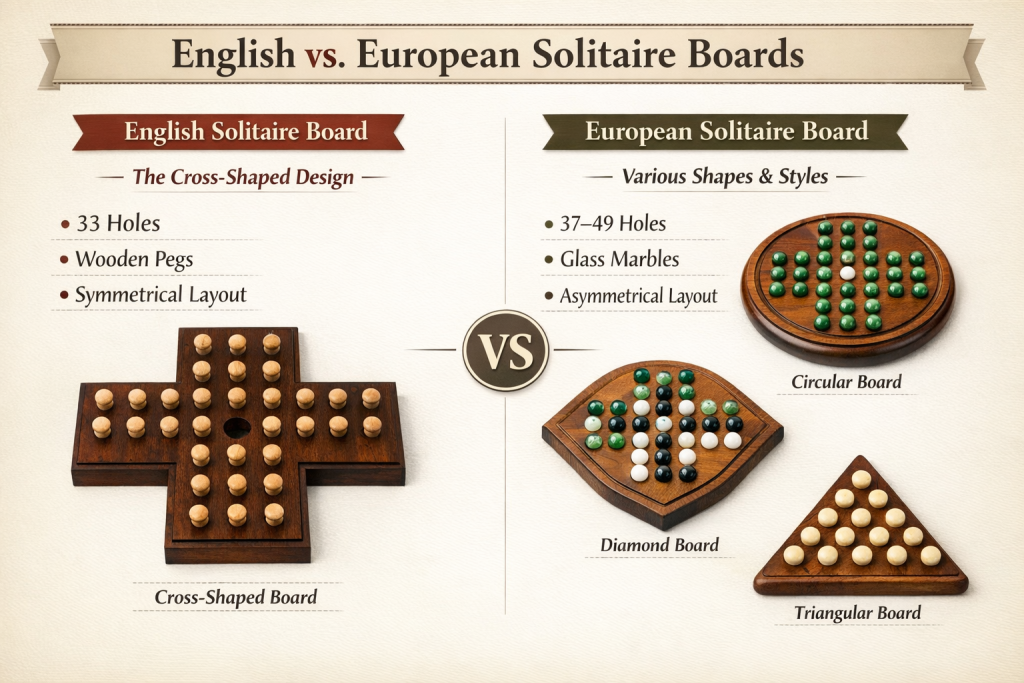
- Shape: The English board is almost universally cross-shaped, consisting of a central 3×3 square with four “arms” extending outward.
- Holes: Standard boards have 33 holes, with the central hole left empty at the start of the game.
- Symmetry: English boards are highly symmetrical, creating uniform movement possibilities across all directions.
- Variations: Occasionally, smaller or larger versions appear with 37 or 45 holes, but the 33-hole configuration remains standard.
European Boards
- Shape: European boards often adopt circular, diamond, or triangular layouts, reflecting a wider variety of geometric aesthetics.
- Holes: French and German boards may have 37, 41, or even 49 holes depending on regional design. Circular boards typically place the holes in concentric patterns, which affects strategy by emphasizing radial movement.
- Asymmetry: Many European boards are intentionally asymmetrical, adding complexity and variety to gameplay.
- Variants: Some European designs feature multiple layers or “rings” of pegs, particularly on German boards, creating multi-stage challenges not present in the English cross board.
3. Material and Craftsmanship
Material choices historically differed between the regions, reflecting local resources and artistic preferences.
- English Boards: Typically made from wood, including beech, oak, or mahogany. English boards are functional and sturdy, focusing on longevity and precise hole spacing. The wood is often polished and sometimes stained, but decoration is minimal.
- European Boards: France and Germany produced boards using a wider variety of materials, including wood, ivory, and metal inlays. French boards in particular often featured luxurious veneers or marquetry, and German boards occasionally incorporated ornate carvings, highlighting their dual role as both a game and a decorative object.
4. Pegs vs. Marbles
Another regional distinction lies in the choice of game pieces.
- English Boards: Traditionally used pegs made of wood. Pegs are easy to manufacture, uniform in size, and durable. The uniformity supports consistent gameplay and allows for faster learning.
- European Boards: Frequently employed marbles, which vary in size and color. Marbles add an aesthetic appeal and tactile satisfaction but introduce slight variations in movement due to weight and roundness. Some high-end European boards even used glass or semi-precious stone marbles for a luxury feel.
5. Gameplay Strategy Differences
Board design significantly influences the strategy and difficulty of the game.
English Boards
- The symmetrical cross shape encourages linear thinking—players often focus on central clearing and symmetry.
- With 33 holes, standard solutions often rely on moving from the outer arms toward the center.
- Predictable hole arrangements allow for well-documented strategies, making the English board a favorite for beginners and competitive players alike.
European Boards
- Circular or triangular layouts promote radial and diagonal thinking.
- Asymmetrical boards create localized challenges, requiring careful planning to avoid isolating pegs in unreachable areas.
- Larger European boards with more holes increase complexity and extend gameplay duration.
- Due to these challenges, European boards are often preferred by advanced players seeking a more strategic puzzle experience.
6. Cultural Significance
- English Solitaire: Often associated with Victorian parlors and intellectual leisure. Its simplicity and reproducibility helped it spread to schools, clubs, and later, digital adaptations.
- European Solitaire: Considered both a game and a work of art. Luxury boards were often given as gifts or displayed as part of home decor. The European tradition emphasized aesthetic enjoyment as much as gameplay.
7. Modern Adaptations
In contemporary times, both English and European board designs have influenced digital and tabletop versions.
- English Style in Apps: Most mobile and PC solitaire apps adopt the English cross layout for its simplicity, intuitive design, and compatibility with touch interfaces.
- European Style in Puzzles: European boards inspire complex puzzle variations, including triangular peg solitaire and circular marble solitaire games. These designs often appear in specialty board games and luxury collectibles.
Manufacturers today continue to produce both types in wood, acrylic, and even 3D-printed formats, preserving the traditional aesthetics while introducing modern convenience.
8. Choosing the Right Board
When selecting a solitaire board, the choice often depends on skill level, aesthetic preference, and intended use:
| Feature | English Board | European Board |
|---|---|---|
| Shape | Cross | Circular, diamond, or triangular |
| Holes | 33 | 37–49 |
| Symmetry | High | Often asymmetrical |
| Pegs/Marbles | Wooden pegs | Marbles (glass, stone, or wood) |
| Complexity | Beginner-friendly | Advanced strategy-focused |
| Aesthetic Appeal | Minimalist, functional | Decorative, luxurious |
| Gameplay Focus | Linear, central clearing | Radial, multi-stage clearing |
9. Conclusion
The regional variations between English and European solitaire boards demonstrate how cultural preferences, design philosophy, and material availability shape the evolution of a classic game.
- English boards prioritize symmetry, simplicity, and reproducibility, making them accessible and widely recognized.
- European boards emphasize artistic craftsmanship, strategic complexity, and tactile appeal, appealing to enthusiasts and collectors.
Understanding these differences enriches the experience of solitaire, allowing players to appreciate not just the puzzle but the heritage and artistry behind each board. Whether you are a casual player, a collector, or a puzzle strategist, exploring both English and European designs provides insight into the cultural dimensions of one of the world’s most enduring games.