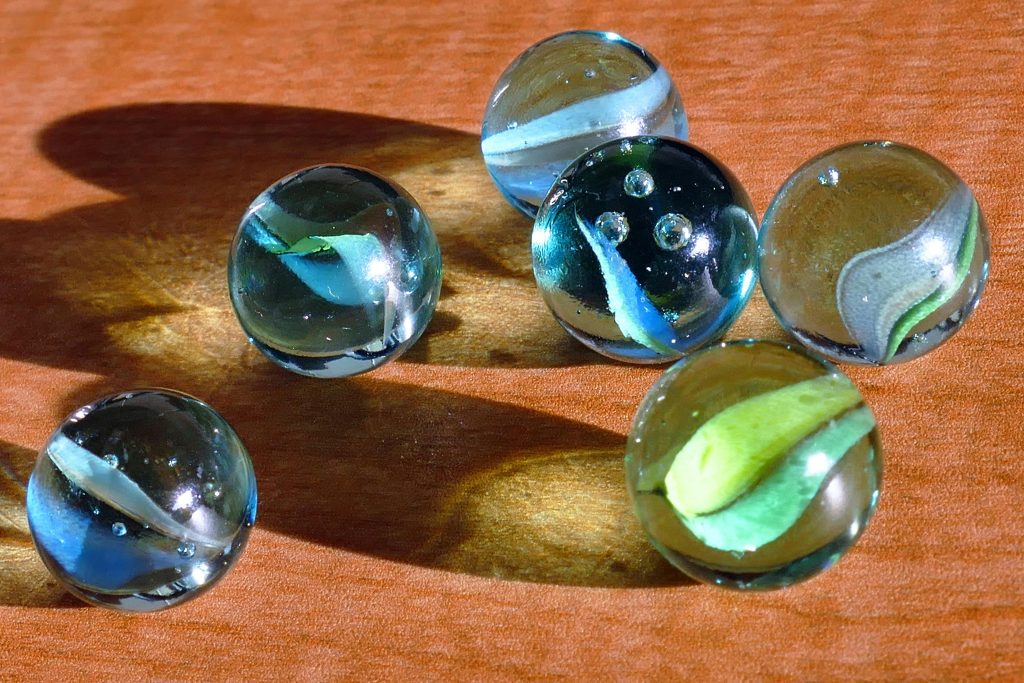

Few people realise that the history of marbles extends far beyond the factories of Germany and America. Long before industrial machines rolled perfect spheres of glass, artisans in Asia—particularly China—were shaping exquisite miniature worlds by hand. From Qing Dynasty porcelain spheres to early 20th-century export glass marbles, China’s influence on marble design reveals a story of art, trade, and craftsmanship that shaped collecting traditions across the globe.
The Earliest Chinese Marbles
Archaeological evidence shows that spherical playthings existed in China as early as the Han Dynasty (around 200 BC). These early objects were not marbles in the modern sense but small orbs made from clay, polished stone, or carved bone used in games of dexterity or ritual. Over centuries, these evolved alongside the development of fine porcelain—an invention that would later define Chinese decorative art worldwide.
By the late Ming and early Qing Dynasties (17th–18th centuries), porcelain craftsmanship reached breathtaking refinement. Artisans at Jingdezhen, the porcelain capital of China, began producing small glazed spheres as decorative curiosities. Some were used as puzzle pieces in tabletop games; others were simply admired for their flawless glaze and brilliant colour. Though they were not mass-produced toys, collectors today view these porcelain spheres as the ancestors of the marble as we know it.
Qing Dynasty Porcelain Spheres
During the Qing Dynasty (1644–1912), porcelain “marbles” became a subtle expression of wealth and taste. They were typically around one to two centimetres in diameter, crafted from fine kaolin clay, and finished with underglaze blue patterns, famille-rose enamels, or celadon-green tones. Some were even adorned with tiny painted landscapes or calligraphic characters.
Unlike Western marbles, which often focused on internal swirls and colour play, Chinese porcelain examples were valued for surface perfection. The emphasis was on symmetry, glaze depth, and the painter’s skill. When held up to light, a well-made Qing marble glowed softly—its translucency revealing the high firing temperatures and purity of the porcelain.
Collectors today occasionally encounter these pieces in mixed lots of Asian antiques. Because many were produced as decorative miniatures rather than toys, they often appear alongside snuff bottles, miniature vases, and scholar’s objects. Authentic examples command strong prices, particularly those showing imperial-style motifs or exceptionally thin walls.
Transition to Glass and Export Production
As the 19th century progressed, European trade flooded Chinese ports with new materials and ideas. Western glassworks inspired Chinese artisans to experiment with lamp-worked and pressed glass marbles. By the early 20th century—around the 1910s and 1920s—Chinese workshops in cities such as Tianjin and Shanghai began producing simple glass marbles for export.
These marbles were intended for mass markets in America, Britain, and Australia, often sold through dime stores and catalogues. They were inexpensive, visually striking, and sometimes inconsistently shaped—a charming contrast to the precision of German machine-made marbles. Many early exports feature distinctive bubbles, off-centre cores, or colour streaks unique to Chinese glassmaking techniques of the period.
While they were often dismissed as “cheap imports” at the time, collectors now recognise their historical and aesthetic importance. Early Chinese glass marbles demonstrate the global spread of marble play culture and the adaptation of foreign materials into local craftsmanship.
Identifying Features of Chinese Porcelain and Glass Marbles
Recognising authentic Chinese marbles requires careful observation. Here are a few key identifying features for collectors:
1. Material and Weight
Porcelain marbles are heavier and more opaque than glass. They often have a cool, dense feel and a perfectly smooth surface when glazed. Early glass marbles, on the other hand, tend to be lighter with irregular bubbles and a softer texture.
2. Colour and Finish
Qing porcelain marbles display traditional Chinese palette colours: celadon green, cobalt blue, white, and soft rose. Hand-painted motifs are small and precise. Export glass marbles from the early 20th century usually feature bright single colours (amber, green, turquoise, or clear) with uneven swirls or slight fogging within the glass.
3. Pontil Marks and Seams
Hand-worked marbles show pontil scars—the small circular marks where they were detached from the glass rod. Machine-made marbles have mould seams, while handmade Chinese marbles generally do not. A carefully ground or polished pontil often indicates higher quality.
4. Irregularities
Unlike uniform Western machine marbles, Chinese examples may vary slightly in diameter or roundness. These imperfections add charm and authenticity, reflecting the artisan’s hand rather than industrial precision.
5. Provenance
Antique markets in the UK occasionally mix Chinese export marbles into jars of European examples. Look for marbles with slightly offbeat colours, asymmetrical swirls, or distinctive porcelain glazes—they’re often misidentified and undervalued.
Collector Tips
-
Handle with care: Porcelain marbles can chip easily, especially around the pontil or edge. Always store them in padded trays or soft compartments.
-
Avoid harsh cleaning: A mild wipe with a damp cloth is sufficient. Abrasive cleaners can dull the glaze or remove delicate enamel painting.
-
Use good lighting: When photographing or inspecting, a diffused LED light helps reveal internal bubbles in glass marbles or glaze translucency in porcelain.
-
Research markings: Some late-Qing or Republic-era porcelain examples bear maker’s marks, often in blue or red. Documenting these can significantly aid identification.
-
Buy from trusted sources: Antique fairs, reputable dealers, or long-standing online sellers specialising in Asian ceramics are safer than bulk listings with vague origins.
The Growing Interest Among Collectors
In recent years, collectors in Europe and America have begun to re-evaluate the place of Chinese marbles in the broader story of marble-making. Where once they were overlooked as curios or novelties, they are now prized for their individuality and artistry. The contrast between a pristine German “Lutz” marble and a softly glowing Qing porcelain sphere highlights not just regional styles but entirely different philosophies of beauty.
Chinese marbles represent craftsmanship shaped by centuries of ceramic mastery and cultural symbolism. They remind us that the marble, though a small and humble object, can embody vast traditions of art and play.
Why They Matter Today
Beyond their visual appeal, Chinese marbles connect collectors to a global history of creativity and exchange. Each handmade sphere tells a story: of artisans experimenting with flame and glaze, of trade routes linking continents, and of a universal fascination with light captured in motion.
For modern collectors, seeking out these pieces offers a chance to preserve a lesser-known chapter of marble history. Whether porcelain relics of the Qing court or early glass exports made for Western playrooms, they all share the same quiet allure—the marriage of craftsmanship and wonder that keeps collectors searching for the next glint of forgotten glass.
In essence:
Chinese marbles remind us that artistry knows no borders. Forged in the kilns of ancient dynasties and polished by time, they remain small testaments to the beauty of precision, patience, and play.