
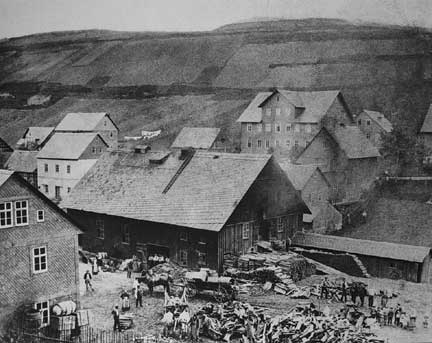
Lauscha and Thuringia: The Glassmaking Villages That Conquered the World
Nestled in the forested mountains of central Germany, the village of Lauscha and surrounding communities in the Thuringian Forest seem unlikely candidates for global industrial dominance. Yet from these remote settlements emerged an industry that supplied the world with glass marbles, Christmas ornaments, glass eyes, and countless other glass treasures for over two centuries. Understanding how this remarkable transformation occurred reveals a unique convergence of geography, resources, skills, and economic necessity that created one of history’s most specialized regional industries.
Geographic Foundations: Why Thuringia?
The Thuringian Forest region possessed several natural advantages that made glassmaking not just possible but economically sensible. Dense forests provided virtually unlimited fuel for the hungry furnaces required for glass production, a critical resource when wood represented the primary energy source for heating glass to working temperatures exceeding 1000 degrees Celsius. The mountainous terrain, while limiting agricultural potential, offered this abundance of timber that supported energy-intensive industries.
Local sand deposits, while not the finest quality available in Germany, proved adequate for producing glass suitable for toys, ornaments, and other decorative items. The region’s relative isolation from major urban centers paradoxically became an advantage—labor costs remained low, overhead expenses minimal, and families willing to work long hours in cottage-industry settings created competitive advantages that wealthier urban manufacturers couldn’t match.
Water-powered grinding and polishing operations utilized the region’s mountain streams, providing mechanical energy before widespread electrification. This natural infrastructure supported finishing operations that enhanced product quality without requiring expensive capital investments in alternative power sources.
The mountainous landscape also created a culture of self-sufficiency and specialized craft production. Agricultural limitations meant families needed supplementary income sources, making home-based glass production an attractive economic strategy that could be pursued year-round regardless of growing seasons.
The Greiner Legacy: Founding a Dynasty
The story of Thuringian glassmaking centers on several pioneering families, with the Greiners emerging as particularly influential. When the glassmaking tradition established itself in Lauscha during the mid-16th century, it initially focused on utilitarian vessels and window glass. The transformation to decorative glass products, toys, and eventually marbles occurred gradually over subsequent centuries.
Early Lauscha glassmakers worked in primitive forest furnaces, producing basic items for local markets. The crucial innovation came when craftsmen began developing specialized techniques for creating hollow glass beads, small figures, and decorative elements using lampworking methods. This technique, employing hand-held torches rather than large furnaces, allowed individual craftsmen to work from home workshops, transforming glass production from a factory-based industry to a cottage industry that could employ entire families.
By the 18th century, Lauscha had established itself as a center for glass bead production, creating decorative elements used in jewelry, embroidery, and costume decoration across Europe. This expertise in manipulating small-scale glass objects provided the technical foundation for marble production, as the skills required for shaping beads translated directly to creating spherical marbles.
The Cottage Industry Model
What distinguished Thuringian glass production from other glassmaking centers was its unique organizational structure. Rather than large factories employing hundreds of workers, Lauscha operated through a network of home workshops where families worked as independent producers. A typical Lauscha household might contain a small lamp-working bench where the father and older sons created glass items, while wives and daughters handled finishing work, sorting, and packaging.
This cottage industry model created remarkable economic efficiency. Overhead costs remained minimal—no factory buildings to maintain, no expensive machinery to purchase, no centralized power requirements. Families worked flexible hours, intensifying production during high-demand periods while reducing output when orders slackened. Children learned glassworking skills from early ages, creating a self-perpetuating system of skill transmission that maintained quality across generations.
The workshop setup was deceptively simple. A glassworker sat at a bench before a flame fueled initially by tallow lamps, later by oil, and eventually by gas. Glass rods in various colors, purchased from larger glass manufacturers, stood ready in containers. Simple hand tools—pontil rods, graphite paddles, shears, and shaping implements—completed the equipment. Despite this simplicity, skilled craftsmen produced work of remarkable sophistication and beauty.
The Marble Revolution
While the exact origins of marble production in Lauscha remain somewhat obscure, evidence suggests significant production began in the early-to-mid 19th century. German glassworkers recognized that their bead-making expertise could be applied to creating decorative glass spheres that children used for games. Early marbles were likely simple single-color spheres, but craftsmen quickly realized that applying decorative techniques developed for beads created far more attractive and valuable products.
The development of distinctive German marble types—swirls, ribbons, latticinio patterns, onionskins, and adventurine-enhanced varieties—reflected both technical innovation and aesthetic experimentation. Each new pattern type represented some craftsman’s creative breakthrough, quickly copied by competitors and refined through countless iterations until standardized techniques emerged.
Production methods became remarkably efficient through specialization. Some craftsmen focused exclusively on specific marble types, developing extraordinary speed and consistency through repetitive practice. A skilled marble maker could produce hundreds of marbles daily, each one hand-formed yet remarkably consistent in size and quality. This combination of handcraft quality with quasi-industrial output volumes created products that machine production would later struggle to replicate aesthetically despite superior production speeds.
The Distribution Network
Creating marbles in remote Thuringian villages meant nothing without effective distribution systems. Lauscha developed sophisticated export networks that reached global markets, transforming local production into an international industry. Merchants and factors, often based in larger German cities or foreign capitals, placed bulk orders with Lauscha producers, who filled them through the cottage industry network.
The role of Jewish merchants proved particularly important in establishing international distribution channels. These middlemen connected Thuringian producers with retailers across Europe, Britain, and America, handling logistics, financing, and market development that individual craftsmen couldn’t manage from isolated villages. This commercial infrastructure transformed cottage production into global trade.
By the late 19th century, German marbles flooded international markets, appearing in toy shops, general stores, and mail-order catalogs worldwide. American children in the 1890s and early 1900s played almost exclusively with German-made marbles, as domestic production remained negligible until M.F. Christensen’s machine innovations after 1905. British markets similarly depended on German imports, despite Britain’s own pottery marble traditions.
Catalog companies like Sears Roebuck and Montgomery Ward in America offered German marbles in their massive catalogs, bringing Thuringian glass craftsmanship to rural farms and frontier towns across the United States. The marbles traveled thousands of miles from their forest village origins to children who never imagined the cottage workshops where skilled hands had shaped each piece.
Economic and Social Impact
The marble industry transformed Thuringian communities economically and socially. Lauscha evolved from an impoverished forest village into a prosperous specialized manufacturing center. While glassworkers never became wealthy by urban standards, the cottage industry provided reliable income that exceeded what mountain farming could offer. Families could remain in ancestral villages rather than migrating to industrial cities, preserving traditional communities while participating in modern commercial economy.
The industry created complex social hierarchies within villages. Master glassworkers who developed new techniques or secured major contracts achieved elevated status and relative prosperity. Merchants and factors who controlled distribution networks wielded considerable economic power despite not producing goods themselves. The system also created dependencies, as individual craftsmen relied on merchants for materials, market access, and payment, occasionally leading to exploitation when market power concentrated in few hands.
Education systems adapted to support the glass industry. Specialized trade schools taught glassworking techniques systematically rather than relying solely on informal apprenticeship. These schools preserved knowledge, standardized training, and ensured quality maintenance across the industry. Students learned chemistry, color theory, and design alongside practical glassworking skills, creating craftsmen who understood their materials scientifically as well as intuitively.
Decline and Transformation
The dominance of Thuringian marble production faced existential challenges in the early 20th century. World War I severed export networks, cutting German producers off from crucial American and British markets. During this disruption, American manufacturers developed machine production methods that could produce adequate marbles at dramatically lower costs than handmade imports.
Even after the war, German handmade marbles struggled to compete against mechanized American production. The price differentials became insurmountable—American machine-made marbles sold for fractions of handmade costs while achieving acceptable quality for most consumers. German exports declined precipitously through the 1920s and 1930s, never recovering their former market dominance.
The Nazi era and World War II delivered further devastating blows. Many skilled glassworkers perished in the conflict, breaking generational skill transmission. Post-war division placed Lauscha in East Germany, where Communist economic planning disrupted traditional cottage industry models. The industry survived but fundamentally changed, with production consolidated into state-owned enterprises and traditional methods increasingly abandoned.
Legacy and Modern Revival
Today, Lauscha maintains its glassmaking traditions but on vastly reduced scales compared to its 19th-century peak. A handful of craftsmen preserve traditional marble-making techniques, producing pieces primarily for collectors rather than children’s play. These modern artisans face challenges their ancestors never imagined—sourcing traditional glass rods, maintaining antique equipment, and finding markets willing to pay premium prices for handmade goods in an era of mass production.
Museums in Lauscha and surrounding communities preserve the region’s glassmaking heritage, displaying antique tools, documenting production methods, and maintaining archives of the industry’s golden age. These institutions remind visitors that this quiet mountain village once supplied the world with treasures that brought joy to millions of children.
The marbles themselves remain the most enduring legacy. Scattered through collections worldwide, these handmade German pieces testify to the skill, artistry, and commercial acumen of Thuringian glassworkers who transformed their mountain villages into centers of global industry. Each German handmade marble represents not just childhood play but a unique moment in industrial history when cottage craftsmanship competed successfully in international markets, proving that quality, skill, and tradition could conquer the world from the most unlikely origins.