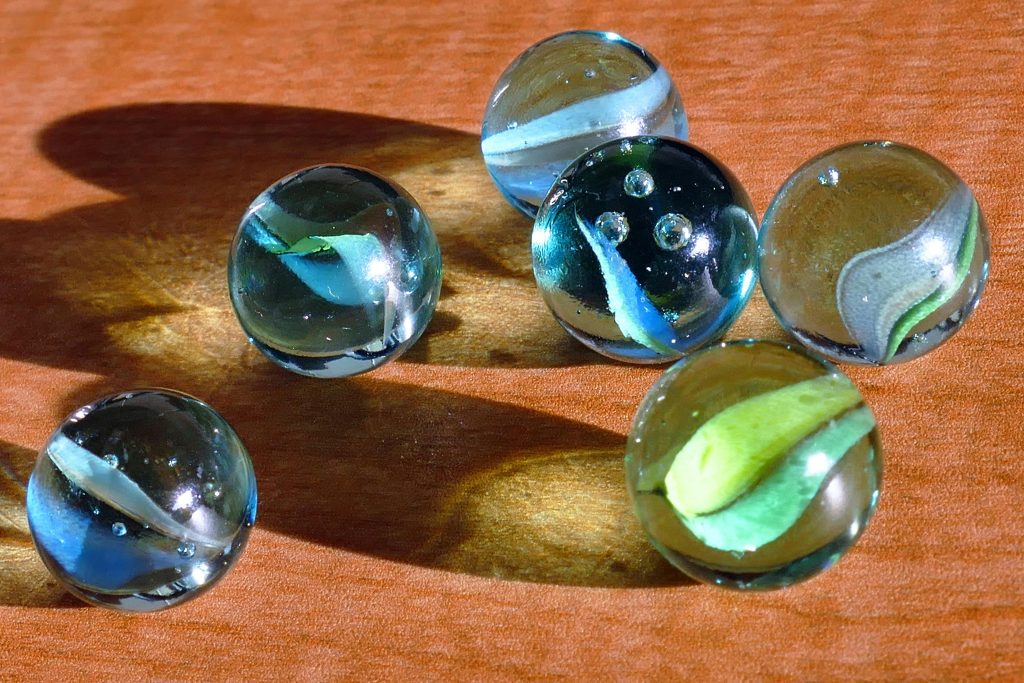

Here’s a detailed, historically grounded chronicle of the influential Greiner family and their pivotal role in the rise of German glass marble manufacture, especially centered on the Thuringian glassmaking tradition. This narrative shows how a craft inherited across generations became a globally recognized industry that supplied marbles to children and collectors worldwide — driven by innovation, entrepreneurship, and early industrial organization.
Origins: The Greiners and the Birth of Thuringian Glassmaking
The roots of the Greiner family’s impact reach deep into early German glassmaking history. Glassblower families were typically multi‑generational, passing knowledge from father to son, and the Greiners were among the most widespread of these families, with branches active across southern and central Germany. Their name — derived from a word for sand or sandy place — reflected the raw materials central to the craft.
In the late 16th century, Hans Greiner and glassmaker Christoph Müller were among the first to establish a glassworks at Lauscha in the Thuringian Forest region (today’s southern Thuringia). This settlement transformed a forested backwater into a hub of glass production by exploiting local quartz sands, plentiful wood fuel, and potash fluxes — key resources for early glassmaking.
For generations, Lauscha remained a cottage‑industry region where families like the Greiners operated small, wood‑fired furnaces and passed down their specialized skills. Early production was artisan‑scale, focusing on hollowware, beads, ornaments, and small decorative items — often blown by hand and marketed through regional trade networks.
Innovation in Marble Production: Elias Greiner and the Marbelschere
The mid‑19th century marks the decisive pivot from general glassmaking to specialized marble manufacture — and central to this transformation was Elias Greiner Vetter’s son (often referred to simply as Elias Greiner). Born into an established Lauscha glassmaking lineage, he combined craft skill with entrepreneurial drive.
The Marbelschere Patent (1848–49)
Around 1846, Elias Greiner developed a critical innovation: the marble scissor (Marbelschere or marble scissors). This tool enabled glassworkers to cut molten glass rods into uniform sections, which could then be shaped into spheres. This approach represented a major advancement over purely freehand gathering, allowing more consistent size and scale — and was key to making marbles in commercial quantities.
In 1849, Elias and his partner Septimius Greiner received an official patent recognizing their method for producing “artificial agate and precious stone balls”. This patent was validated by administrative authorities after inspection and evidence of significant production.
Workshop Organization and Early Expansion
With the marbles’ economic promise established, the Greiners moved to scale production:
- Specialized Works: In 1853, they built a dedicated glassworks and furnace in Unterlauscha designed specifically for their marble and fine glass production. Initially equipped with four workstations, it expanded rapidly to ten as demand grew.
- Technical Expertise: The Greiners also developed a color grinding mill and proprietary tools for glass decoration and finishing. Elias, noted for his background as a porcelain painter and color maker, produced a wide palette of hues and finishes for their spheres — far more sophisticated than previous, more rudimentary products.
- Product Diversity: The family produced marbles in a variety of sizes, colors, and patterns — from solid hues to imitation agate and multi‑colored designs meant to mimic precious stones. These variations increased their appeal in both toys and decorative markets.
The Greiners’ success encouraged others; by 1856, competing workshops in Lauscha — including the Kuhnert family and others — began producing marbles as well, even in defiance of the original Greiner patent. Within two decades, more than ten independent units were making marbles in the region.
Industrial Networks and World Markets
The Greiner family did not just innovate in their workshop; they were early adopters of commercial distribution practices that transformed local craft production into exportable goods.
Decentralized Production and Family Networks
Rather than centralizing into one large factory, the Greiners and other glassmaking families in Lauscha established decentralized workshops. Each was run by relatives or apprentices versed in specialized techniques. This structure:
- Spread skilled labor across many small units.
- Allowed flexible production to meet fluctuating demand.
- Fostered specialized niches (e.g., color glass, large spheres, or ornate patterns).
This model proved resilient against local resource constraints (like wood allotments or fuel shortages) and allowed incremental capacity expansion without heavy capital outlay.
Exports and Global Reach
By the late 19th century, marbles from Lautsca — propelled in part by Greiner innovation — constituted a significant export good. Millions of handmade pieces were shipped, especially to markets in North America and across Europe. Lauscha was widely regarded as the world’s leading marble producer in the period before machine production scaled up.
Collectors today acknowledge that German handmade marbles dominated the toy market and core collecting sphere through the early 20th century, a testament to their technical quality and artistic variety.
Legacy: Craft, Culture, and Industry
The Greiners’ contribution to glassmaking extends beyond marbles; they were part of a broader Thuringian glass tradition that pioneered technologies, styles, and organizational forms still admired by historians and collectors. Their role in establishing Lauscha’s reputation as a glass production center echoes today, long after the original workshops ceased operation.
While later industrialization (including mass‑production in the United States) overshadowed handwork in terms of sheer volume, the craftsmanship and global networks developed by families like the Greiners laid critical foundations. Without their technical inventions (like the marbelschere), workshop structures, and early export engagement, the transition from artisanal craft to global toy industry might have followed a very different path.
Conclusion
The story of the Greiner family is a case study in how craft traditions adapt, innovate, organize, and reach global markets:
- Intergenerational Craft Transmission: Skills passed down for centuries enabled technical innovation.
- Technical Breakthroughs: The marbelschere and other tools enabled repeatable, scalable marble production.
- Entrepreneurial Production: Building dedicated works and skilled labor networks in Lauscha.
- Export Networks: Supplying marbles worldwide and establishing Germany as the premier marble source.
Their legacy lives on not only in antique collections but in the very idea that a small forest village’s glassmakers could influence the childhoods of children across continents.