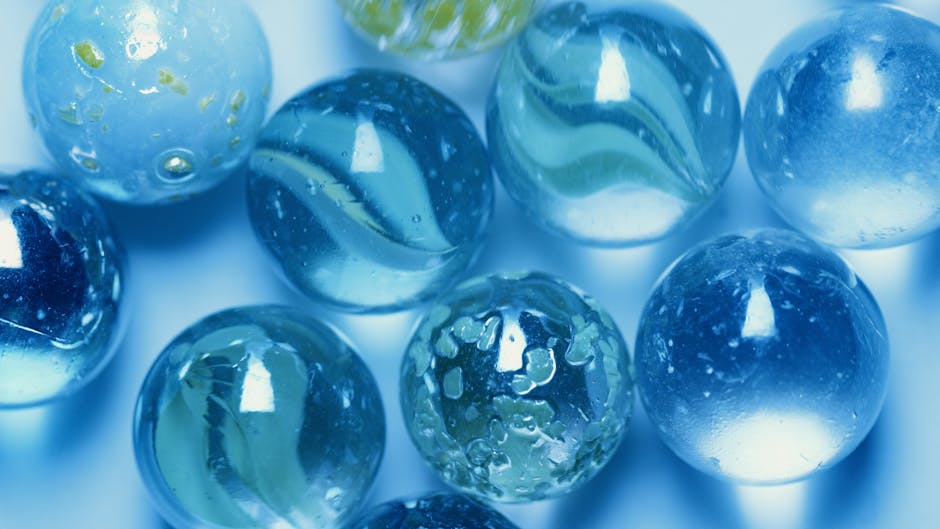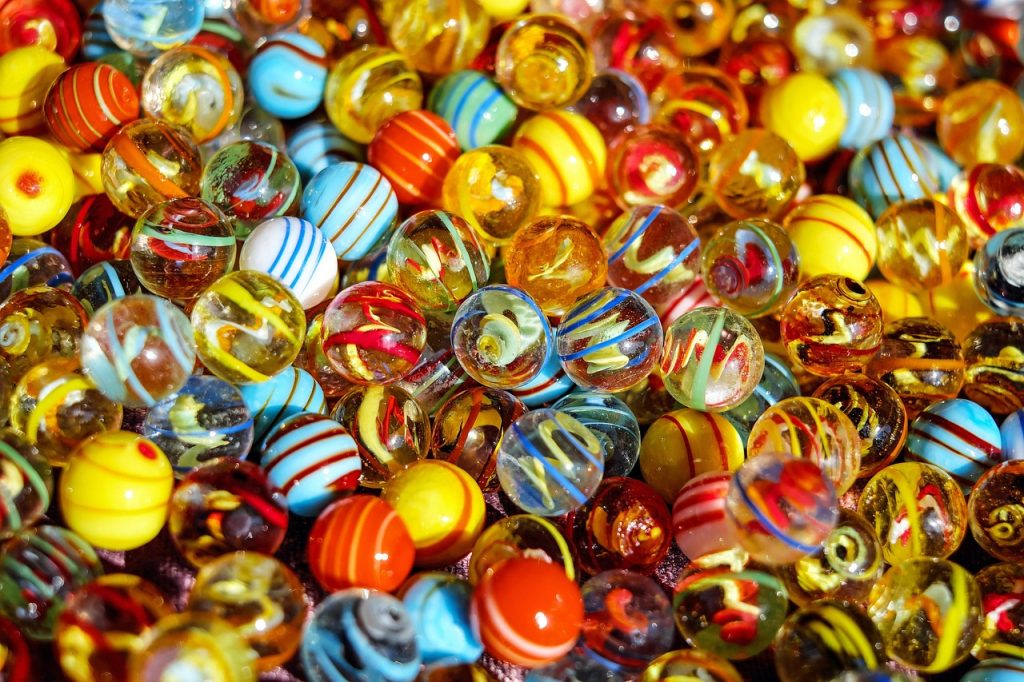
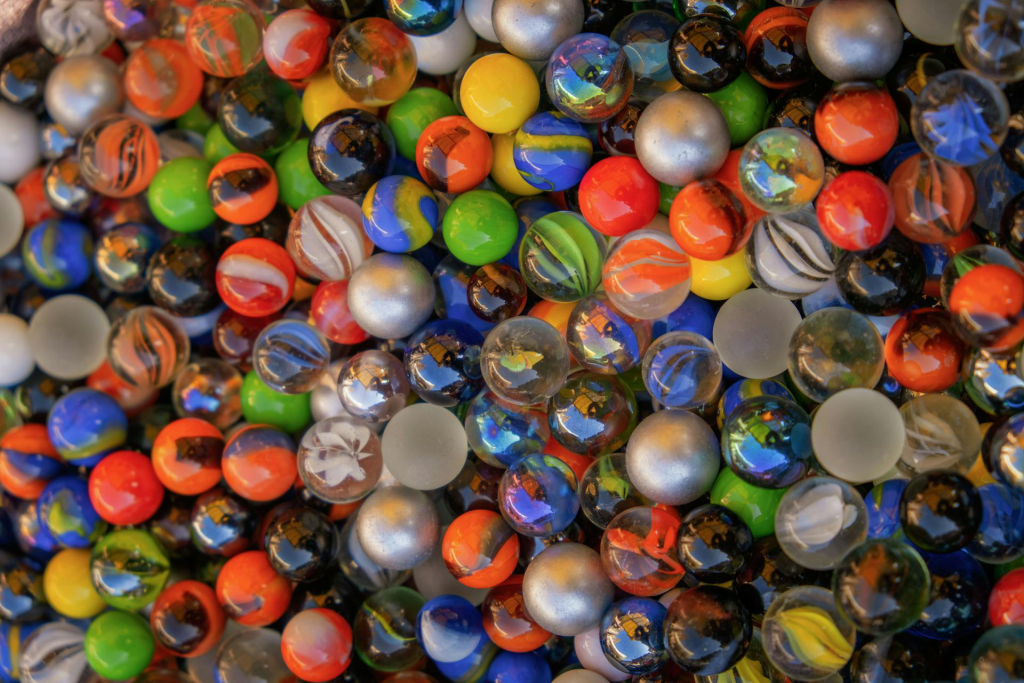
To the untrained eye, an old marble might look like a child’s toy. But to collectors, that same small sphere could be worth hundreds — or even thousands — of pounds.
So, what separates a common marble from a valuable one?
Let’s break down the main factors: age, craftsmanship, condition, rarity, material, and provenance.
1. Age: The Older, the Better (Usually)
Age is a major indicator of value — especially when it comes to handmade and early machine-made marbles.
- Pre-1900 Handmade Marbles (especially German handmades) are the most sought after. Each was made individually using tools like pontil rods and shears.
- Early American Machine-Made Marbles (1910–1930s) also have collector interest because they represent the transition from artisanal to industrial production.
- Modern Marbles can still be valuable — particularly those made by contemporary glass artists in limited runs — but they must show outstanding artistry.
Collector Tip:
If a marble has visible pontil marks (small rough spots where the glass was detached from the rod), it’s almost certainly handmade and pre-1900.
2. Craftsmanship and Technique
The way a marble was made tells you everything about its value. Early glassworkers in Germany and the U.S. turned molten glass into art, creating marbles that were miniature masterpieces.
Some of the most prized handmade types include:
- Onionskin: Opaque base with hundreds of colourful flecks.
- Mica: Sparkling flakes suspended within the glass.
- Joseph’s Coat: Straight, multicoloured stripes running from pole to pole.
- Lutz: Marbles containing goldstone (aventurine) that glitter like copper.
- Clambroth: Fine coloured lines around a milky base.
Intricate internal patterns, symmetry, and colour layering all add value. A simple swirl marble might be worth only a few pounds, but a well-executed onionskin with mica can reach several hundred.
Collector Tip:
Hold the marble to natural light — true quality glass reveals depth and dimensionality. Cheap reproductions often look flat and dull.
3. Condition and Clarity
Condition is crucial. Even a rare marble loses value if it’s badly damaged.
Look for:
- No major chips or cracks
- Minimal surface scratching (called “flea bites”)
- Clear glass and unfaded colours
- Original polish (avoid ones that have been tumbled or re-polished — it can reduce collector value by 50–70%)
Marbles are graded using terms like:
| Grade | Description |
|---|---|
| Mint | As made, no visible damage |
| Near Mint | One or two small marks |
| Good | Light play wear, still presentable |
| Fair | Obvious wear, chips, or dullness |
| Poor | Heavy damage or missing glass |
Collector Tip:
A rare marble in near-mint condition is exponentially more valuable than a common marble in perfect shape.
4. Rarity and Design Variation
Rarity drives demand.
Some designs were made only in small batches or by specific factories.
For example:
- German Lutz marbles with thick aventurine stripes are extremely rare.
- Christensen Agate Co. marbles from early 1900s Ohio are prized for their bright, opaque colours and flame patterns.
- Early handmade slags (half opaque, half transparent) are also desirable.
Limited runs, unique colours, and factory experiments can make certain marbles much more valuable than similar-looking ones.
Collector Tip:
Compare your marble to known catalogued examples from reference books or collector sites. If yours differs in colour, size, or pattern, it may be a rare variant.
5. Material: Glass, Stone, or Clay
While glass marbles dominate collecting, other materials can hold serious value too.
- Stone Marbles: Early hand-ground examples made from agate, limestone, or marble itself (especially German polished agates from the 1800s).
- Clay Marbles: Simple, earthy types — mostly of historical interest, though some glazed “Bennington” types fetch attention.
- Sulphide Marbles: Contain a tiny figurine (usually white ceramic) suspended inside clear glass — among the most collectible of all.
Collector Tip:
If your marble feels heavy, cool to the touch, and shows natural striations, it may be stone — check for signs of hand polishing rather than moulding.
6. Provenance and History
A marble’s story can multiply its worth.
If it came from a known collection, was made by a famous glass artist, or originates from a historically documented batch, collectors will pay a premium.
Examples:
- Marbles from the Christensen Agate Company (Ohio, USA, early 1900s)
- Akro Agate boxed sets from the 1920s–30s
- Handmades sourced from Lauscha, Germany, or early French workshops
Even personal provenance — such as “found in a Victorian toy chest” — can make an item more appealing to buyers.
Collector Tip:
Keep notes, photos, and any original containers or packaging. Documentation adds credibility — and value.
7. Size and Shape
Size plays a subtle but important role.
- Standard marbles (½” to ⅝”) are common.
- Larger shooter marbles (¾” to 1½”) are rarer and typically more valuable.
- Oversized handmades, especially onionskins or sulphides, can command high prices.
Unusual shapes — slightly oval, flattened, or misshapen — can also be desirable if they’re a result of handcrafting, not damage.
8. Market Trends and Current Demand
The marble market, like any collectible niche, shifts with time. Currently:
- German handmades remain the backbone of high-end collecting.
- Early American machine-mades (especially Christensen and Akro Agate) are rising in value.
- Contemporary art marbles (modern glass artists) have a growing following.
Check auction results, collector forums, and price guides regularly — what was £50 five years ago might now be £300 if the maker’s name gained recognition.
Collector Tip:
Search recent eBay “sold” listings or Marble Collectors Society of America auctions for up-to-date benchmarks.
9. Signs of a Reproduction
Unfortunately, reproductions and fakes are common — especially for mica and onionskin marbles.
Watch out for:
- Too-perfect surfaces with no pontil marks
- Cheap glitter or metallic paint inside
- Consistent factory patterns with no variation
- Modern glass colours (especially neon tones)
- Unrealistic prices on online marketplaces
Rule of thumb:
If it looks new or too perfect, it probably is.
10. Expert Appraisal and Community Knowledge
Even experienced collectors seek second opinions.
If you believe your marble might be valuable:
- Post detailed photos in collector groups or forums.
- Compare your marble to catalogued examples.
- Attend a marble show or fair — experts can often identify authenticity instantly.
Recommended Communities:
- Marble Collectors Society of America (MCSA)
- Facebook groups like Marble Connection or Antique Handmade Marbles
- Regional collector clubs in the UK, Europe, and USA
Final Thoughts
Determining a marble’s value is part science, part art.
You need an eye for detail, knowledge of history, and the patience to research — but that’s what makes marble collecting so rewarding.
Each marble carries a tiny piece of history: a flicker of colour from a 19th-century glass furnace, or a child’s cherished toy from a long-forgotten game.
When you learn to recognise that craftsmanship, you’re not just valuing glass — you’re preserving a story.