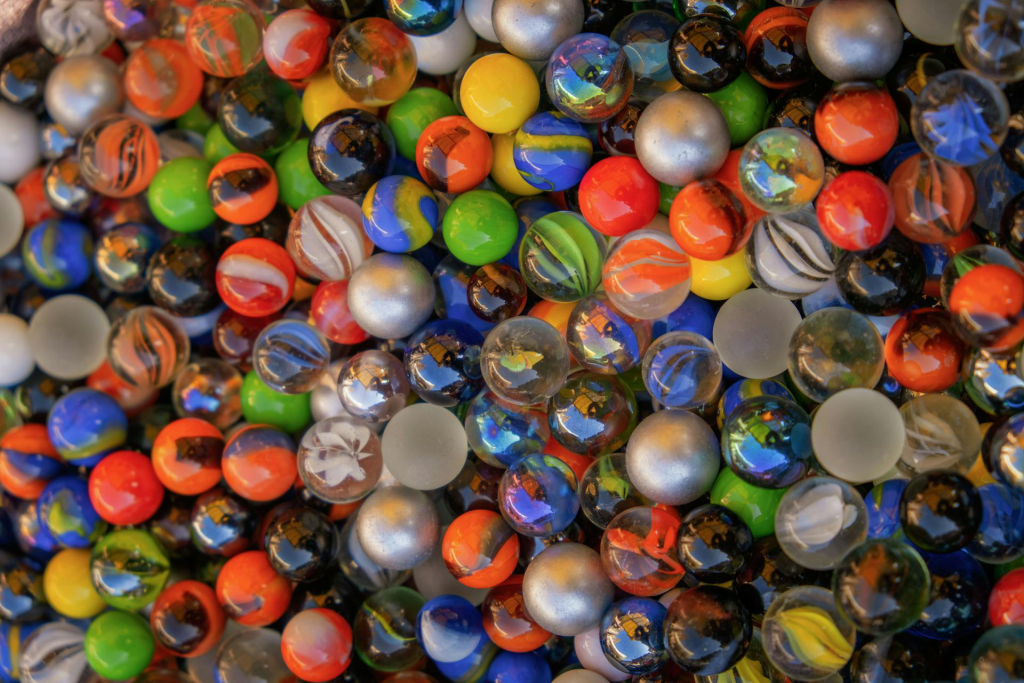
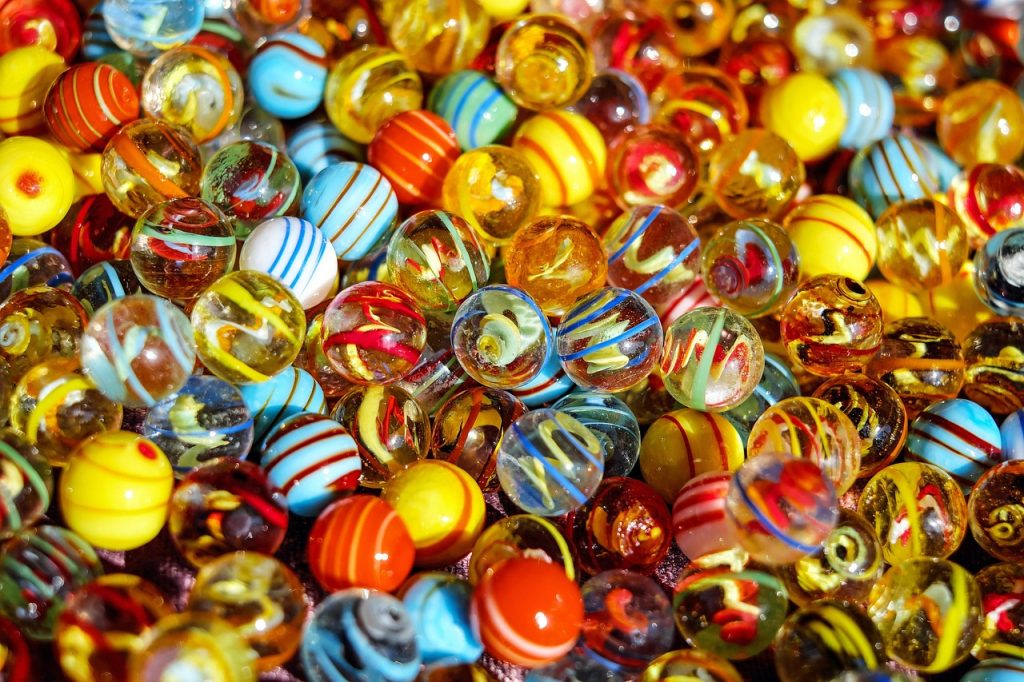
When collectors first encounter vintage marbles, they’re often surprised by the remarkable variation in sizes. From tiny peewees barely larger than a peppercorn to massive shooters that fill the palm of your hand, marble dimensions tell a fascinating story about gameplay, manufacturing economics, and regional preferences throughout history. Understanding these size variations is crucial for proper identification, valuation, and appreciating the full context of your collection.
The Standard Size Categories
Historically, marbles were categorized into specific size ranges, each with its own name and purpose. While exact measurements varied slightly by manufacturer and region, certain standards emerged throughout the golden age of marble production.
Peewees represented the smallest category, typically measuring between 3/8 inch and 1/2 inch in diameter. These diminutive marbles served primarily as target marbles in various games, where their small size made them challenging to hit. German manufacturers excelled at producing exquisite handmade peewees in the late 19th and early 20th centuries, often featuring intricate swirl patterns compressed into incredibly small spheres. The skill required to create detailed patterns at this scale makes vintage handmade peewees particularly prized by collectors today.
Regular or playing marbles ranged from 1/2 inch to 5/8 inch in diameter, representing the most common size found in historical collections. This category formed the bulk of production across all major manufacturers, as these marbles served as the standard currency in most marble games. Children would accumulate dozens or even hundreds of marbles in this size range, trading and playing with them daily. The wear patterns on vintage examples often tell stories of countless playground battles and cherished victories.
Shooters occupied the 3/4 inch to 1 inch range and served as the primary playing marble in games where children would knock other marbles out of a ring or circle. The larger size provided better control and momentum when flicked from the thumb, making skilled players formidable opponents. Premium shooters often featured the highest quality glass and most vibrant colors, as young players prized their favorite shooting marbles and would guard them jealously.
Boulders or giants exceeded 1 inch in diameter, with some exceptional examples reaching 2 inches or more. These impressive spheres were rarely used in actual gameplay but instead served as prizes, display pieces, or special tournament rewards. The sheer amount of glass required to produce large marbles made them considerably more expensive, and their size presented manufacturing challenges that only the most skilled craftsmen could overcome without introducing flaws or bubbles.
Manufacturing Implications of Size
The diameter of a marble significantly impacted its production cost and complexity. Larger marbles required more raw materials, but the relationship wasn’t simply proportional. A marble twice the diameter required roughly eight times the volume of glass, dramatically increasing material costs. This economic reality explains why manufacturers produced far fewer large marbles and why vintage boulders command premium prices today.
Handmade marble production faced particular challenges with size variation. German glassworkers gathered molten glass on the end of a pontil rod and shaped it into a sphere through careful manipulation and rolling on a marver or specialized tool. Maintaining pattern integrity while scaling up or down required exceptional skill. A latticinio swirl pattern that looked balanced at 5/8 inch might appear stretched and awkward at 1 inch, requiring the craftsman to adjust the number and thickness of glass threads accordingly.
Machine-made marble production standardized sizes more effectively than handmade methods. Early machines like those used by M.F. Christensen and Akro Agate could be calibrated to produce consistent diameters, though some variation remained inevitable. Manufacturers typically dedicated production runs to specific sizes, allowing for efficient material usage and consistent output quality.
Regional and Temporal Variations
European marble makers, particularly Germans, showed greater diversity in size offerings than their American counterparts. German handmade marbles from the Lauscha region commonly ranged from tiny 3/8 inch examples to monsters exceeding 2 inches, with skilled craftsmen able to produce virtually any size upon request. This flexibility reflected the artisanal nature of German production and the custom orders they fulfilled for distributors worldwide.
American machine-made manufacturers, by contrast, standardized around more limited size ranges that aligned with popular games and retail packaging. The famous bag of marbles sold in American dime stores typically contained 50 to 100 regular-sized marbles with one or two shooters, establishing consumer expectations that influenced production decisions for decades.
During the Victorian era, particularly in England, smaller marbles gained favor for parlor games like solitaire and Chinese checkers. These games required uniform, modest-sized marbles that could fit precisely in drilled holes on wooden boards. Consequently, British pottery marbles from this period tend toward the smaller end of the spectrum, typically between 1/2 and 5/8 inch.
Collecting Considerations
Size significantly impacts both the value and collectibility of vintage marbles. Handmade marbles at the extremes of the size spectrum command premiums, as peewees under 1/2 inch and boulders over 1 1/4 inches are substantially rarer than mid-range examples. A pristine German handmade onionskin measuring 2 inches might sell for ten times the price of a comparable 5/8 inch example.
However, size alone doesn’t determine value. A common machine-made marble in an unusual large size might be worth less than a rare handmade pattern in a standard size. Collectors must evaluate size alongside pattern, condition, rarity, and provenance when assessing worth.
Display considerations also factor into collecting decisions. Larger marbles showcase intricate patterns more dramatically and create impressive visual focal points in collections. Many advanced collectors specifically seek oversized examples of favorite patterns to serve as display centerpieces.
Practical Identification Tips
When examining vintage marbles, accurate size measurement aids in identification and authentication. Manufacturers often produced specific patterns only in certain size ranges, making dimension a useful diagnostic tool. For example, certain Christensen Agate slags rarely appear in sizes exceeding 3/4 inch, so a purported Christensen slag measuring 1 1/4 inches warrants skeptical examination.
Reproduction marbles sometimes reveal themselves through incorrect sizing. Modern makers producing vintage-style marbles may not match historical size distributions, creating examples that appear superficially authentic but fall outside typical ranges for their apparent age and origin.
Understanding historical marble sizes enriches our appreciation for these miniature glass treasures. Each dimension category served specific purposes in the rich world of marble games and collecting, reflecting the ingenuity of manufacturers and the preferences of generations of players. Whether you favor tiny peewees or impressive boulders, recognizing how size influenced production, gameplay, and value adds depth to every marble in your collection.