The marble collecting world has witnessed extraordinary prices over the past few decades as the hobby matured from casual nostalgia into serious investment-grade collecting. Understanding what drives these record-breaking sales illuminates the factors that create exceptional value, guides collecting strategies, and reveals the remarkable passion that transforms simple glass spheres into treasured artifacts commanding prices that would astound the children who once played with them.
The Legendary Sulphides
Among the most consistently valuable marbles, antique sulphides with embedded figures have achieved some of the highest authenticated prices in collecting history. These Victorian-era masterpieces, primarily produced in Germany and France during the mid-to-late 19th century, combined technical virtuosity with artistic beauty in ways that modern collectors find irresistible.
A particularly exceptional sulphide featuring a detailed standing bear figure sold at auction for over $8,000 in the early 2000s, establishing benchmarks that subsequent sales would reference. The bear’s crisp detail, the marble’s large size exceeding 2 inches, and the pristine clarity of surrounding glass combined to create an almost perfect example of the form. The air bubble halo surrounding the figure remained intact, enhancing rather than detracting from the overall presentation.
Even more remarkably, a sulphide containing an extremely rare religious figure reached approximately $10,000 at specialized auction, driven by the subject matter’s uniqueness and the exceptional execution of the embedded ceramic piece. Religious imagery appeared far less frequently in sulphide production than animals or decorative motifs, creating scarcity that passionate collectors rewarded with premium prices.
The largest authenticated sulphide marble, measuring nearly 2.5 inches in diameter and containing an intricately detailed lion figure, changed hands privately for a reported $12,000-$15,000. This transaction, while not publicly auctioned, became legendary within collecting circles and established sulphides as serious investment-grade collectibles rather than mere childhood toys.
German Handmade Masterpieces
Exceptional German handmade marbles, particularly those featuring complex patterns, rare colors, or unusual sizes, regularly achieve prices that seem extraordinary for items originally costing pennies. The technical skill required to create these pieces by hand, combined with their age and increasing scarcity in pristine condition, drives values that continue climbing.
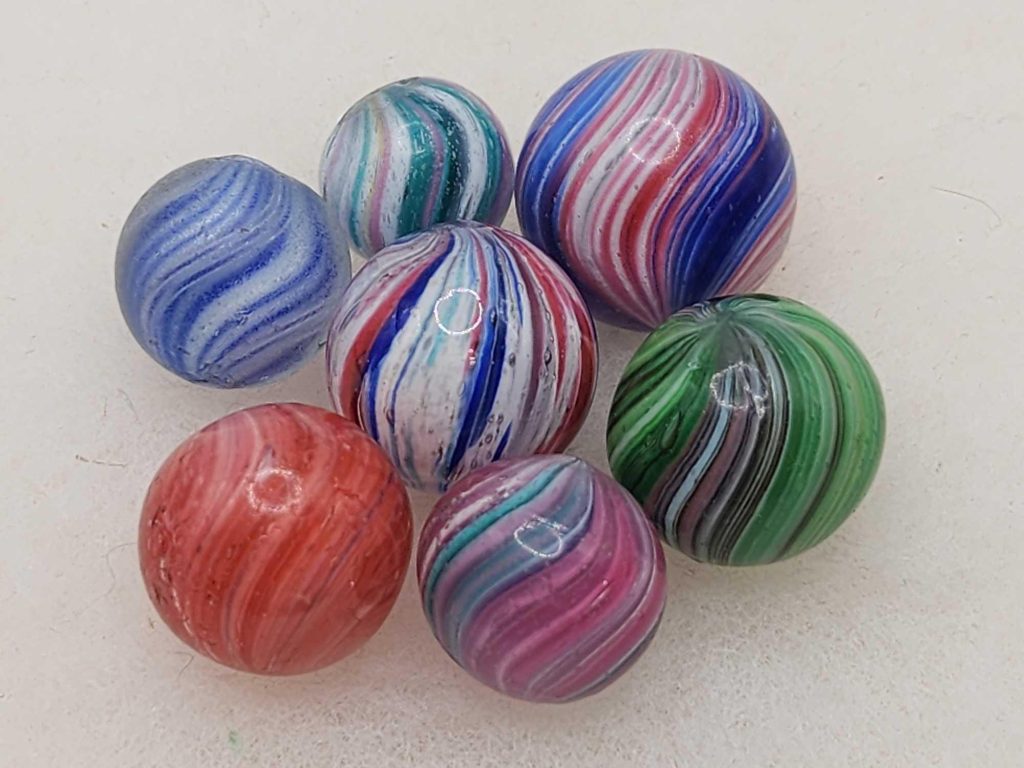
A near-mint German handmade onionskin marble measuring approximately 2 inches sold for over $6,000, with its value derived from the combination of large size, perfect pattern execution, and exceptional preservation. Onionskin patterns require extraordinary skill at any size, but scaling up to 2 inches while maintaining pattern integrity and avoiding flaws represents glassworking mastery that few craftsmen achieved.
Lutz marbles incorporating genuine goldstone or aventurine glass with copper flakes have achieved remarkable prices when combining rarity with beauty. An exceptional four-panel Lutz onionskin in pristine condition reached approximately $8,500 at auction, driven by the marble’s large size, the symmetrical arrangement of aventurine bands, and vibrant base colors that created stunning visual impact. The incorporation of expensive goldstone glass into an already complex pattern demonstrated the original maker’s commitment to creating something extraordinary.
Indian swirls and other rare German handmade types have sold for $3,000-$5,000 when presenting perfect examples of their type. These prices reflect not just rarity but the marble’s ability to represent the absolute pinnacle of its category—the example against which all others are measured.
The Akro Agate Oxblood Phenomenon
No American machine-made marble commands more attention or higher prices than genuine Akro Agate oxbloods. These legendary rarities, produced during the 1920s and 1930s through difficult-to-control glass chemistry, represent the holy grail for many collectors focusing on American machine-made marbles.
Documented sales of premium Akro oxbloods have reached $5,000-$7,000 for examples displaying ideal color saturation, perfect condition, and appropriate size. The deep brownish-red coloring throughout the marble, combined with subtle purple undertones and complete absence of damage, creates specimens that multiple collectors compete to acquire.
The rarity driving these prices stems from limited original production—the challenging chemistry required to achieve oxblood coloring meant many production runs failed to meet standards—and the reality that many oxbloods entered actual play and sustained damage over decades. Mint or near-mint examples become increasingly scarce as time passes, supporting continued price appreciation.
A particularly exceptional oxblood measuring nearly 3/4 inch with extraordinarily deep, even coloring and zero flaws reportedly sold privately for over $8,000, though this transaction remains difficult to verify completely. Whether this specific price is accurate or somewhat inflated through collector mythology, it reflects the reverence with which the marble community regards perfect oxblood examples.
Christensen Agate Rarities
Christensen Agate Company’s brief production period and distinctive marble types have created a category of collectibles that regularly achieve impressive prices. Their electric colors, guineas, and unusual slag combinations attract dedicated collectors willing to pay premiums for perfect examples.
A Christensen Agate electric yellow flame marble in mint condition sold for approximately $2,500, with value derived from the combination of vibrant color intensity, perfect pattern execution, and pristine preservation. Electric colors represent Christensen at their most artistically ambitious, and flawless examples become increasingly difficult to locate.
Rare color combinations in Christensen slags, particularly red or unusual amber variations, have reached $1,500-$3,000 when presenting ideal characteristics. The company’s limited production window means fewer examples entered circulation initially, and losses through play and time have further reduced available supplies of premium specimens.
Contemporary Art Marbles
While vintage marbles dominate high-value sales, contemporary art marbles created by studio glass artists have achieved remarkable prices, demonstrating that marble collecting encompasses both historical artifacts and modern artistic creations. Master contemporary marble makers like Josh Simpson, Mark Matthews, and other recognized artists produce limited pieces that command immediate collector attention.
Exceptional contemporary art marbles featuring complex internal landscapes, dichroic glass effects, or innovative techniques have sold for $2,000-$5,000, with particularly significant pieces occasionally exceeding these ranges. These prices reflect the artistic merit, technical difficulty, and limited production quantities rather than historical significance, creating a parallel collecting category alongside vintage marbles.
Factors Driving Record Prices
Analyzing record-breaking sales reveals consistent factors that elevate certain marbles to extraordinary value levels. Rarity forms the foundation—marbles that exist in very limited quantities naturally command premium prices when multiple collectors compete for scarce examples. Condition proves equally critical, as minor damage significantly reduces value even for rare types. Size frequently impacts price, with unusually large examples of desirable types achieving multiples of standard-size equivalents.
Provenance increasingly influences top-tier sales, with marbles from famous collections or those documented in reference works carrying premiums. Visual impact matters enormously—marbles that create immediate “wow” reactions when viewed tend to achieve higher prices than technically rare but visually unremarkable examples. Historical significance adds value, particularly for marbles representing important innovations or manufacturers’ finest achievements.
Market Evolution and Future Trends
The marble collecting market has matured considerably over recent decades, developing sophisticated authentication methods, specialized dealers, and regular auction events that provide price transparency. This maturation supports continued value appreciation for premium examples while helping establish more realistic pricing for common types.
Internet accessibility has democratized information while expanding the collector base globally. Collectors worldwide can now research, buy, and sell marbles in ways impossible before online marketplaces and specialist forums emerged. This expanded market potentially supports higher prices for exceptional pieces while also revealing that certain previously rare marbles exist in greater quantities than early collectors believed.
Authentication concerns increasingly impact high-value sales, as reproduction awareness grows and collectors demand greater documentation for expensive purchases. Marbles achieving record prices typically include expert authentication, detailed photography, and clear provenance information that reassures buyers about authenticity and condition.
Investment Considerations
While record-breaking sales demonstrate marble collecting’s financial dimension, prudent collectors recognize that most marbles appreciate modestly if at all, with extraordinary prices reserved for exceptional examples meeting multiple desirability criteria simultaneously. The marbles achieving five-figure prices represent tiny fractions of one percent of all collectible marbles, making them poor models for typical collecting experiences.
Nevertheless, premium examples in protected categories—pristine German handmade rarities, perfect Akro oxbloods, exceptional sulphides—have demonstrated relatively consistent value appreciation over decades. Collectors treating marble acquisition partially as investment should focus on condition, rarity, and authenticity while recognizing that liquidity remains limited compared to more established collectibles markets.
The passion driving record-breaking marble sales ultimately transcends financial considerations. These prices reflect collectors’ deep appreciation for craftsmanship, beauty, and historical significance embodied in miniature glass spheres. Each record sale celebrates not just monetary value but the enduring human f