
Among the endless swirl of colours, bubbles, and glass, a quiet mystery hides: how many early Asian-made marbles have been mistaken for their European or American cousins? For decades, collectors focused mainly on German, American, and English production, but research and rediscovery have revealed that Asia — especially China and Japan — played a fascinating role in the evolution of marble-making.
These early Asian marbles often sit unnoticed in jars or collections, mislabelled or dismissed as “unknown origin.” With the right knowledge, however, these overlooked spheres can become prized discoveries — genuine lost treasures that add depth and intrigue to any collection.
A Forgotten Chapter in Marble History
When we speak of early marbles, most minds jump to 19th-century Lauscha glassworks in Germany or early 20th-century American companies like Akro Agate or Peltier. Yet long before these factories perfected machine precision, Asian artisans were shaping miniature wonders by hand.
China, Japan, and India each developed forms of decorative spheres centuries before marbles became commercial toys. Clay, stone, and later glass were all used to make playing pieces, charms, and decorative tokens. Many of these items entered Europe through trade routes in the 18th and 19th centuries, mingling with Western collections. Over time, their distinct origins were forgotten.
Today, rediscovering an Asian-made marble is like unearthing a hidden footnote in global toy history — one written in colour, fire, and glass.
Materials and Craftsmanship: What Sets Asian Marbles Apart
Understanding materials is the first step in identifying Asian marbles.
Porcelain and Ceramic
Chinese porcelain spheres from the Qing and early Republic eras are instantly recognizable once you’ve seen one in person. They have a fine, cool surface and a subtle translucence. Glazes may range from pale celadon green to pure white or underglaze blue patterns. Unlike Western marbles, their beauty lies in surface perfection rather than internal swirl.
Japanese examples sometimes feature a matte glaze or hand-painted floral or wave motifs — tiny, precise, and unmistakably Japanese in aesthetic. These porcelain pieces often predate glass marbles and were made in small workshops rather than large factories.
Glass
Asian glass marbles from the late 19th to early 20th centuries often show a handmade or small-batch character. Instead of uniform shapes, you may notice slightly irregular sizes, uneven colour distribution, and more visible air bubbles.
Chinese glass marbles frequently have muted or opaque colours — amber, turquoise, or milky white — with streaks or foggy swirls. Early Japanese ones can include layered cores or soft pastel tones, reflecting the artistry of traditional lampworking techniques.
Stone and Clay
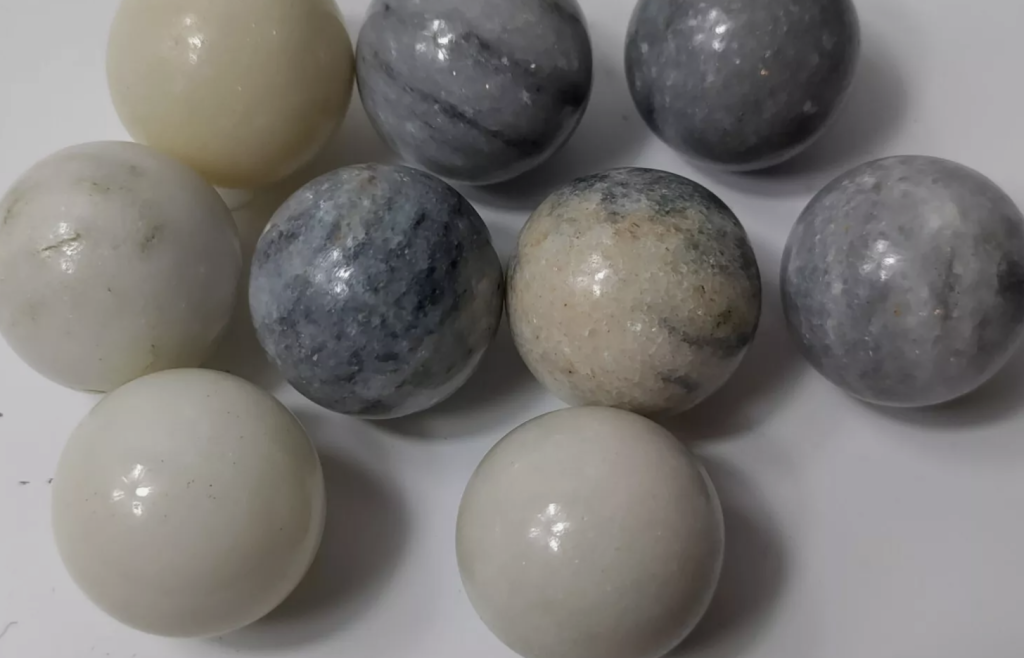
Before glass became common, both China and India produced clay or stone play pieces. Hand-rolled clay marbles, fired in low-temperature kilns, have a coarse texture and earthen colour. Polished stone versions (like agate, jade, or soapstone) were sometimes used for tabletop games or as ornaments for scholars’ desks.
If you find a particularly heavy or cool-to-the-touch marble that doesn’t resemble modern glass, it may belong to this early tradition.
Patterns and Aesthetic Signatures
Asian marbles tend to follow different artistic sensibilities compared to Western examples.
- Chinese Marbles: Often emphasize simplicity — soft single colours or subtle internal veils. Some display miniature internal threads or fog-like inclusions that resemble natural formations rather than bold patterns.
- Japanese Marbles: Exhibit refined balance and harmony — sometimes containing a centered bubble, faint ribbon, or inner line reminiscent of brush strokes in ink painting.
- Indian and Southeast Asian Marbles: Can feature natural mineral variation, often in clay or stone, with earthy reds, ochres, and greys rather than bright glass hues.
In short, Asian marbles generally favour natural beauty and subtle imperfection — what Japanese aesthetics call wabi-sabi — rather than the mechanical uniformity of machine-made Western pieces.
Distinguishing Asian Marbles from Western Ones
Here are a few practical comparisons:
| Feature | Asian Marbles | European / American Marbles |
|---|---|---|
| Shape | Slightly irregular, often handmade | Uniform, machine-perfect after 1900 |
| Surface | Porcelain glaze or uneven glass | Highly polished, smooth |
| Colour | Muted, natural tones; soft pastels | Bright, bold primaries |
| Patterns | Subtle streaks, veils, or fog | Sharp swirls, ribbons, or lattices |
| Pontil Marks | Often visible or roughly ground | Usually absent or machine-cut |
| Weight | Heavier (porcelain/stone) | Lighter (soda-lime glass) |
Authenticity vs. Reproduction
The growing interest in early Asian marbles has naturally led to reproductions — some innocent, others less so. To ensure authenticity:
- Inspect the pontil: Old handmade marbles have pontils that show wear and oxidation. Reproductions often have sharp, fresh-looking marks.
- Check for aging: Genuine antique glass or porcelain shows surface wear — tiny scratches or a soft patina. Modern copies feel slick and flawless.
- Ask for provenance: If a seller claims an Asian marble is “antique,” ask where it was sourced. Many fakes originate from modern decorative glass workshops.
- Look at scale: Modern reproductions are often slightly larger (20–25 mm) than authentic early Asian examples, which tend to be 12–18 mm.
- UV light test: Early glass often glows faintly under UV due to manganese content. Modern glass may not.
A good rule of thumb: genuine old marbles feel “quiet.” Their colours are soft, their edges rounded, and they have a presence that modern reproductions lack.
Collector Tips for Finding Early Asian Marbles
- Search mixed lots: Antique fairs and online listings often mislabel Asian examples as “unknown origin.” Look closely at irregular marbles with softer hues.
- Examine estate collections: Collectors who began in the 1960s–70s sometimes acquired Asian pieces unknowingly. Their jars may hide treasures.
- Visit Asian antique markets: Shops dealing in snuff bottles, scholar’s stones, or small curios sometimes carry porcelain marbles.
- Network with other collectors: Online forums and marble Facebook groups occasionally identify Asian examples posted by members.
- Record and photograph: Because there’s limited reference material, every discovery helps build the shared knowledge base.
Why These Marbles Matter
Early Asian marbles broaden our understanding of global craftsmanship. They represent independent traditions — artisans experimenting with clay, porcelain, and glass without Western industrial influence. Each handmade sphere embodies a dialogue between play, art, and culture.
For collectors, identifying an early Asian marble isn’t just about rarity or value; it’s about recognition — giving credit to overlooked creators and adding new texture to the tapestry of marble history. In a collection dominated by Western production, even a single authentic Asian piece can stand out like a relic of another age.
Final Thoughts
Rediscovering early Asian marbles requires patience, curiosity, and an open eye for the subtle. They don’t shout with bold colours or factory precision. Instead, they whisper — through muted tones, slight imperfections, and quiet craftsmanship.
Each discovery reminds us that the story of marbles is not confined to a single continent. It’s a global tale of imagination, trade, and artistry, told through spheres of clay and glass. Somewhere in your collection, there may already be a small piece of that forgotten history — a marble made not by machine, but by the steady hand of an artisan half a world away.