Understanding the fundamental distinction between handmade and machine-made marbles represents the most critical skill any collector can develop. This division separates not merely manufacturing methods but entire eras of production, aesthetic philosophies, and collectible value hierarchies. While both categories contain exceptional examples worthy of preservation and study, recognizing the characteristics that distinguish them unlocks deeper appreciation and more informed collecting decisions.
The Handmade Era: Artisan Craftsmanship
Handmade marbles dominated production from ancient times through the early 20th century, with German glassworkers in the Thuringia region achieving unparalleled mastery of the craft. These artisans created each marble individually using techniques refined over generations, gathering molten glass on the end of a pontil rod and shaping it through practiced manipulation, rolling, and careful temperature control.
The hallmark of any handmade marble is the pontil mark or cut-off point, visible as a rough spot, small raised area, or distinctive scar where the craftsman severed the finished marble from the pontil rod. This feature appears on virtually every authentic handmade marble, though skilled workers minimized its prominence through careful cold-rolling techniques that smoothed the surface while the glass remained workable. Collectors examining potential handmade marbles should locate this pontil mark, as its absence strongly suggests machine manufacture or modern reproduction.
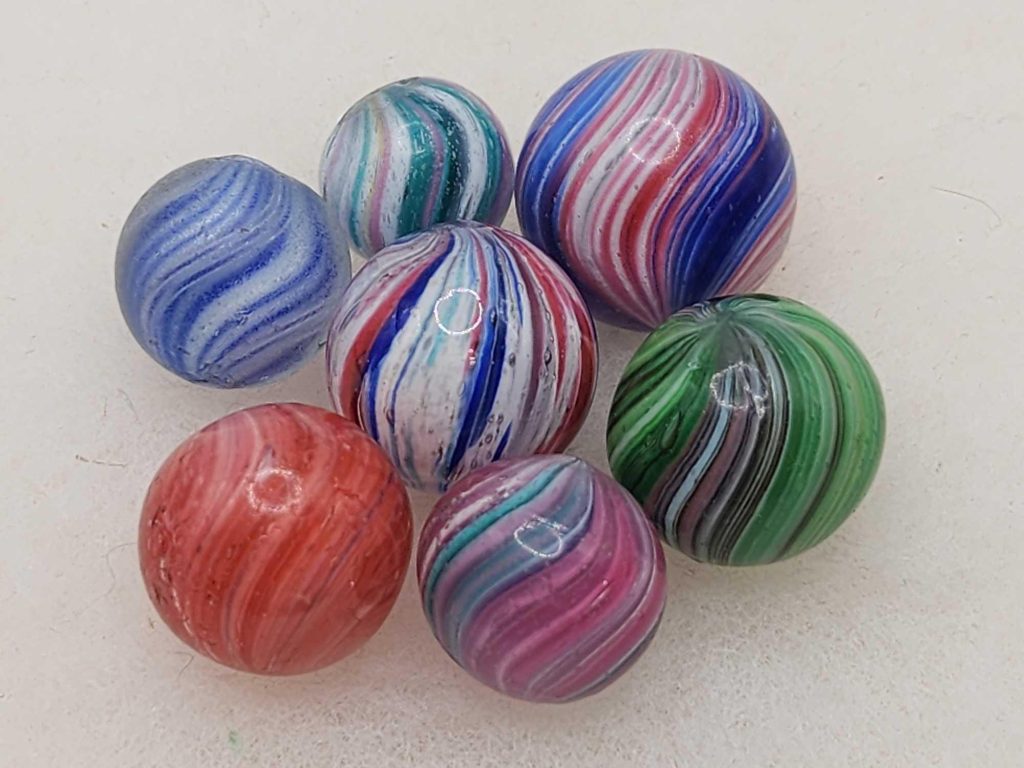
German handmade swirls represent the pinnacle of this artisan tradition. Craftsmen created these masterpieces by gathering clear or colored base glass, then applying contrasting glass threads in precise patterns before shaping the mass into a sphere. As the marble formed, these threads twisted into distinctive swirl patterns including ribbon swirls, divided cores, solid cores, and latticinio designs. Each type followed specific construction methods that produced recognizable results, yet no two handmade marbles emerged exactly identical.
The organic irregularity of handmade marbles distinguishes them from machine-made counterparts. Swirl patterns may appear slightly asymmetrical, color distribution varies subtly across the surface, and the overall shape, while spherical, rarely achieves the mechanical precision of factory production. These “imperfections” constitute part of handmade marbles’ charm and authenticity, reflecting the human element in their creation.
End-of-day or end-of-cane marbles emerged when glassworkers used leftover glass from regular production, combining random colors into unique, unrepeatable patterns. Despite persistent mythology suggesting these marbles were actually made at day’s end, many were intentional productions using the aesthetic of combined glass colors. Nevertheless, their chaotic beauty and color combinations distinguish them from planned pattern production.
Other handmade varieties include lutz marbles incorporating goldstone or aventurine glass with metallic copper flakes, onionskins with their distinctive layered appearance resembling vegetable skin, and clambroths featuring semi-opaque white or gray base glass. Each type required specific technical knowledge and careful execution, making authentic examples increasingly valuable as collectors recognize the skill involved.
The Machine Revolution: Standardization and Innovation
The transition from handmade to machine-made marble production transformed the industry fundamentally. Martin Frederick Christensen revolutionized marble manufacturing in 1905 when he patented the first automatic marble-making machine in Akron, Ohio. This innovation reduced production costs dramatically, standardized sizes and shapes, and enabled mass production that made marbles affordable for every American child.
Machine-made marbles display characteristic seam lines where the two rollers or cups that formed the marble met during production. These seams may appear as faint lines encircling the marble or as slightly raised areas, depending on the specific machine and manufacturer. While some machines produced nearly seamless marbles, most examples show detectable seams upon close examination, providing the primary diagnostic feature for identifying machine manufacture.
American machine-made manufacturers including Akro Agate, Peltier Glass, Marble King, and Christensen Agate developed distinctive styles and patterns that collectors now pursue avidly. Each company’s machines produced characteristic results, from Akro’s corkscrews and patches to Peltier’s rainbows and comic strips, creating a rich taxonomy of machine-made types.
The symmetry and consistency of machine-made marbles contrasts sharply with handmade production. Patterns repeat with mathematical precision, colors distribute evenly, and shapes achieve near-perfect sphericity. While this uniformity initially seems less artistic than handmade irregularity, many machine-made patterns display sophisticated beauty and technical innovation worthy of appreciation in their own right.
Certain machine-made varieties achieved remarkable collectibility despite industrial origins. Akro Agate oxbloods, with their deep red coloration, rank among the most valuable marbles regardless of production method. Christensen slags, combining opaque white base glass with transparent colored glass, created dramatic marbles that showcase machine production’s aesthetic potential. Peltier comic strips, featuring hand-applied decals under transparent glass, merged machine efficiency with decorative artistry.
Key Identification Features
Several diagnostic characteristics help collectors distinguish handmade from machine-made marbles with confidence:
Pontil marks indicate handmade production almost certainly. These marks appear as rough spots, small raised areas, or distinctive scars, typically on opposite sides of the marble where it was held and cut. Machine-made marbles lack pontils entirely.
Seam lines reveal machine manufacture. These lines encircle the marble where roller cups met during formation, sometimes subtle but usually detectable under magnification or strong lighting.
Pattern symmetry provides clues about production method. Machine-made patterns typically show perfect or near-perfect symmetry, while handmade swirls and decorations display organic variation reflecting manual manipulation.
Surface texture differs between production methods. Handmade marbles often show slight surface irregularities, tiny bubbles, or minor imperfections from hand-working. Machine-made surfaces achieve consistent smoothness with regular precision.
Size consistency within a group suggests machine manufacture. Handmade marbles vary slightly even when produced by the same craftsman, while machine production maintains remarkably uniform dimensions.
Collecting Considerations and Value
The handmade versus machine-made distinction profoundly impacts marble values, though not always predictably. Generally, handmade marbles command premium prices, particularly exceptional German swirls, rare lutz examples, and pristine onionskins. The labor intensity and individual artistry of handmade production creates inherent scarcity that supports higher valuations.
However, certain machine-made marbles exceed average handmade marbles in value. Rare Akro oxbloods, unusual Christensen patterns, and mint-condition examples from prestigious manufacturers bring impressive prices at auction. Rarity, condition, and aesthetic appeal matter as much as production method when determining worth.
Serious collectors typically pursue both handmade and machine-made examples, recognizing that each category offers unique rewards. Handmade marbles provide connection to artisan traditions and individual craftsmanship, while machine-made marbles document American industrial innovation and democratic access to beautiful playthings.
Building Knowledge and Expertise
Distinguishing handmade from machine-made marbles requires hands-on experience examining authenticated examples. Attending marble shows, visiting museums with marble collections, and studying reference books builds the visual memory necessary for confident identification. Many experienced collectors recommend beginners handle both types extensively, developing tactile and visual familiarity that photographs alone cannot provide.
Online resources, collector forums, and specialized dealers offer valuable educational opportunities, though nothing replaces direct examination of verified examples. As pattern recognition develops through repeated exposure, subtle differences between handmade and machine-made marbles become increasingly apparent, transforming initial confusion into confident expertise.
Whether drawn to handmade artistry or machine-made innovation, understanding this fundamental division enriches every aspect of marble collecting. Each marble tells a story about its creation, the technologies available to its makers, and the aesthetic values of its era, making the handmade versus machine-made distinction far more than a mere technical classification.