
Germany became a major center for marble production for several interconnected historical, technological, and economic reasons. Understanding these factors helps collectors appreciate why German marbles remain so highly valued and sought after today.
Early Glassmaking Tradition
Germany has a long history of glassmaking, especially in regions like Thuringia and Bohemia (now part of the Czech Republic).
The town of Lauscha, Thuringia, is often called the birthplace of the modern glass marble. Glassworkers in Lauscha were producing hand-blown glass beads, toys, and ornaments as early as the 16th century.
These artisans developed advanced techniques for melting, shaping, and coloring glass, giving them the skills necessary to create high-quality marbles.
Key point: Marble-making required both precision and artistry, which German glassmakers already mastered.
Abundant Raw Materials
Germany had easy access to silica (sand), potash, and other minerals essential for glass production.
Silica provided the base material for glass.
Potash and other fluxes lowered the melting temperature and allowed for more controlled, clearer glass.
Locally available minerals also enabled vibrant colors and patterns that became signature designs in German marbles.
Result: German makers could produce both high-quality clear glass marbles and intricately colored swirls without depending heavily on imported raw materials.
Skilled Artisan Communities
Certain German regions developed specialized communities of glass artisans:
Families passed skills down through generations, creating workshops where handmade marbles became a local craft industry.
By the 19th century, towns like Lauscha and Nürnberg had dozens of small marble-making workshops.
Techniques such as lampworking and molded glass allowed artisans to create unique patterns like cat’s eyes, swirls, and slag marbles.
Significance: This concentration of skill meant Germany could dominate the global marble market, producing both everyday play marbles and collectible art pieces.
Early Industrialization and Marble Machinery
Germany was also an early adopter of mechanized marble production:
In the late 19th century, inventors like Martin Frederick Christensen (later in the U.S.) studied German methods to create machine-made marbles.
German workshops combined hand-crafting techniques with emerging machinery, allowing production at scale while maintaining quality.
Example: The “swinger” or marble machine allowed precise, uniform spheres that could be mass-produced, giving German marbles an edge in both domestic and international markets.
Cultural and Market Factors
Germany had both domestic demand and export networks:
Marbles were popular toys in Germany, especially among children in the 19th and early 20th centuries.
German producers exported extensively to Europe, North America, and later worldwide.
Many German marbles were seen as high-quality and collectible, creating an international reputation that reinforced production concentration.
Innovation in Design and Color
German marble makers excelled in inventing new marble types and patterns:
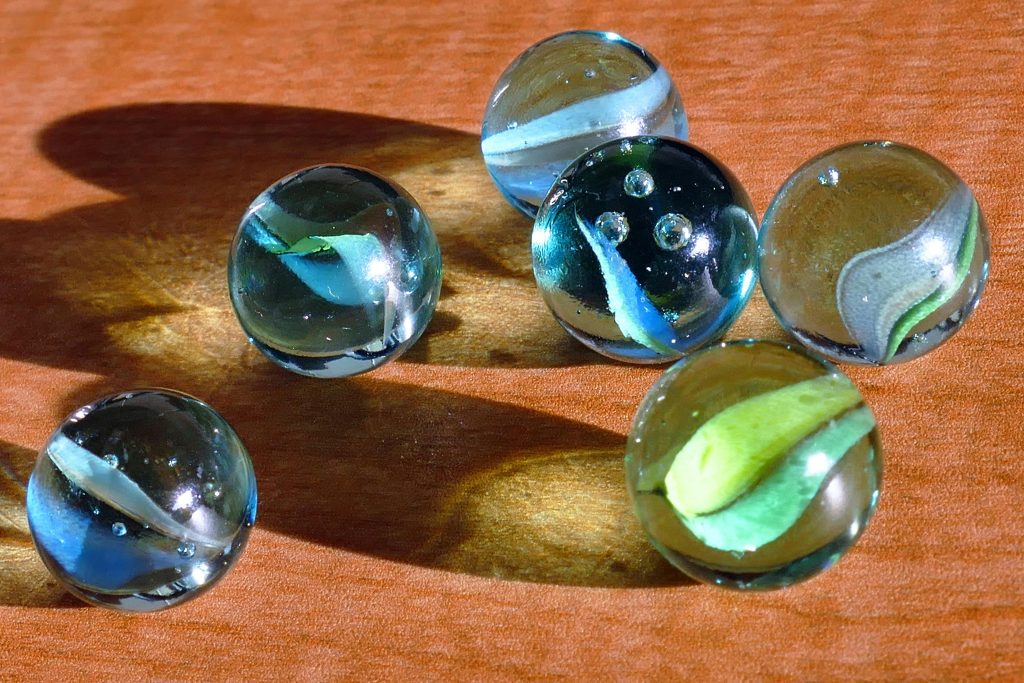
Cat’s-eye marbles – invented in Lauscha around 1840, featuring a colored fiber or ribbon inside a clear sphere.
Swirls and slag patterns – often using leftover or mixed glass to create unique designs.
Specialty and collectible marbles – hand-blown or lampworked marbles that were artistic as well as functional.
Impact: This innovation made German marbles highly desirable for both children and collectors, sustaining their popularity for decades.
Legacy and Collector Value
Even today, German handmade marbles from the 19th and early 20th centuries are highly prized by collectors:
The craftsmanship, color patterns, and historical significance make them rare and valuable.
Towns like Lauscha still produce glass art, maintaining the cultural and artisanal legacy of marble making.
Conclusion
Germany became a hub for marble production because of a unique combination of skill, resources, and innovation:
Centuries-old glassmaking tradition in Thuringia and Bohemia.
Abundant raw materials for high-quality glass.
Generational artisan communities with specialized techniques.
Early adoption of mechanized production methods.
Strong domestic and international market demand.
Creative innovation in marble design and color.
The result was a concentration of both handmade and early machine-made marbles that dominated the European and eventually global marble market. Collectors today still seek out German marbles for their artistry, quality, and historical significance.
Shopping Basket